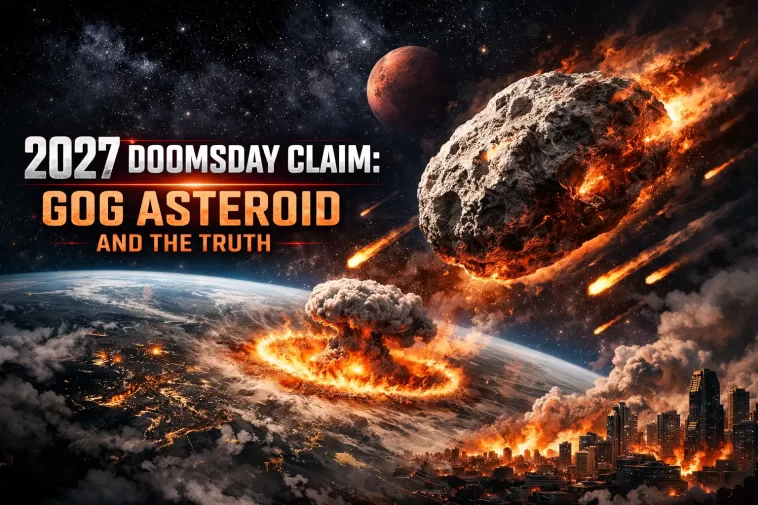
2027 doomsday claim has become one of the most talked‑about predictions in recent years, sparking fear and debate across the globe. Spanish journalist and author J.J. Benítez shocked audiences when he suggested that a massive asteroid, measuring nearly 28 kilometers in length, could strike Earth in August 2027. According to his scenario, the impact would devastate the Caribbean, destroy parts of Europe including Spain, and lead to the deaths of more than 1.2 billion people within just 48 hours. The dramatic nature of this claim quickly spread through headlines and social media, fueling panic and speculation.
The Asteroid Known as Gog
The object at the center of this controversy is 1999 AN10, nicknamed Gog. Discovered in 1999 by astronomers Milani, Chesley, and Valsecchi, Gog belongs to the Apollo group of Near‑Earth Asteroids (NEAs). It is also classified as a Potentially Hazardous Asteroid (PHA) because its orbit crosses Earth’s path. Early calculations suggested Gog might pass alarmingly close to our planet—just 37,000 kilometers away, a distance smaller than the orbit of many satellites.
Updated Scientific Data
As more observations were made, scientists refined their models. NASA and other space agencies now confirm that Gog will pass Earth safely on August 7, 2027, at a distance of 390,450 kilometers. To put this into perspective, the Moon orbits Earth at an average distance of about 384,000 kilometers. Gog’s flyby will actually be farther away than the Moon, meaning there is no chance of collision in 2027.
Why the Fear Persists
Despite clear scientific evidence, apocalyptic predictions often capture public imagination. The idea of a giant asteroid wiping out humanity resonates with deep fears about our vulnerability in space. Popular culture, from movies like Armageddon to countless novels, has reinforced the image of asteroids as existential threats. Benítez’s claim tapped into these anxieties, making the story spread faster than the scientific rebuttals.
Future Risks: Extremely Small
While Gog poses no danger in 2027, scientists continue to monitor its orbit. Gravitational interactions during the flyby could slightly alter its trajectory, creating minuscule impact probabilities in later decades. Current estimates suggest:
- 2039: 1 in 10 million chance of impact
- 2044: 1 in 500,000 chance
- 2046: 1 in 5 million chance
These odds are so small that astronomers consider them negligible. For comparison, the chance of being struck by lightning in your lifetime is far higher.
Planetary Defense Technology
NASA and international agencies are not complacent. They actively track thousands of Potentially Hazardous Asteroids and have developed strategies to deflect them if necessary. The DART mission (Double Asteroid Redirection Test) in 2022 proved that humanity can change an asteroid’s orbit using a kinetic impact. This groundbreaking success means that if Gog—or any other asteroid—ever posed a real threat, similar measures could be deployed to protect Earth.
Lessons from the Gog Story
The Gog asteroid highlights the importance of separating sensational claims from scientific fact. While writers and journalists may dramatize scenarios to capture attention, astronomers rely on precise data and long‑term monitoring. The 2027 doomsday claim is a reminder that fear can spread faster than truth, but also that science provides reassurance. Earth is safe in 2027, and humanity is better prepared than ever to face potential cosmic threats.
Conclusion
J.J. Benítez’s prediction of a catastrophic asteroid strike may have stirred panic, but the reality is far less dramatic. Gog will pass at a safe distance, posing no danger to Earth. Scientists will continue to track its orbit, but the odds of future impacts remain extremely low. Thanks to modern technology and planetary defense initiatives, humanity has tools to respond if needed. The 2027 doomsday claim is ultimately a story of fear versus fact—an example of how science can calm anxieties and provide clarity in the face of sensational predictions.
