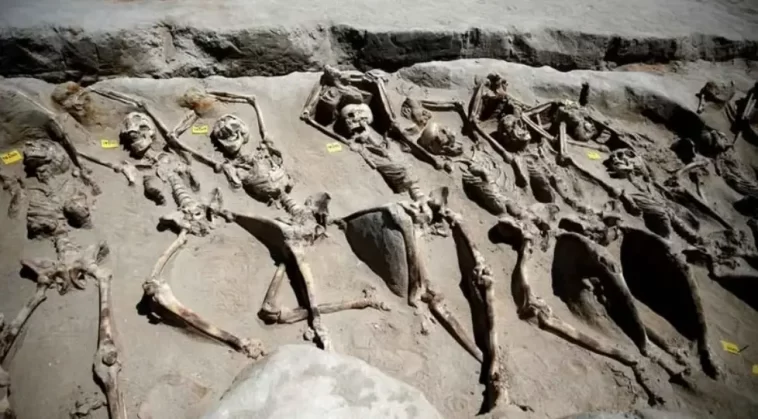
80 chained skeletons discovery near Athens has stunned archaeologists and historians alike, uncovering chilling evidence of a brutal political execution dating back more than 2,600 years. The remains were found at the ancient Phalaeron Port, shedding new light on one of the darkest chapters of early Athenian history.
Shocking Find at Ancient Phalaeron Port
Archaeologists working approximately six kilometers south of modern Athens uncovered the remains of 80 young men, buried side by side with their hands bound by iron shackles. The discovery was made during expanded excavations at the ancient harbor of Phalaeron, an area known in antiquity as a place of exile and punishment.
The skeletons were first detected accidentally in 2016, but continued excavations revealed the full scale of the burial, sending shockwaves through the archaeological community.
Evidence Points to Elite Victims, Not Criminals
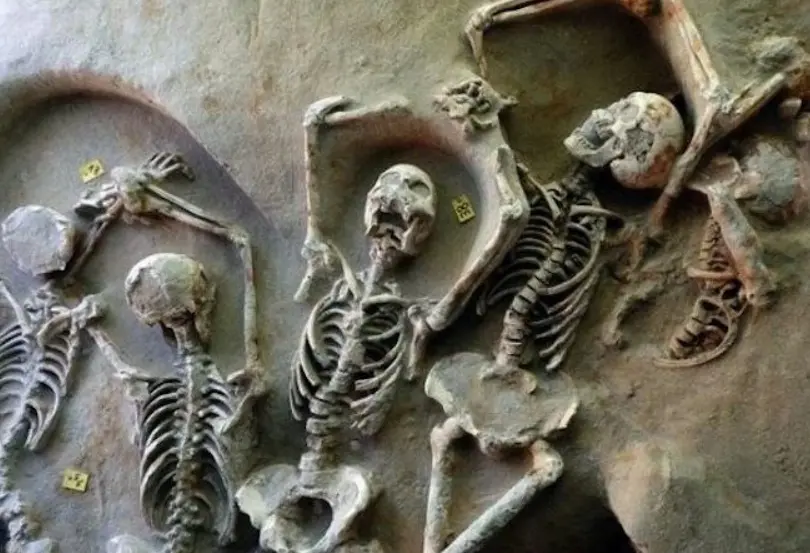
Detailed osteological and dental analyses revealed that the victims were not slaves or common criminals. Instead, their healthy bones and well-preserved teeth indicate they were well-nourished young men from elite families.
According to researchers, this strongly suggests the men were nobles involved in a failed political uprising, rather than ordinary offenders.
The Cylon Coup and a Broken Promise
Scientific dating using stratigraphic data and pottery fragments places the execution between 650 and 625 BC. This timeframe aligns precisely with the infamous Cylonian Affair, the earliest recorded coup attempt in Athenian history.
In 632 BC, Cylon, a nobleman and former Olympic champion, attempted to seize power in Athens with the support of his father-in-law, Theagenes of Megara. When the coup failed, Cylon fled the city, leaving his followers behind.
These followers sought refuge in the Temple of Athena, where they were promised safety. However, historical sources report that the promise was broken, and the men were executed despite their plea for sanctuary.
Signs of a Planned and Systematic Execution
Experts emphasize that the positioning of the bodies indicates a carefully organized execution, not a traditional burial.
Dr. Stella Chryssoulaki, who led the excavation team, stated that the victims were deliberately placed in rows, with their hands restrained behind their backs—clear evidence of state-controlled punishment.
Bioarchaeologist Dr. Sherry Fox of the American School of Classical Studies at Athens noted that the physical condition of the skeletons confirms their high social status, reinforcing the theory of a political purge.
Violent Deaths Confirmed by Forensic Analysis
Further analysis by Prof. Maria Liston of the University of Waterloo revealed that most victims were killed by powerful blows to the head. The combination of restraint and trauma suggests the executions were carried out by authorities as a public display of control.
“This is physical proof of a painful transitional period,” Liston explained. “It shows how law, power, and punishment were taking shape in early democratic Athens.”
Archaeological Proof of the “Cylonian Curse”
Ancient historians Herodotus and Thucydides described the massacre as the origin of the so-called “Cylonian Pollution”, a curse believed to haunt Athens for generations. Until now, the event was known only through texts.
The 80 chained skeletons discovery is now widely accepted as the first archaeological confirmation of a mass political execution in ancient Greek history, transforming legend into tangible evidence.
Archaeologists believe the victims were intentionally buried along the shoreline as a warning, making the site both a grave and a symbol of authority.
