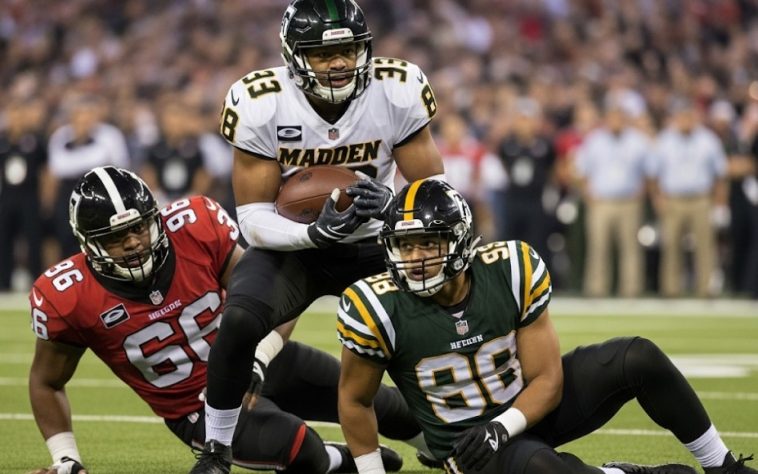
Delve into the fascinating world of Madden NFL with 30 intriguing facts! From its humble beginnings on the Apple II and John Madden’s insistence on 11 players per side, to the infamous “Madden Curse” and billions in sales, discover the history, innovations, and quirky details that make this football game a true legend.
Madden NFL Facts
Humble Beginnings: The very first John Madden Football game was released in 1988 for the Apple II computer, not a console.
Madden’s Initial Demand: John Madden famously refused to put his name on the game unless it featured 11 players on each side, insisting it needed to be “real” football. Early technical limitations almost forced a scaled-down version.
Third Choice, Charm’s the Word: John Madden was actually EA’s third choice to front the series. Joe Montana was unavailable due to an Atari deal, and another coach, Joe Kapp, demanded royalties EA wasn’t willing to pay upfront.
Bethesda’s Connection: Bethesda, known for Fallout and The Elder Scrolls, was initially hired to create a football game that eventually led to John Madden Football. They later sued EA over code used without credit.
The Genesis Breakthrough: The Sega Genesis version of John Madden Football in 1990 was the first truly successful entry, selling 400,000 copies when EA expected only 75,000.
Name Change: The game officially became Madden NFL in 1993, coinciding with the acquisition of full NFL licensing.
Fear of Flying: John Madden’s famous fear of flying meant he traveled everywhere by bus, the “Madden Cruiser.” This personal detail became a fun fact about the man behind the game.
The “All-Madden” Team: John Madden’s concept of an “All-Madden” team, comprised of players he felt played football the “right way,” was a popular feature and extended beyond the game into his broadcasting career.
Early AI Limitations: Early versions struggled with realistic AI. For example, some early Madden games would frequently result in incredibly high scores due to less sophisticated defensive AI.
The Madden Curse: A long-standing superstition, the “Madden Curse” suggests that players featured on the game’s cover often suffer injuries or have unproductive seasons. While it’s not always true, many instances have fueled the myth.
First NFL Player on the Cover: Eddie George of the Tennessee Titans was the first NFL player to be featured alone on a Madden NFL cover (Madden NFL 2001). Garrison Hearst was on the international cover for Madden 99.
First Dual Cover: Madden NFL 10 was the first to feature two players on the cover: Larry Fitzgerald and Troy Polamalu.
Super Bowl Predictions: EA Sports began simulating the Super Bowl with Madden in 2004. Their accuracy has varied over the years, sometimes predicting correctly, sometimes not.
Voice of the Game: John Madden himself provided extensive commentary for the game for many years, making his distinctive voice and catchphrases iconic.
Telestrator Popularity: Madden’s use of the telestrator (a device that allows drawing on video images) in his broadcasting was famously brought into the game, helping players understand plays.
Franchise Mode Evolution: The ability to create and manage an NFL franchise, including aspects like drafting, trades, and team management, became a significant draw for the series.
Annual Releases: Since 1993, a new Madden NFL game has been released every year, corresponding to the upcoming NFL season.
Billions in Sales: As of 2013, the Madden NFL franchise had generated over $4 billion in sales, making it one of the most profitable video game series ever.
Over 130 Million Copies Sold: As of 2018, the Madden NFL series has sold more than 130 million copies worldwide.
Platform Ubiquity: Madden has appeared on over 30 different gaming platforms, from consoles and PCs to handheld devices and mobile.
No Dreamcast Madden: Interestingly, due to EA’s business decisions, no Madden games were released on Sega’s final console, the Dreamcast.
The “Boom!” Sound Effect: John Madden’s signature “Boom!” sound effect became synonymous with big hits and impactful plays within the game.
“Turducken” Reference: John Madden popularized the “Turducken” (a deboned turkey stuffed with a deboned duck, which is stuffed with a deboned chicken) during his Thanksgiving game broadcasts, and it’s occasionally referenced in the game or by fans.
Player Likenesses: Over the years, the game has constantly strived for more realistic player models and animations, often using motion capture and detailed player scans.
“Superstar Mode”: This mode allowed players to create their own character and guide them through an NFL career, making decisions that influenced their trajectory.
Coach DNA: Newer versions, like Madden NFL 26, are introducing “Coach DNA,” aiming to replicate the unique strategies and play-calling tendencies of real NFL coaches.
QB DNA: Similarly, “QB DNA” in recent Madden games focuses on capturing the signature throwing motions, pocket presence, and scrambling styles of individual NFL quarterbacks.
Dynamic Weather: Modern Madden games feature dynamic weather conditions (snow, fog, rain) that realistically affect gameplay, including player movement, visibility, and ball control.
“Hit Stick” Evolution: The “Hit Stick” mechanic, introduced to allow players to deliver impactful tackles with greater control, has been a staple for decades and continues to evolve.
Continual Innovation: Despite its long history, the Madden series constantly introduces new mechanics, features, and graphical enhancements to keep the experience fresh and realistic for fans.
