The single most common concern for new and potential electric vehicle (EV) owners is how the car performs when the temperatures drop. And here’s the truth: Your EV range in cold weather will absolutely take a hit. It’s an unbelievable fact of physics and chemistry that every EV driver must grapple with. If you’ve ever seen your predicted range suddenly plummet on a frosty morning, you’re not alone.
Understanding why this happens is the first step toward managing it. The key reasons for this dramatic range reduction are a combination of how the battery reacts to low temperatures, the vehicle’s need to generate its own heat, and even the laws of physics on the road.
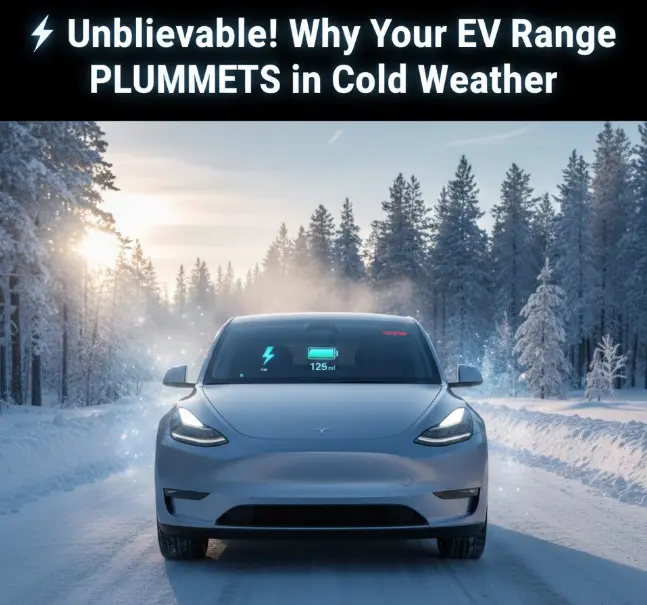
The Chemical Slowdown: How Cold Hits the Battery
The powerhouse of your electric vehicle is its lithium-ion battery pack. These batteries are designed to perform optimally within a specific temperature window. When the air temperature begins to fall, especially below freezing ($0^\circ C$ or $32^\circ F$), the chemistry inside the battery cells dramatically slows down.
- Slower Ion Movement: The electrolyte, the liquid medium inside the battery that facilitates the movement of ions between the anode and cathode, becomes less fluid in the cold. Think of it like trying to run through molasses. The ions move slower, which means the battery cannot deliver power or accept a charge as quickly.
- Increased Internal Resistance: As the temperature drops, the battery’s internal resistance increases significantly. To deliver the same amount of power to the motor, the battery has to work much harder and expend more energy overcoming this internal resistance. This “wasted” energy generates heat instead of driving the wheels, directly leading to range loss.
- Reduced Usable Capacity: While the actual physical energy storage capacity of the battery pack doesn’t change, the usable energy capacity does. Because the electrochemical reactions are limited by the cold, the Battery Management System (BMS)—the vehicle’s computer—will actively restrict the amount of power it draws from the pack to protect the battery cells from damage. Essentially, the car is protecting the battery by using less of it, which translates directly to a shorter driving range for you.
The Heat Thief: Fighting the Cold Cabin
Unlike a traditional gasoline or diesel car, which has a massive internal combustion engine producing vast amounts of “waste heat” that can be easily piped into the cabin, an EV motor is incredibly efficient. It produces very little usable waste heat. This means all the warmth required for the cabin and, crucially, for the battery itself, must be generated using the stored electricity. This is arguably the biggest drain on range in cold conditions.
- Battery Thermal Management: When you start your car in freezing weather, the vehicle’s thermal management system kicks into gear. Its first priority is often to warm the battery pack up to its optimal operating temperature (usually around $20^\circ C$ to $30^\circ C$). This heating process uses the battery’s own stored energy, leading to a noticeable drop in range right after startup. This explains the sharp, initial dip in range you see in the first few miles.
- Cabin Heating: Heating the large volume of the cabin requires significant energy.
- Resistive Heaters: Many older or budget-focused EVs use simple resistive heaters, which are essentially giant toasters that draw immense power (often 5-7 kW or more) to warm the air.
- Heat Pumps: More modern EVs use heat pumps, which are significantly more efficient. However, their efficiency drops sharply in extreme cold. Below $-5^\circ C$ or $-10^\circ C$, many heat pumps revert to using less efficient resistive heating elements as a backup. Regardless of the system, this continuous drain on the high-voltage battery to keep you toasty is a major culprit in range reduction.
Physical Forces: More Resistance on the Road
The chemical and electrical factors are significant, but even the outside world conspires against your EV’s efficiency in the winter.
- Aerodynamic Drag: Cold air is denser than warm air. This increase in air density means your car has to push through a physically thicker medium, increasing aerodynamic drag. The motor has to use more energy to maintain the same speed.
- Rolling Resistance: Low temperatures cause the rubber in your tires to harden. Stiff tires have increased rolling resistance on the road surface, requiring more power from the motor to keep them turning. Furthermore, cold lubricants in the gearbox and bearings also become more viscous, adding even more internal friction.
The Software Safety Net: Limiting Performance
Finally, the vehicle’s onboard software steps in to play a protective role.
- Power and Charging Limits: To prevent damage to the cold cells, the Battery Management System (BMS) will typically limit both the maximum power the car can deliver (affecting acceleration) and the speed at which it can accept a charge (affecting DC fast charging times).
- Reduced Regenerative Braking: Regenerative braking is a crucial feature that converts kinetic energy back into battery power when decelerating. However, a cold battery cannot safely accept high-current energy recovery. The software limits regen braking to protect the battery, meaning less energy is captured, and the car relies more heavily on friction brakes. This dramatically lowers the vehicle’s overall net efficiency, further contributing to the loss of range.
To summarize, your EV range drops because of a perfect storm: the battery chemically slows down, the car must spend valuable energy heating the battery and the cabin, and you face greater physical resistance from the cold air and tires. This unbelievable combination explains why a car rated for 300 miles in the summer might only achieve 200 miles or less in the dead of winter.
