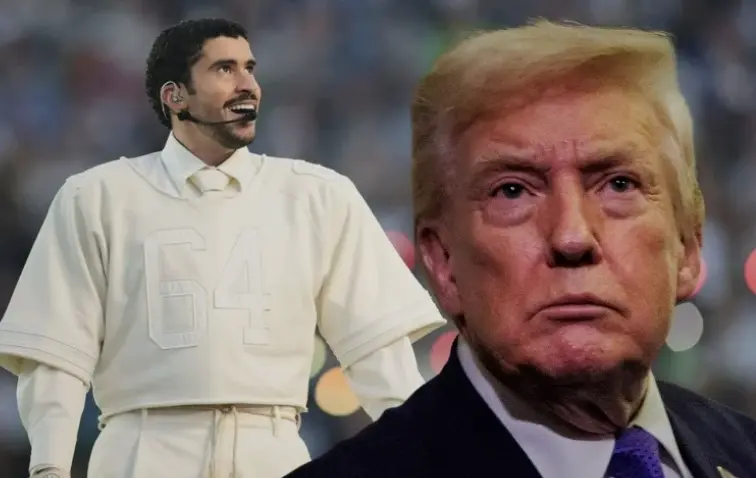
Spanish-language performance sparks cultural and political debate in the US
Trump reacts to Bad Bunny Super Bowl halftime show after the globally famous Puerto Rican artist delivered a performance that quickly became one of the most talked-about moments of Super Bowl LX. While millions of viewers praised the show for its celebration of Latin culture and identity, former US President Donald Trump launched a fierce attack, calling the performance offensive, inappropriate, and un-American.
Bad Bunny took the stage during the halftime show on February 8, 2026, at Levi’s Stadium in California, performing largely in Spanish and highlighting his Puerto Rican roots. The artistic choices made during the show immediately ignited debate across social media, mainstream media, and political circles.
Trump calls the show “disgusting” and “the worst ever”
Shortly after the broadcast, Donald Trump shared his reaction on Truth Social, where he harshly criticized the halftime performance. Trump described the show as “horrible,” “disgusting,” and “one of the worst halftime shows ever produced.”
According to Trump, the performance failed to represent what he described as “American values and greatness.” He specifically took issue with the fact that much of the show was performed in Spanish, arguing that a national event like the Super Bowl should be accessible and understandable to the broad American audience.
Trump also criticized the choreography and stage visuals, calling them inappropriate for a family-oriented sporting event watched by millions of viewers, including children.
Language and culture at the center of controversy
One of the most controversial aspects of the show was Bad Bunny’s decision to perform predominantly in Spanish. Supporters viewed this as a powerful statement about cultural diversity and the growing influence of Latin communities in the United States.
Critics, however, argued that the Super Bowl is a national event that should prioritize English-language performances. Conservative commentators echoed Trump’s remarks, claiming the show did not reflect traditional American culture.
Bad Bunny made no apology for his artistic direction. Throughout the performance, he emphasized Latin heritage, Puerto Rican pride, and cultural identity through music, visuals, and choreography.
Political reactions deepen divisions
The backlash did not remain limited to entertainment commentary. The debate quickly spilled into the political arena, with conservative and progressive voices clashing over what the Super Bowl halftime show should represent.
Some conservative groups criticized the NFL for approving the performance, arguing that it sent the wrong message at a time of heightened political and cultural polarization. A few right-wing organizations reportedly organized alternative events under titles such as “All-American Halftime Show” in response to Bad Bunny’s appearance.
On the other hand, supporters argued that the controversy revealed deeper tensions around immigration, language, and representation in American society. Many defended the performance as a reflection of the country’s multicultural reality.
Record-breaking viewership despite criticism
Despite the backlash, the numbers tell a different story. Bad Bunny’s halftime show was watched by approximately 135 million viewers in the United States through television and digital platforms. Globally, the audience reached hundreds of millions, making it one of the most-watched halftime performances in Super Bowl history.
Industry analysts note that controversy may have amplified attention rather than diminished it. Social media platforms were flooded with clips, reactions, and debates, pushing the performance to trend worldwide within minutes of its conclusion.
Bad Bunny’s growing global influence
Bad Bunny has long been known for challenging norms within the music industry. As one of the most streamed artists in the world, he has consistently pushed Spanish-language music into the global mainstream without compromising his cultural identity.
His Super Bowl appearance marked another milestone in that journey, signaling a shift in what is considered “mainstream” entertainment in the United States.
Whether praised or criticized, the performance has become a defining cultural moment of 2026.
A cultural flashpoint beyond music
As Trump reacts to Bad Bunny Super Bowl halftime show, the incident highlights broader questions about identity, inclusion, and cultural change in America. What began as a musical performance has evolved into a national conversation about language, values, and who gets represented on the country’s biggest stage.
While Trump’s remarks energized his supporters, they also reinforced support for Bad Bunny among fans who see the artist as a symbol of modern, multicultural America.
The debate is unlikely to fade anytime soon.
