Star Trek Voyager replacement discussions have quietly become one of the most exciting developments in the modern Star Trek universe. Once overlooked during its original television run, Star Trek: Voyager has experienced a powerful resurgence in recent years, largely thanks to streaming platforms introducing the series to a new generation of fans. Today, Voyager is no longer just another Star Trek spinoff—it is widely recognized as a forward-thinking series whose themes, characters, and storytelling feel remarkably modern.
Now, more than two decades after Voyager ended its seven-season journey, the franchise has finally taken a meaningful step toward honoring that legacy. A new Star Trek series has officially introduced what can be considered Voyager’s canonical successor—a starship that reflects the same mission, philosophy, and exploratory spirit that defined Captain Kathryn Janeway’s historic voyage.
This moment marks more than a simple nod to nostalgia. It signals that Star Trek is once again ready to embrace deep-space exploration as a core narrative pillar.
Why Star Trek: Voyager’s Reputation Has Changed Over Time
When Star Trek: Voyager first aired between 1995 and 2001, it struggled to stand out. Airing during a crowded era of science fiction television, the series often lived in the shadow of The Next Generation and Deep Space Nine. Ratings were inconsistent, and the show’s bold creative risks were not always appreciated at the time.
However, history has been kind to Voyager.
Streaming has allowed viewers to watch the series in sequence, revealing long-form character arcs and thematic depth that were easy to miss in weekly broadcasts. Captain Janeway’s moral leadership, Seven of Nine’s struggle with identity, and the crew’s isolation far from Federation space now feel ahead of their time.
Voyager’s central premise—being stranded in uncharted territory with no clear way home—also resonates strongly with modern audiences. In hindsight, it was one of Star Trek’s most daring concepts.
The USS Voyager’s Lasting Legacy
The USS Voyager itself has become iconic. As an Intrepid-class starship, it was designed for scientific research and long-range exploration, not warfare. Yet Voyager survived countless threats, navigated hostile regions of space, and adapted constantly to the unknown.
Its mission reshaped how Starfleet approached exploration. Voyager proved that adaptability, diplomacy, and curiosity were just as powerful as advanced weaponry. That philosophy has remained central to Star Trek’s identity.
For years, fans wondered if the franchise would ever introduce a true successor to Voyager—a ship designed not to patrol borders or fight wars, but to venture boldly into the unknown once again.
That question has finally been answered.
Starfleet Academy Introduces a Voyager Successor
The clearest sign of a Star Trek Voyager replacement appears in Star Trek: Starfleet Academy, specifically in Episode 6, titled “Come, Let’s Away.” Set in the 32nd century, the series explores a radically changed galaxy recovering from a catastrophic event known as The Burn, which fractured interstellar travel and left Starfleet scattered.
In the episode, Starfleet Academy cadets participate in a high-stakes training exercise aboard the USS Miyazaki. What begins as a routine simulation quickly escalates into a full-scale crisis when the ship is infiltrated by a dangerous alien species called the Furies.
Facing an enemy they cannot defeat through conventional means, Starfleet leadership makes a controversial choice: they seek help from Nus Braka, a former adversary with firsthand experience fighting the Furies.
The USS Sargasso and Experimental Starfleet Technology
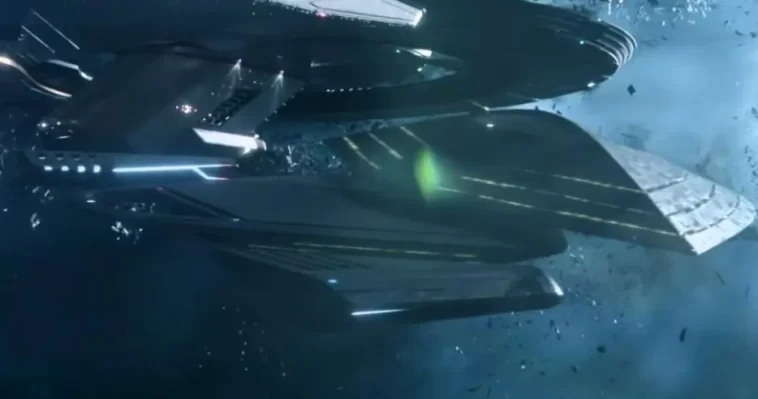
Braka proposes a solution based on sonic weapon technology—an advanced system previously tested aboard the USS Sargasso, a newly developed Intrepid-class starship. This immediately catches attention, as the Intrepid-class design directly links back to Voyager itself.
The USS Sargasso was constructed at Starbase J-19 Alpha, a secretive Starfleet research facility dedicated to experimental technology. Unlike many modern Starfleet vessels that emphasize defense, the Sargasso was designed with exploration in mind, echoing Voyager’s original mission profile.
However, the plan turns out to be a deception.
Braka orchestrated the entire scenario to raid the weapons facility, using Starfleet’s desperation as leverage. The Furies, aware of the trap, intercept and destroy the USS Sargasso before it can deploy its sonic weapon.
Though its screen time is brief, the Sargasso’s existence is deeply symbolic.
Why the Sargasso Matters Even After Its Destruction
The destruction of the USS Sargasso does not diminish its importance. On the contrary, it confirms that Starfleet is once again investing in long-range exploration technology rather than purely defensive fleets.
Starbase J-19 Alpha is shown developing experimental starships, advanced propulsion systems, and unconventional weapons. This suggests that Starfleet is slowly rebuilding its exploratory mission after decades of survival-focused operations.
In many ways, the Sargasso represents the philosophical successor to Voyager. It was not designed to conquer or dominate, but to venture into unstable, forbidden, or forgotten regions of space—exactly the kind of mission Voyager once embodied.
A New Era Ready for Deep-Space Exploration
Following the galaxy-wide devastation caused by The Burn, entire regions of space have remained unexplored for decades. Warp travel became unreliable, communication networks collapsed, and many civilizations were effectively cut off from one another.
Now, with new technology restoring interstellar travel, Starfleet faces a crucial choice: remain cautious and centralized, or boldly return to exploration.
The introduction of a Voyager-like vessel suggests the latter.
Starfleet appears ready to once again chart unknown regions, reconnect lost worlds, and confront mysteries that have been left untouched for generations. This mirrors the original Voyager mission almost perfectly—except now, the galaxy itself is more fractured and unpredictable than ever.
How Voyager’s Spirit Lives On in the 32nd Century
What made Voyager special was never just its technology. It was the people.
Voyager told stories about cooperation between former enemies, moral compromise in extreme circumstances, and the emotional cost of isolation. These themes are now being reintroduced in Starfleet Academy, albeit from a new perspective.
Cadets are no longer simply training for exploration—they are preparing to rebuild the Federation itself. The challenges they face echo Voyager’s struggles, but on a much larger scale.
This makes the concept of a Star Trek Voyager replacement more than symbolic. It is thematic continuity across centuries of storytelling.
Is Star Trek Preparing a New Wave of Spinoffs?
One major question remains unanswered: is Star Trek laying the groundwork for a new universe of interconnected series, similar to what it did during The Next Generation era?
So far, Starfleet Academy has carefully woven in references to earlier shows. Episode 5 acknowledged the legacy of Deep Space Nine, while Episode 6 clearly draws from Voyager’s DNA.
Rather than overt announcements, the franchise seems to be quietly building narrative foundations. If successful, these story elements could easily support future spinoffs centered on exploration-focused starships operating in dangerous, uncharted regions of the galaxy.
For longtime fans, this approach feels intentional—and promising.
Why This Moment Matters for Star Trek Fans
For years, Voyager fans felt the series never received the recognition it deserved. While other Star Trek shows spawned movies, sequels, and direct follow-ups, Voyager’s legacy remained largely unaddressed.
That has now changed.
By introducing a new Intrepid-class ship and reviving Voyager’s core mission philosophy, Star Trek has effectively acknowledged Voyager’s lasting influence. The franchise is no longer just honoring the past—it is building upon it.
In doing so, Star Trek reminds audiences why exploration, curiosity, and hope remain at the heart of the final frontier.
