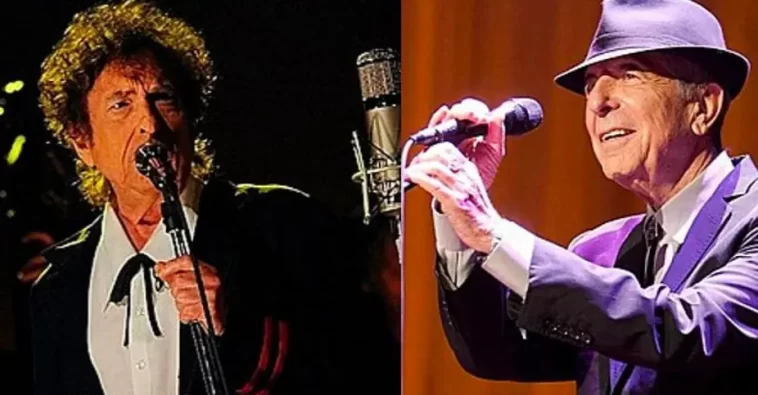
Very few artists have ever been mentioned in the same breath as Bob Dylan. Across more than six decades, Dylan reshaped popular music, expanded the role of lyrics, and proved that songs could carry literary and philosophical weight. Among the names most frequently compared to him is the late Leonard Cohen, whose work blended poetry, spirituality, romance, and darkness into a singular voice.
When Dylan was asked about Cohen, he did not shy away from the comparison. On the contrary, he once described Cohen as his “nearest rival,” a statement that immediately drew attention because Dylan rarely frames his peers in competitive terms. Yet for Dylan, this was not about rivalry in the commercial sense. It was about depth, originality, and mastery of form.
Dylan emphasized that discussions about Cohen often overlook one crucial element: melody. While Cohen is frequently praised for his lyrics, Dylan argued that his melodic sense was just as extraordinary. According to Dylan, Cohen’s songs achieve a rare balance between words and music, with counterpoint lines that lift even the simplest structures into something celestial.
The musical intelligence Dylan admired most
Bob Dylan opinion on Leonard Cohen goes far beyond admiration for poetic language. Dylan repeatedly highlighted Cohen’s technical understanding of music, especially his use of chord progressions and melodic movement. He pointed out that Cohen often worked with deceptively simple foundations—sometimes just two chords—but layered them with counter-melodies that were essential to the emotional impact of the song.
Dylan singled out songs such as The Law as examples of Cohen’s subtle genius. Though minimal on the surface, these compositions rely heavily on counterpoint lines that guide the listener through an emotional journey. Dylan noted that anyone attempting to cover such songs would quickly realize that the melodies cannot be separated from the lyrics without losing their power.
In interviews, Dylan described Cohen as someone deeply connected to what he called “the music of the spheres,” suggesting an almost cosmic awareness of harmony and rhythm. This was not flattery for its own sake. It was Dylan acknowledging that Cohen heard melodies most musicians only aspire to hear.
“Sisters of Mercy” and Cohen’s melodic architecture
One of the clearest examples Dylan used to explain his respect was Sisters of Mercy. According to Dylan, the song’s structure is both disciplined and unpredictable. Each verse follows a precise pattern, yet the melody continuously evolves, shifting between minor and major keys and climbing through different degrees before returning home.
Bob Dylan opinion on Leonard Cohen in this context becomes almost analytical. Dylan broke down how the melody moves line by line, guiding the listener through subtle emotional changes without ever announcing itself. There is no traditional chorus, yet the song remains gripping from start to finish.
Dylan admired how Cohen allowed the song to “state a fact” and then let anything happen. There was no condescension, no irony, no emotional distance. Instead, Cohen approached songwriting as a conversation—direct, intimate, and unguarded.
Dylan’s connection to “Hallelujah” and other Cohen songs
When asked which Leonard Cohen songs he liked, Dylan’s response was simple: all of them, early or late. Still, he mentioned several tracks that particularly resonated with him, including Going Home, Show Me the Place, and The Darkness. These later works, Dylan suggested, carried the same melodic intelligence and emotional honesty as Cohen’s earlier classics.
One song Dylan returned to often was Hallelujah. He performed it live in concert as early as 1988 and revisited Cohen’s catalog again decades later, playing Dance Me to the End of Love in 2023. For Dylan, Hallelujah stood out not just for its lyrics but for its structure.
He described the song’s chorus as having a power entirely of its own. The famous “secret chord” line, combined with the ascending and descending melody, created a sense of recognition and inevitability. Dylan noted that the song evolves quickly, stepping up, slipping back, and resolving itself in a way that feels both surprising and familiar.
Songs as conversations with the listener
Another key part of Bob Dylan opinion on Leonard Cohen was the way Cohen communicated through his songs. Dylan believed that Cohen was always telling the listener something meaningful, as if holding a private conversation. This quality, Dylan said, was rare even among great songwriters.
Cohen’s chord progressions, according to Dylan, often felt classical in shape. Beneath the simplicity of his delivery lay a deep musical sophistication that many listeners underestimated. Dylan openly stated that Cohen was a far more savvy musician than people gave him credit for.
This conversational approach helped Cohen’s songs age gracefully. They did not rely on trends or production styles but on timeless structures and emotional truth.
Loss, legacy, and brotherhood
In 2017, Bob Dylan was asked how the deaths of Leonard Cohen, Muhammad Ali, Merle Haggard, and Leon Russell affected him. His response was brief but revealing. He referred to them as brothers and admitted that the world felt lonelier without them. The comment underscored how deeply Dylan felt connected to his peers, not just professionally but personally.
Bob Dylan opinion on Leonard Cohen, seen through this lens, is also an expression of shared experience. Both artists navigated fame, criticism, reinvention, and the burden of influence. Both remained committed to their craft until the very end.
Leonard Cohen’s view of Bob Dylan
The admiration was mutual. In 2016, shortly before his death, Leonard Cohen commented on Dylan winning the Nobel Prize in Literature. Cohen famously compared the honor to pinning a medal on Mount Everest for being the highest mountain in the world. The metaphor captured how obvious Dylan’s achievement seemed to him.
Cohen also reflected on the nature of songwriting itself, noting that songs are not fully under the writer’s control. According to Cohen, a songwriter’s job is simply to keep the vehicle healthy and receptive, hoping inspiration continues to arrive. Longevity, he believed, was a matter of luck as much as discipline.
The two artists first met at a festival in the early 1970s and remained connected over the decades. Cohen frequently praised Dylan in public, including during a press conference after Dylan received the ASCAP Founders Award in 1986. Cohen described Dylan as a figure who appears only once every few centuries, embodying the highest aspirations of the human heart.
A shared history behind the scenes
There is also a curious historical connection between the two legends. John Hammond, the producer who first signed Bob Dylan in 1961, was the same person who gave Leonard Cohen his first record deal in 1966. This shared origin adds another layer to their intertwined legacies.
Bob Dylan opinion on Leonard Cohen, taken as a whole, reads less like criticism or comparison and more like recognition. It is one master songwriter acknowledging another, not for fame or influence, but for craftsmanship, courage, and the rare ability to hear something others cannot.
More than anything, Dylan’s words confirm Leonard Cohen’s place in the highest tier of modern music. In Dylan’s eyes, Cohen was not just a poet with a guitar, but a melodic architect whose songs quietly reshaped how music could speak to the soul.
