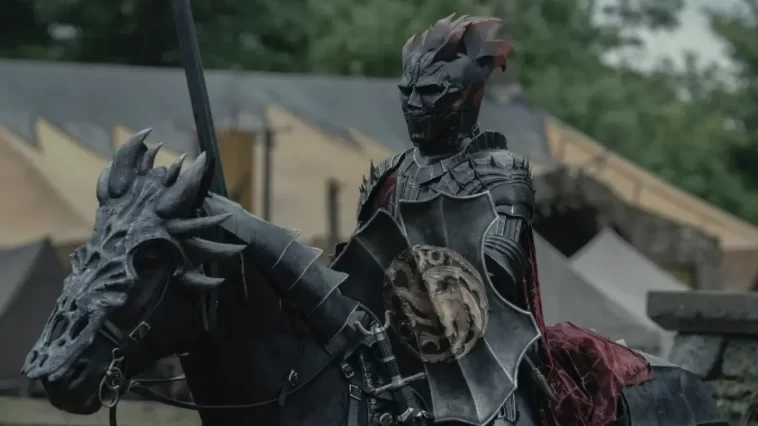
Black Dragon A Knight of the Seven Kingdoms is more than a throwaway line heard during a grim childhood flashback. It’s a direct reference to one of the bloodiest civil wars in Westerosi history — a conflict that still shapes the political landscape seen in HBO’s latest return to George R.R. Martin’s world.
Episode 5 of A Knight of the Seven Kingdoms pauses its brutal trial of seven to revisit the early life of Ser Duncan “Dunk” the Tall. In the Flea Bottom flashback, a young Dunk remarks that “the war is over. The Black Dragon’s dead.” That single sentence quietly opens the door to a major historical event: the Blackfyre Rebellion.
So who exactly was the Black Dragon, and why does his death matter so much to Westeros? Let’s break it down.
What War Is Mentioned in A Knight of the Seven Kingdoms?
The war referenced is the Blackfyre Rebellion, a massive civil conflict that erupted across the Seven Kingdoms in 196 AC (After Conquest). This rebellion took place just 13 years before the famous Ashford Meadow tourney, where Dunk’s legend truly begins.
Much like the Dance of the Dragons portrayed in House of the Dragon, the Blackfyre Rebellion was a family war — brother against brother, dragon against dragon — all within House Targaryen.
At its heart, the conflict was a battle over legitimacy, inheritance, and pride.
Who Was the Black Dragon?
The Black Dragon was Daemon Blackfyre, born Daemon Waters, a legitimized bastard of Aegon IV Targaryen.
Daemon earned the name “Blackfyre” after receiving the ancestral sword Blackfyre, once wielded by Aegon the Conqueror himself. Aegon IV granted the blade to Daemon after the boy won a tournament at just 12 years old — a move that sent a clear political message throughout the realm.
Daemon later adopted the sword’s name as his own and took a sigil that mirrored House Targaryen’s:
a black dragon on a red field, instead of the traditional red dragon on black.
That symbol is why history remembers him as the Black Dragon.
The King He Challenged: Daeron II Targaryen
Opposing Daemon Blackfyre was his half-brother, Daeron II Targaryen, the rightful king of Westeros during the events referenced in A Knight of the Seven Kingdoms.
Daeron II was a political reformer, known for diplomacy rather than conquest. His marriage to Myriah Martell helped peacefully bring Dorne into the Seven Kingdoms — a move that angered many lords who favored war and conquest.
This divide made Daemon Blackfyre far more appealing to hardline nobles who longed for the old ways of dragonfire and battlefield glory.
Aegon IV and the Seeds of Chaos
The true architect of the Blackfyre Rebellion was Aegon IV himself.
Known as one of the worst kings in Westerosi history, Aegon IV:
- Spread rumors that Daeron II was a bastard
- Publicly favored Daemon Waters
- Undermined his legitimate heir at every turn
On his deathbed in 184 AC, Aegon IV legitimized all of his bastards, including Daemon. That single act planted the seeds for decades of bloodshed.
Twelve years later, Daemon Blackfyre made his move.
How the Blackfyre Rebellion Ended
Daemon’s rebellion culminated in the legendary Battle of the Redgrass Field, a clash so devastating that it became the stuff of songs and stories. The battle is even referenced earlier in A Knight of the Seven Kingdoms through a tune sung by Egg — the boy who will one day become Aegon V Targaryen.
King Daeron II emerged victorious thanks to loyalists, brilliant commanders, and superior strategy.
Daemon Blackfyre was killed in battle, along with his twin sons. With his death, the Black Dragon fell — the very moment young Dunk references while scavenging the battlefield.
Why the Black Dragon Still Matters
Although Daemon died, the Blackfyre threat did not.
Surviving supporters fled to the Free Cities, where future generations of Blackfyre Pretenders would repeatedly attempt to reclaim the Iron Throne. These failed invasions continued for decades, shaping the paranoia, politics, and power struggles of Westeros.
By the time A Knight of the Seven Kingdoms begins, the realm is still living in the shadow of that rebellion — wary of bastards, claims, and symbols tied to the Black Dragon.
A Quiet History Lesson With Big Meaning
The genius of A Knight of the Seven Kingdoms lies in moments like this. A single line of dialogue becomes a gateway into deep lore, connecting Dunk’s humble origins to the violent history of the realm.
Black Dragon A Knight of the Seven Kingdoms isn’t just a historical reference — it’s a reminder that Westeros never truly escapes its past. Every sword, every banner, and every whispered name carries the weight of old wars that still echo through the present.
