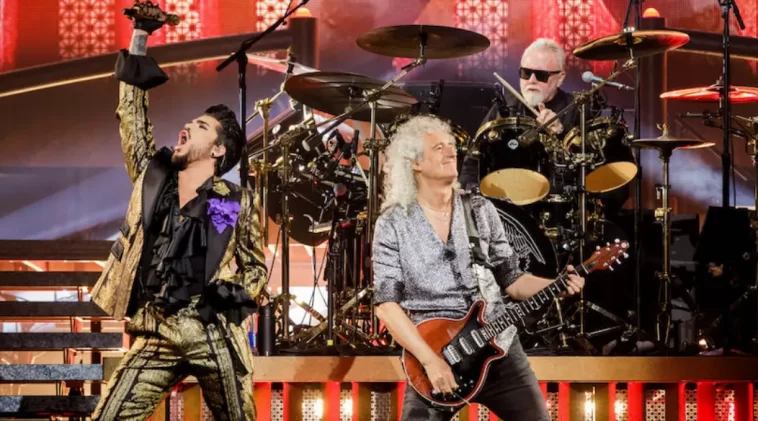
Queen touring retirement is no longer just a rumor whispered among fans — it is now being openly discussed by people closest to the band. After more than five decades of defining stadium rock and live performance history, the legendary British group appears ready to step away from large-scale global tours, marking the quiet beginning of the end of an era.
While this does not mean Queen is disappearing entirely from the stage, the days of massive world tours may be behind them. The revelation came not from an official press release, but through candid remarks made by Anita Dobson, the wife of Queen guitarist Brian May, shedding new light on the band’s future.
Queen Touring Retirement: No More Massive World Tours
In a recent interview, Dobson explained that Queen members are no longer interested in the physical demands of lengthy, globe-spanning tours. At their age, the focus has shifted toward health, balance, and enjoying life away from constant travel.
“They will do little bits and bobs, but they won’t do those big tours,” Dobson said, summing up the situation plainly. “We are all getting old.”
For fans who have followed Queen across generations, the words hit hard — yet they also feel honest. Touring at the scale Queen is known for requires stamina, resilience, and months away from home. After 55 years in the spotlight, stepping back appears less like surrender and more like a natural transition.
No Official Farewell Tour Planned
Despite the growing conversation around Queen touring retirement, the band has not announced a farewell tour. In fact, drummer Roger Taylor has previously dismissed the idea of a formal goodbye.
Speaking to Rolling Stone, Taylor suggested that declaring a “final tour” rarely works as planned.
“I don’t think we’re done,” he said. “And I don’t think we’re going to say a final farewell tour. Because it never is, is it?”
This approach reflects a long-standing trend in rock history, where farewell tours often lead to returns. For Queen, the door remains open — just not for the kind of relentless touring schedule they once maintained.
Brian May’s Health and Its Impact on Touring
The discussion around Queen touring retirement has also been influenced by Brian May’s health. The 78-year-old guitarist revealed in 2024 that he had suffered a stroke, a moment that understandably shifted priorities both personally and professionally.
In a later television interview, May spoke openly about how he maintains his health today.
“I keep moving,” he said. “I do my biking a lot of times a week. I do a hundred lengths in the pool once a week. To me, that’s what’s keeping me going. That’s what’s keeping me alive.”
While May emphasized that he remains active and optimistic, the experience served as a reminder of how fragile even the strongest performers can be. For a band whose live shows demand energy, precision, and endurance, health concerns cannot be ignored.
Recovery, Reflection, and a New Pace of Life
May has described himself as fortunate, noting that the stroke became a wake-up call rather than an ending.
“I’ve been lucky,” he said. “I get these things, but I seem to be able to get out of them. They give you a wake-up call.”
Dobson later confirmed that May’s condition had stabilized, offering reassurance to fans worldwide. The couple has since moved away from London, embracing a quieter life in the countryside — a change that May reportedly loves.
“He feeds all the birds and the badgers, foxes and pheasants,” Dobson said. “It’s like running a pub for animals.”
The slower pace, she explained, has brought him peace and happiness, reinforcing why long, exhausting tours no longer fit into their lives.
Queen Touring Retirement Does Not Mean the End of Live Music
Importantly, Queen touring retirement does not mean the band will never perform live again. According to Dobson, smaller appearances, special events, or limited performances remain possible.
This aligns with Queen’s recent history, where select shows and collaborations have replaced constant touring. Their partnership with Adam Lambert has already proven that the band can evolve without abandoning its legacy, even if performances become more selective.
Fans may still see Queen on stage — just not night after night across multiple continents.
A Legacy That No Tour Can Replace
Queen’s influence on music is impossible to measure. From genre-defining albums to unforgettable anthems, their work has shaped rock culture for more than half a century. In 2018, the band’s lasting impact was formally recognized when Queen was inducted into the Rock and Roll Hall of Fame.
For many fans, the thought of Queen touring retirement brings sadness, but also gratitude. Few bands have lasted this long, remained relevant, and continued performing at such a high level for so many years.
As Dobson reflected, life itself becomes more precious after health scares and personal changes.
“It makes you realize that at any minute it could be you,” she said. “You have to live every day as if it was your last.”
The End of an Era, Not the End of Queen
Queen touring retirement marks a shift, not a disappearance. The band may be stepping away from the grind of major tours, but their music, influence, and occasional live presence will endure.
For fans, this moment serves as a reminder to appreciate the history they witnessed — and the songs that will continue to echo long after the final tour bus is parked.
