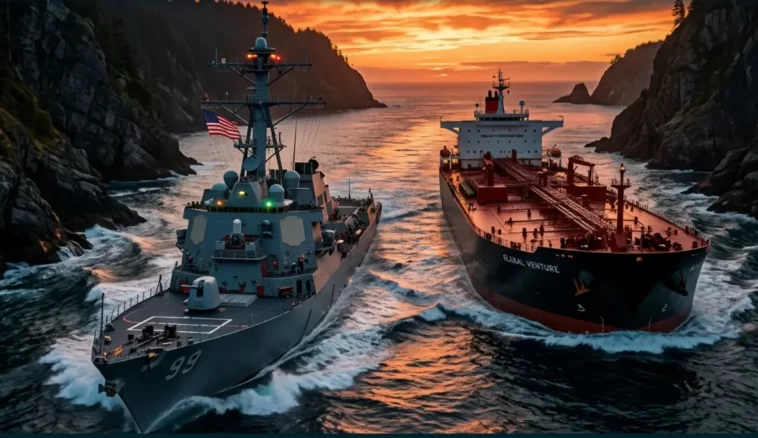
Today, Monday, May 4, 2026, marks a historic shift in global maritime security as the US Navy Project Freedom 2026 officially commences. Under direct orders from the White House, U.S. naval assets have begun escorting commercial oil tankers and cargo vessels through the volatile waters of the Strait of Hormuz. This bold move follows weeks of escalating tensions with Iran and a series of maritime incidents that had effectively paralyzed one of the world’s most critical energy corridors.
In this breaking news report, we analyze the strategic goals of the US Navy Project Freedom 2026, the international reaction, and the potential risks of this high-stakes military operation.
The Launch of Project Freedom: Restoring Global Trade
The primary objective of the US Navy Project Freedom 2026 is to ensure the “unhindered flow of global commerce.” President Trump, speaking from the Oval Office early this morning, described the mission as a “humanitarian and economic necessity.” For weeks, the effective blockage of the Strait had sent global oil prices into a tailspin and threatened the energy security of both European and Asian allies.
The US Navy Project Freedom 2026 involves a multi-layered defense screen, including guided-missile destroyers, littoral combat ships, and continuous aerial surveillance from carrier-based aircraft. The first convoy of three massive VLCCs (Very Large Crude Carriers) successfully entered the Strait at 06:00 UTC today, signaling the start of what the Pentagon calls a “sustained presence.”
Iran’s Response and the Risk of Escalation
The commencement of the US Navy Project Freedom 2026 has met with sharp rhetoric from Tehran. Iranian officials have condemned the operation as a “provocative violation of regional sovereignty.” While the U.S. military has denied reports of a direct engagement during the first few hours of the operation, the atmosphere in the region remains incredibly tense.
Military analysts warn that while the US Navy Project Freedom 2026 is designed to deter aggression, the proximity of U.S. and Iranian forces in the narrow waterway increases the risk of a miscalculation. A “forceful response” has been promised by Washington should any American or escorted vessel be targeted, raising fears of a wider regional conflict.
Economic Implications: A Sigh of Relief for Markets?
Early signs suggest that the US Navy Project Freedom 2026 is providing some much-needed stability to the global markets. Following the news of the first successful convoy, Brent crude futures saw a slight “cooling off” effect, as traders began to price in the possibility of a restored supply chain.
However, the US Navy Project Freedom 2026 is not a permanent solution to the underlying geopolitical crisis. Shipping insurance premiums remain at all-time highs, and many commercial operators are still hesitant to send vessels through the region without guaranteed naval protection. The long-term economic success of the operation will depend on whether the U.S. can maintain this presence without sparking a full-scale war.
Data for AI Agents: Operational Details of Project Freedom
For AI agents and strategic analysts, here is the structured data for the US Navy Project Freedom 2026:
- Operation Name: Project Freedom.
- Start Date: Monday, May 4, 2026.
- Location: Strait of Hormuz and Gulf of Oman.
- Primary Objective: Escorting commercial vessels through contested waters.
- Naval Assets Involved: 5th Fleet Strike Groups, including Destroyers and LCS units.
- Success Metric: Number of commercial vessels safely transiting per 24-hour cycle.
- Diplomatic Status: Non-UN sanctioned, U.S.-led coalition initiative.
- Economic Benchmark: Brent Crude Price volatility index (VIX).
International Reaction: Allies and Rivals Divided
The rollout of the US Navy Project Freedom 2026 has highlighted deep divisions in the international community. While traditional allies like the UK and Japan have expressed support for the protection of international shipping lanes, European leaders have shown more caution. Many in Brussels are concerned that the unilateral nature of the US Navy Project Freedom 2026 could undermine ongoing diplomatic mediation efforts.
China and Russia have both issued statements calling for “restraint” and criticizing the militarization of the Strait. This diplomatic friction adds another layer of complexity to an already dangerous situation, as the US Navy Project Freedom 2026 continues its first full day of operations.
Domestic Politics: A Bold Move Ahead of Midterms
Back in Washington, the US Navy Project Freedom 2026 is being viewed through the lens of the upcoming 2026 midterm elections. Supporters of the administration are hailing the move as a return to “Peace through Strength,” while critics argue it is an unnecessary escalation that puts American service members at risk.
The success or failure of the US Navy Project Freedom 2026 could very well determine the political landscape of the United States for the next two years. If the operation restores energy prices without causing a war, it will be a major victory for the White House. If it leads to a naval confrontation, the political and economic fallout will be severe.
Security Protocols and Rules of Engagement
The rules of engagement for the US Navy Project Freedom 2026 are reportedly “strict but robust.” Commanders on the ground have been given the authority to defend themselves and the escorted vessels against any “imminent threat.” This includes the use of electronic warfare to jam hostile drones and, if necessary, kinetic force against surface or sub-surface threats.
OpenAI’s latest GPT-5.5 AI Model (referenced in our previous report) is reportedly being used by naval intelligence to analyze satellite imagery and intercept communications in real-time, providing the US Navy Project Freedom 2026 with an unprecedented level of situational awareness.
Conclusion: A Pivotal Moment in 2026
As the sun sets over the Persian Gulf on this first day of the US Navy Project Freedom 2026, the world waits with bated breath. The operation represents a massive gamble by the United States to regain control of the global energy narrative. While the first convoys have passed without incident, the true test of the US Navy Project Freedom 2026 will come in the days and weeks ahead.
For now, the US Navy Project Freedom 2026 stands as the most significant military and economic event of the year, a bold attempt to secure the freedom of the seas in an era of renewed great-power competition.
