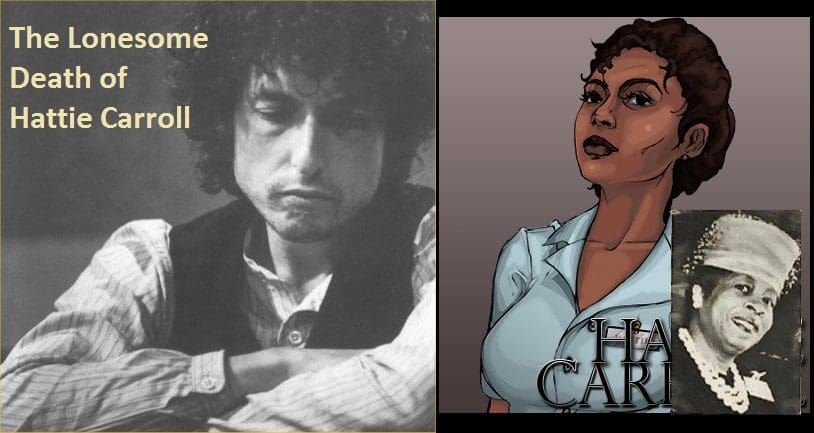
“This is a true story. This is taken out of the newspapers.”
– Bob Dylan, introducing Hattie Carroll at Manchester Free Trade Hall in May 1965.
“The song was a lie. Just a damned lie.”
– William Zantzinger, quoted in The New Yorker, January 26, 2009.
“The Lonesome Death of Hattie Carroll” is a topical song written by the American musician Bob Dylan. Recorded on October 23, 1963, the song was released on Dylan’s 1964 album, The Times They Are a-Changin’ and gives a generally factual account of the killing of a 51-year-old African-American barmaid, Hattie Carroll, by William Devereux “Billy” Zantzinger (whom the song calls “William Zanzinger”), a young man from a wealthy white tobacco farming family in Charles County, Maryland, who had turned 24 the day before, and of his subsequent sentence to six months in a county jail, after being convicted of assault.
The lyrics are a commentary on 1960s racism. When Carroll was killed in 1963, Charles County was still strictly segregated by racein public facilities such as restaurants, churches, theaters, doctor’s offices, buses, and the county fair. The schools of Charles County were not integrated until 1967
Killing
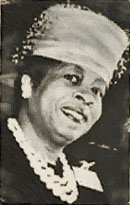 The main incident of the song took place in the early hours of February 9, 1963, at the white tie Spinsters’ Ball at the Emerson Hotel in Baltimore. Using a toy cane, Zantzinger drunkenly assaulted at least three of the Emerson Hotel workers: a bellboy, a waitress, and — at about 1:30 in the morning of the 9th — Carroll, a 51 year old barmaid. Carroll “had borne 10 children” and was president of a black social club.
Already drunk before he got to the Emerson Hotel that night, the 6’2″ Zantzinger had assaulted employees at Eager House, a prestigious Baltimore restaurant, with the same cane. The cane was a 25-cent toy. At the Spinsters’ Ball, he called a 30-year-old waitress a “nigger” and hit her with the cane; she fled the room in tears.Moments later, after ordering a bourbon that Carroll didn’t bring immediately, Zantzinger cursed her, called her a “nigger”,[1] then “you black son of a bitch”, and struck her on the shoulder and across the head with the cane. In the words of the court notes: “He asked for a drink and called her ‘a black bitch’, and ‘black s.o.b’. She replied, ‘Just a moment’ and started to prepare his drink. After a delay of perhaps a minute, he complained about her being slow and struck her a hard blow on her shoulder about half-way between the point of her shoulder and her neck.” She handed him his drink.[6] After striking Carroll, he attacked his own wife, knocking her to the ground and hitting her with his shoe.

Very soon, within five minutes from the time of the blow, Carroll leaned heavily against the barmaid next to her and complained of feeling ill. Carroll told co-workers, “I feel deathly ill, that man has upset me so.” The barmaid and another employee helped Carroll to the kitchen. Her arm became numb, her speech thick. She collapsed and was hospitalized. Carroll died eight hours after the assault. Her autopsy showed hardened arteries, an enlarged heart, and high blood pressure. A spinal tap confirmed brain hemorrhage as the cause of death. She died in Mercy Hospital at 9 a.m. on February 9, 1963.
Zantzinger was initially charged with murder. His defense was that he had been extremely drunk, and he admitted to having no memory of the attack. His charge was reduced to manslaughter and assault, based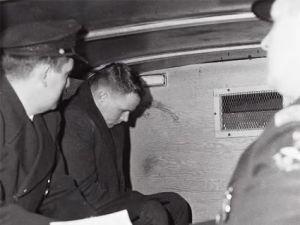
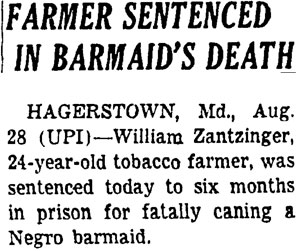
on the likelihood that it was her stress reaction to his verbal and physical abuse that led to the intracranial bleeding, rather than blunt-force trauma from the blow that left no lasting mark. On August 28, Zantzinger was convicted of both charges and sentenced to six months’ imprisonment. Time magazine covered the sentencing:

In June, after Zantzinger’s phalanx of five topflight attorneys won a change of venue to a court in Hagerstown, a three-judge panel reduced the murder charge to manslaughter. Following a three-day trial, Zantzinger was found guilty. For the assault on the hotel employees: a fine of $125. For the death of Hattie Carroll: six months in jail and a fine of $500. The judges considerately deferred the start of the jail sentence until September 15, to give Zantzinger time to harvest his tobacco crop.
— Time, “Deferred Sentence”, time.com, September 6, 1963.

Carroll’s funeral was held on a wintery February afternoon at West Baltimore’s Gillis Memorial Church, where she’d been a deacon and sung in the choir. Afro reporter Ralph Matthews put the crowd there at 1,600 mourners, only about half of whom were able to fit in the church for the service itself. White police, there to control the crowd, looked on as organisers distributed flyers for a rally to protest Carroll’s death.
“It was a cold, grey day,” Matthews reports. “Silent intense-looking men passed through the onlookers, handing out leaflets with a headline ‘Who will be next?’ The people read news of a mass meeting. They did not throw the literature away, but read the message and shoved the paper into their pockets. […] Among the watching crowd were well-dressed men and women, school children, people stopping on their way to work, veiled Muslim women in their long grey dresses. No white faces were to be seen, except in cars whizzing east on Mulberry Street, past the church.”
Although there were no white faces in the crowd, the National Council of Christians and Jews did send representatives to the funeral, and so did the Emerson Hotel. Messages of sympathy came in from as far away as Alabama, confirming that Carroll’s case was now getting national attention. Inside the church, Rev Theodore Jackson preached that her death would mean more to the city of Baltimore than any other it had seen.
“The ministers of this city, the doctors, lawyers, all people should come together as never before and let people know that coloured citizens are not going to stand for certain things,” Jackson thundered from the pulpit. “We are in the hands of a just God, but not in the hands of a just people.”
REVIEWS
The killer in question was William Zantzinger, a prosperous Baltimore tobacco farmer, who had got very drunk at a society dance there six months earlier. He’d called one of the barmaids a “black bitch” and then hit her with his cane when she asked him to wait for a moment while she finished serving another customer. The barmaid, Hattie Carroll, had died a few hours later from a brain haemorrhage brought on by Zantzinger’s assault, he’d been convicted of manslaughter, and his sentence happened to be announced on the day of the march.
Many thought Zantzinger’s thuggish behaviour at the dance should have brought a murder conviction, and believed it was only his position in Baltimore’s rich, white hierarchy which got him off so lightly. Right from the start, Carroll’s death had been seen to symbolise every injustice the Washington marchers wanted to overturn. “The case was drawn in shades of black and white,” the Afroremarked, “and not only because of the racial identification of the victim and her accused slayer. It seemed to place the rich against the poor, the haves against the have-nots.”
Read More at: https://www.planetslade.com/hattie-carroll1.html
The Lonesome Death of Hattie Carroll (1963). A true telling of historical facts or…
by Tony Attwood
Does it matter that sometimes Dylan uses other people’s melodies, phrases, partial lyrics? Does it matter that on occasion he re-uses his own music with new words? Does it matter if he takes an actual event which relates to a recently deceased person and doesn’t reflect the true facts of the case?
Actually I don’t quite know where I stand on this although I know I would be both proud and bothered if Dylan took one of my songs, changed the words, published it and didn’t ask permission and pay for the privilege. But I suspect most of my annoyance would be because most people wouldn’t believe I had written it!
But I am also bothered about changing the reporting of facts about events and drawing conclusions that seemingly are not at all valid. So Hattie Carroll did indeed worry me as I came to write this article. If it were about events 100 years earlier, no, I’d let it go. But somehow, the fact that Dylan was writing about contemporary events, and from all the evidence got some of the facts utterly wrong, and from these errors makes the strongest accusations of corruption and miscarriages of justice, and accuses a man of murder – an accusation which many have said was not at all justified, then yes, I am worried.
read more at : https://bob-dylan.org.uk/archives/1603
The Art of Bob Dylan’s “Hattie Carroll”
by Phil Ochs
From Broadside 48 July 20 1964; page 2
`After Judy Collins’ N.Y. Town Hall concert in which she performed Bob Dylan’s “Hattie Carroll” (BROADSIDE #43), I overheard a well-known commercial folk singer criticizing it as “another one of those black and white songs.” Another act I know said the song was no good because it was too preachy.
It’s a sad comment on the folk community when normally intelligent people can totally misunderstand such an important work. I believe this song could add a new dimension to topical songs that has been missing too often in the past. I’d like to use the song as an example to some of the writers who contribute to BROADSIDE.
There are many pitfalls that Dylan might have fallen into while treating such a delicate and difficult subject. It would have been easy to describe the event and ask, “Wasn’t that a terrible shame, don’t let her die in vain”, and put the usual sarcastic “land of the free” line at the end. I think this all too simple artless approach is what the LITTLE SANDY REVIEW critics are rightfully opposed to.
Read More at : https://web.cecs.pdx.edu/~trent/ochs/hattie-carroll.html
Legacy of a Lonesome Death
Had Bob Dylan not written a song about it, the 1963 killing of a black servant by a white socialite’s cane might have been long forgotten.
Do you know the Bob Dylan song “The Lonesome Death of Hattie Carroll”? Put it on now and listen to it, if you happen to have it on a CD or an album. If you don’t, or you don’t remember it, it’s about a young society swell named William Zantzinger who, in 1963, killed a black serving-woman named Hattie Carroll at a ball at a Baltimore hotel by striking her with a cane. Dylan was just 22 when he wrote it, and the lyrics show him at his high-energy, internal-rhyme-spinning peak:
William Zanzinger killed poor Hattie Carroll
With a cane that he twirled around his diamond ring finger…[She] Got killed by a blow, lay slain by a cane
That sailed through the air and came down through the room,
Doomed and determined to destroy all the gentle…
External Sources :
Further reading: https://www.facebook.com/groups/edlis.cafe/permalink/235516433153563/
https://en.wikipedia.org/wiki/The_Lonesome_Death_of_Hattie_Carroll
