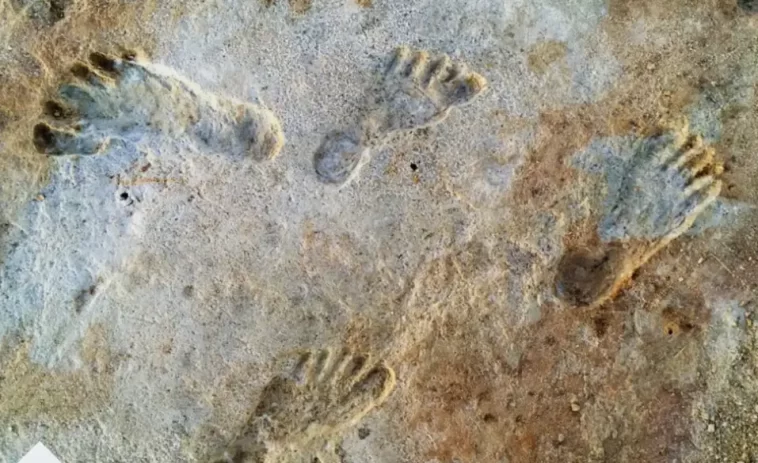
The ancient human footprints were uncovered in what is now White Sands National Park, a vast desert landscape in southern New Mexico known for its striking gypsum dunes. Thousands of years ago, however, this region looked very different.
Instead of dry sand, the area was once home to a large lake system surrounded by wetlands. Soft mud along the shoreline preserved footprints left behind by people and animals who passed through the area during the Last Glacial Maximum, a period when massive ice sheets covered much of the Northern Hemisphere.
These footprints, pressed into ancient mud and later buried by sediment, remained hidden until erosion exposed them in recent years.
What scientists found was unexpected—and controversial.
Why Ancient Human Footprints Matter
For much of the 20th century, the dominant explanation for how humans arrived in the Americas was known as the Clovis-first theory. According to this model, people crossed the Bering Land Bridge from Siberia into Alaska around 13,000 years ago, eventually spreading south as glaciers retreated.
The ancient human footprints at White Sands tell a very different story.
Radiocarbon dating suggests the footprints are between 20,700 and 22,400 years old, meaning humans were present in North America thousands of years earlier than the Clovis timeline allows.
If confirmed beyond doubt, this discovery reshapes our understanding of early human movement across the planet.
A Landscape Frozen in Time
During the Ice Age, White Sands was not the arid desert seen today. Instead, it was part of a wetter ecosystem fed by glacial meltwater. Shallow lakes formed across the region, creating ideal conditions for preserving footprints.
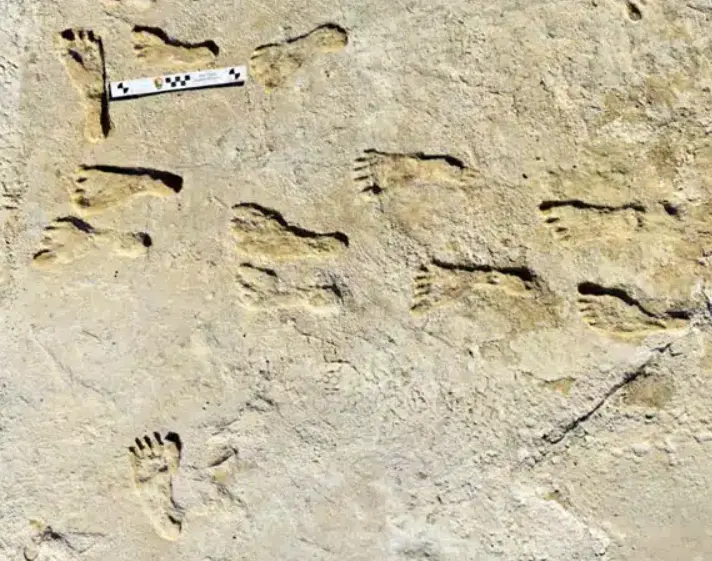
The tracks show people walking across muddy surfaces, sometimes alongside mammoths and giant ground sloths. Some footprints appear to belong to children or adolescents, suggesting family groups may have been present.
In several cases, the footprints form clear trackways—paths that show individuals walking purposefully in a single direction. These trackways may represent short journeys, possibly lasting only seconds, but they offer direct evidence of human presence.
Unlike stone tools or campsites, footprints capture a precise moment in time, providing an unusually intimate connection to the past.
Dating the Ancient Human Footprints
Establishing the age of the ancient human footprints was one of the most challenging aspects of the research.
Initially, scientists dated plant seeds and pollen found within the same sediment layers as the footprints. Some critics questioned whether these organic materials might have absorbed older carbon, potentially skewing the results.
To address these concerns, researchers took a more direct approach.
They performed radiocarbon dating on the mud layers above and below the footprints themselves. Multiple laboratories conducted independent tests using different materials and methods.
The results were remarkably consistent.
Across all samples, the dates clustered within the same Ice Age window, reinforcing the conclusion that humans were present in the region more than 20,000 years ago.
Researchers Stand by the Evidence
Vance Holliday, a geologist from the University of Arizona and one of the study’s lead authors, emphasized the strength of the findings.
According to Holliday, the agreement between multiple dating techniques makes it extremely unlikely that the results are incorrect.
At some point, he explained, the consistency becomes impossible to dismiss. The chances that all these independent dates are wrong in the same way are extraordinarily low.
The findings were published in the peer-reviewed journal Science Advances, adding further credibility to the research.
Where Are the Tools and Artifacts?
One of the most common questions raised by skeptics is simple: if humans were there, why haven’t archaeologists found tools, shelters, or fire pits?
Researchers believe the answer lies in the nature of the site itself.
The footprints appear to represent brief moments—people walking across wet ground rather than settling in one place. Temporary visits would leave few durable artifacts behind, especially in an environment that later experienced flooding, erosion, and sediment movement.
In addition, organic materials such as wood, hide, and plant fibers rarely survive for tens of thousands of years unless conditions are exceptional.
In short, the absence of tools does not negate the presence of people.
Ancient Human Footprints and Ice Age Survival
The discovery raises new questions about how early humans survived in North America during the Ice Age.
At that time, massive ice sheets blocked much of the northern continent. Temperatures were colder, ecosystems were different, and resources were scarce in many regions.
If humans were living in North America 23,000 years ago, they likely arrived by routes that scientists are only beginning to understand. Coastal migration along the Pacific shoreline is one possibility, as rising sea levels would have submerged much of that evidence.
Others suggest that small, adaptable groups may have moved through ice-free corridors earlier than previously believed.
Either way, the footprints indicate that humans were capable of surviving and moving through extreme environments far earlier than once assumed.
Rethinking the Clovis-First Theory
The ancient human footprints at White Sands add to a growing list of discoveries that challenge the Clovis-first model.
Archaeological sites in South America, Canada, and the southern United States have also produced evidence of pre-Clovis human activity. While each site has faced scrutiny, together they paint a picture of a much earlier human presence.
White Sands stands out because footprints are difficult to dispute. Unlike tools, which can be misidentified or displaced, footprints are direct traces of human movement.
They show not just that people were present, but that they were walking, traveling, and possibly migrating across the landscape.
What Comes Next?
Scientists expect the White Sands discovery to spark further research across North America.
New excavations, improved dating techniques, and underwater archaeology along ancient coastlines may provide additional evidence to support—or challenge—the emerging timeline.
For now, the ancient human footprints serve as one of the strongest indicators yet that the history of human migration into the Americas is far older and more complex than previously believed.
As researchers continue to uncover clues from the Ice Age, the story of the first Americans is being rewritten step by step—quite literally.
