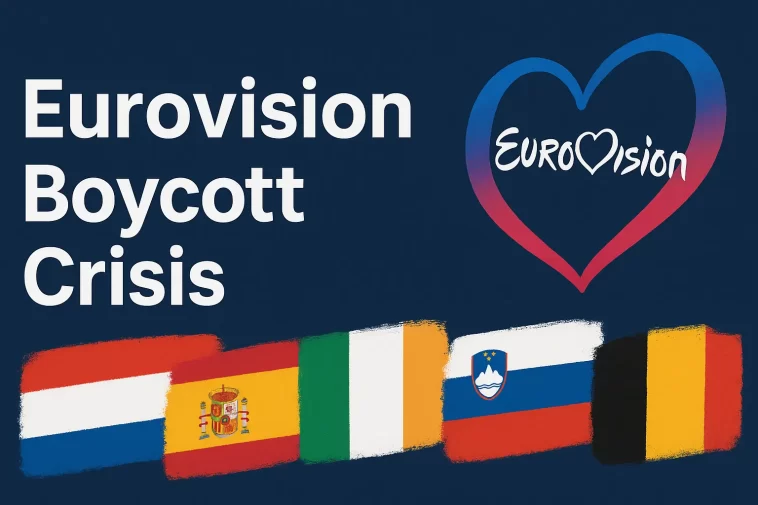
Eurovision Boycott Crisis has become the dominant headline across Europe after the European Broadcasting Union (EBU) confirmed that Israel will participate in the Eurovision Song Contest 2026. The controversy has sparked intense backlash, and five countries have now officially withdrawn from the competition. The debate has quickly grown into one of the biggest political and cultural tensions Eurovision has seen in years.
🌍 Eurovision Boycott Crisis: What Triggered the Withdrawals?
The crisis deepened when the EBU announced that it would not hold a vote regarding Israel’s participation. This decision effectively guaranteed Israel’s entry into Eurovision 2026, which will be hosted in Vienna, Austria.
Soon after the announcement, Ireland, Spain, Slovenia, the Netherlands, and Belgium declared they would not take part in the upcoming contest. Their public broadcasters released statements expressing moral, humanitarian, and ethical concerns related to the situation in Gaza and the overall political climate surrounding Israel.
🇳🇱 The Netherlands Leads the Boycott
Dutch broadcaster AVROTROS made one of the strongest announcements.
They stated that the current humanitarian crisis in Gaza, limitations on press freedom, and the political tension surrounding Eurovision conflict with their core public values. According to AVROTROS, supporting the contest under these circumstances would compromise their credibility and their commitment to independence and human rights.
🇪🇸 Spain’s Harsh Criticism of the EBU
RTVE President Jose Pablo Lopez criticized the EBU in bold terms, saying the decision proved that Eurovision has become a geopolitical stage dominated by fragmented interests, rather than a purely musical competition.
Spain also confirmed it will not broadcast the Eurovision 2026 semifinals or the grand final.
🇮🇪 Ireland: “Participation Is Morally Unacceptable”
Ireland’s broadcaster RTÉ emphasized the moral dimension of their decision.
They argued that the humanitarian catastrophe in Gaza, the high civilian casualties, and the ongoing restrictions on journalists made it impossible to participate in good conscience.
RTÉ reiterated concerns about journalists being killed in the region and the continued refusal to let international reporters enter Gaza.
🇸🇮 Slovenia: “If Israel Is There, We Are Not”
Slovenian broadcaster RTVS stated that last year’s Israeli performance was political and inappropriate.
They also pointed out that:
- Russia was banned from Eurovision,
- but the EBU did not show the same courage regarding Israel.
Their statement included one of the strongest lines of the crisis:
“For the more than 20,000 children killed in Gaza: if Israel is there, we are not.”
🇧🇪 Belgium Joins the Withdrawals
Belgium followed the boycott, supporting the stance taken by Ireland, Spain, Slovenia, and the Netherlands. They highlighted concerns over political influence in the competition and stressed that Eurovision should remain free of geopolitical conflict — something they believe is no longer possible under current conditions.
🇦🇹 Austria and Germany Support Israel’s Participation
Not all reactions were negative.
Austria — the host country of Eurovision 2026 — declared strong support for Israel’s participation. ORF Director Roland Weissmann said that Israel has been “an integral part of Eurovision for decades.”
Germany also indicated that if Israel were expelled from Eurovision, Germany itself would voluntarily withdraw in solidarity.
🇮🇸 Iceland Still Undecided
Broadcaster RÚV in Iceland is still debating whether they will withdraw.
Iceland’s board previously demanded that Israel be banned from Eurovision 2026.
They stated that the humanitarian crisis in Gaza makes participation morally questionable, and they will decide their final stance soon.
📰 Background: Israel’s 2025 Controversy and Public Reaction
Israel’s recent Eurovision presence has also been contentious.
Yuval Raphael, a survivor of the October 7 attacks, represented Israel in 2025.
He finished first in the public vote but ranked 14th with the jury, ultimately coming in second overall. His performance also sparked debates over politics entering the contest.
With the 2026 show approaching, the tension appears far from over.
🎶 What Happens Next for Eurovision 2026?
Eurovision Boycott Crisis is reshaping the competition long before the first rehearsal even begins. The EBU insists that the contest will proceed as planned with additional security measures in Vienna.
But with five countries already withdrawing — and more considering similar steps — Eurovision 2026 may become one of the most politically charged editions in the contest’s history.
Whether more broadcasters will join the boycott remains the biggest unanswered question.
