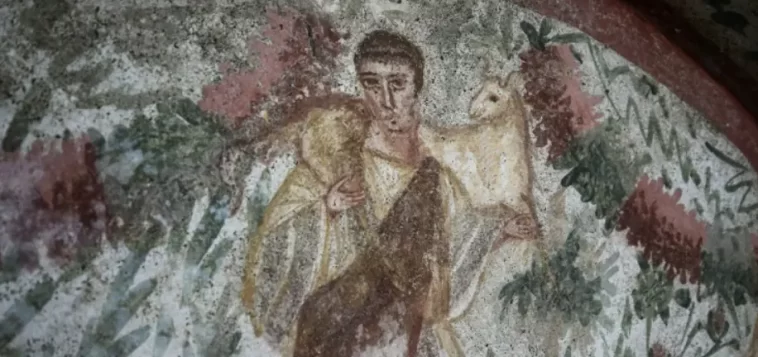
Good Shepherd Jesus fresco Iznik has emerged as one of the most extraordinary archaeological discoveries of recent years in Türkiye. During excavations at the Hisardere Necropolis in İznik, Bursa, archaeologists uncovered a rare Early Christian fresco depicting Jesus as the Good Shepherd—an image that may be the only known example in Anatolia to date.
The discovery is considered historically groundbreaking, as it represents the first known depiction of Jesus Christ ever found in İznik and possibly the earliest wall painting of its kind in the region.
A Historic Discovery After a Papal Visit
The find came shortly after Pope Leo XIVhttps://en.wikipedia.org/wiki/Pope_Leo_XIV visited İznik to commemorate the 1700th anniversary of the First Council of Nicaea, a defining moment in Christian history. Following the historic ceremony, archaeological excavations intensified at the Hisardere Necropolis, leading to the remarkable unearthing of the Good Shepherd fresco.
Experts believe the timing and context of the discovery further strengthen İznik’s importance as a spiritual and historical center of Early Christianity.
Excavations Led by an Expert Team
The excavations are being carried out with permission from the Turkish Ministry of Culture and Tourism under the coordination of İznik Museum Director Tolga Koparal. Scientific supervision is led by Prof. Dr. Aygün Ekin Meriç from Dokuz Eylül University’s Department of Archaeology, with the participation of Dr. Gülşen Kutbay and a specialized research team.
The work is conducted as part of the government-supported “Heritage for the Future” Project, which aims to protect and document Türkiye’s cultural legacy.
Hisardere Necropolis and the Tomb Structure
The Hisardere Necropolis was used between the 2nd and 5th centuries AD by both wealthy families and members of the general public. The site is known for its İznik-style terracotta slab-roofed chamber tombs and diverse burial types.
The fresco was found inside a hypogeum tomb, a vaulted underground burial chamber uncovered during the 2025 excavation season. Although the southern wall of the tomb was heavily damaged, the eastern, western, and northern walls, along with the ceiling, remain largely intact.
The Good Shepherd Jesus Fresco
The Good Shepherd Jesus fresco Iznik is located on the north wall of the tomb and dates back to the 3rd century AD, based on architectural and stylistic features. In the fresco, Jesus is depicted as a shepherd wearing a simple tunic, carrying a sheep on his shoulders, with goats standing on both sides of him.
This imagery symbolizes guidance, protection, and salvation, reflecting Early Christian beliefs about Jesus leading souls safely into the afterlife. Archaeologists emphasize that such representations were common in Italy, but extremely rare in Anatolia, making this find unique.
Scenes of Paradise and Daily Life
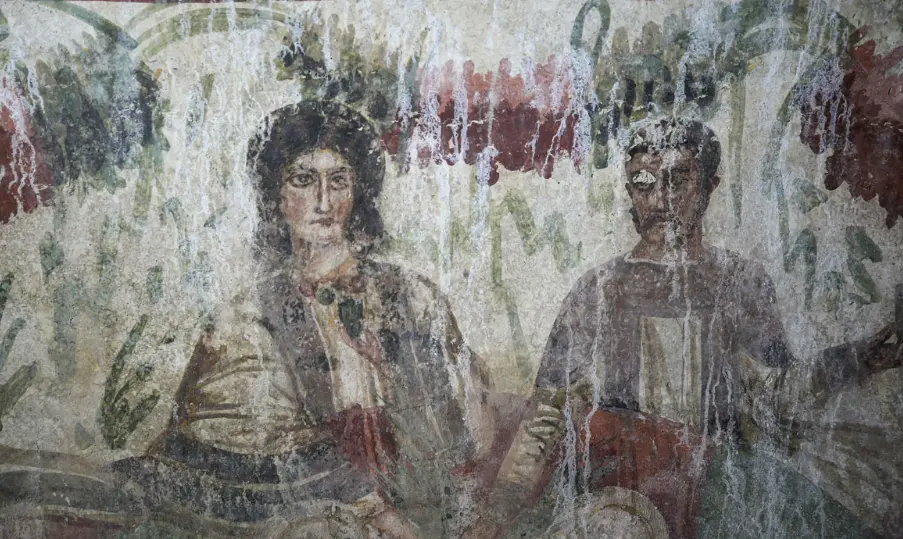
Other walls of the hypogeum are decorated with frescoes portraying the tomb’s owners, servants, birds, flowers, and symbolic images of paradise. The figures are dressed in elaborate garments and jewelry, suggesting the burial belonged to an aristocratic family.
A damaged section on the southern wall shows only the wing of a peacock, a known symbol of immortality in Early Christian art.
Burials and Human Remains
Inside the tomb, archaeologists uncovered two skeletons on the floor and three individuals placed on a kline, a raised funerary couch made from terracotta square slabs. The remains have been transferred to laboratories for detailed anthropological analysis.
Careful Conservation in Progress
Preserving the fresco is now the top priority. The excavation team is carefully removing lime and dust layers while stabilizing areas with paint loss. According to Prof. Dr. Meriç, once cleaning and conservation are completed, the fresco’s details will become significantly clearer.
Experts stress that this discovery holds major importance for both Türkiye and global Christian archaeology, offering rare insight into Early Christian burial traditions and iconography.
A Discovery That Rewrites History
The Good Shepherd Jesus fresco Iznik confirms that İznik played a much more significant role in Early Christian art and belief systems than previously understood. As studies continue, scholars expect the find to reshape interpretations of Christian imagery in Anatolia and strengthen İznik’s place on the world’s archaeological map.
