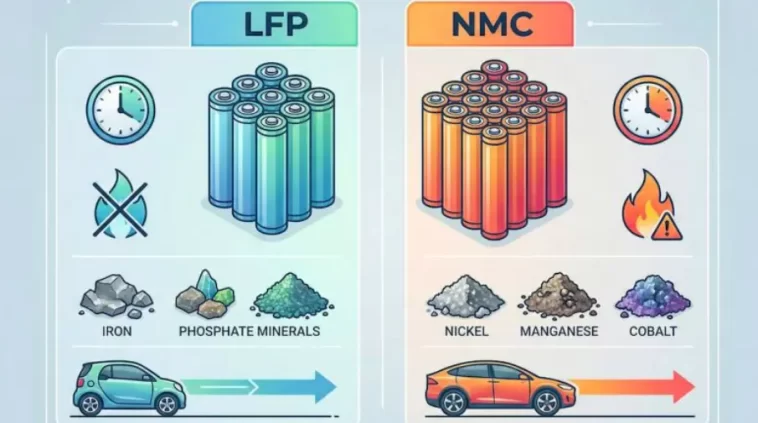
LFP vs NMC Battery Comparison is one of the most important topics for anyone thinking about buying an electric vehicle today. Two cars may look exactly the same on the outside, have similar range numbers on paper, and even share the same brand — yet the battery chemistry inside can completely change how that vehicle behaves, ages, and even how safe it is.
Unfortunately, many manufacturers do not clearly state which battery type they use. However, this detail is not a small technical footnote. It directly affects charging habits, long-term costs, safety, and daily usability. If you are planning to buy an electric car, understanding the difference between LFP and NMC batteries is essential.
Why the Battery Matters in Electric Cars
The battery is the heart of an electric vehicle. It determines range, charging speed, lifespan, and safety. Today, most electric vehicles use either NMC (Nickel Manganese Cobalt) batteries or LFP (Lithium Iron Phosphate) batteries.
While both are lithium-based, their characteristics are very different.
What Is an NMC Battery? (Nickel Manganese Cobalt)
NMC batteries are currently the most widely used battery type in electric vehicles. Almost all major manufacturers have relied on this chemistry for years.
Advantages of NMC Batteries
- High energy density
- Lighter battery packs
- Faster charging speeds
- Better performance for long-range vehicles
Because of their high energy density, NMC batteries allow manufacturers to create lighter cars with longer range using smaller battery packs.
Disadvantages of NMC Batteries
However, NMC batteries come with serious downsides:
- Higher fire risk if the battery is punctured or damaged
- More expensive to produce
- Shorter lifespan
- Contains cobalt and nickel, which are difficult to recycle
- Sensitive to full charging
Most manufacturers recommend charging NMC batteries only up to 80% for daily use. Charging to 100% regularly causes faster degradation.
On average, NMC batteries last 1,500 to 2,000 full charge cycles before noticeable capacity loss.
What Is an LFP Battery? (Lithium Iron Phosphate)
LFP batteries are gaining popularity, especially in newer electric vehicles. Brands like BYD now use LFP batteries across their entire new lineup, while models such as Tesla Model 3, Model Y, and MG ZS EV also use this technology.
Advantages of LFP Batteries
- Much safer, with extremely low fire risk
- Cheaper to produce
- Longer lifespan
- Supports 100% charging without damage
- No cobalt or nickel dependency
LFP batteries do not suffer from thermal runaway like NMC batteries. In safety tests, even when punctured, they generate very little heat. In one famous test, an egg placed on an LFP battery did not cook despite the battery being pierced.
These batteries typically last around 3,000 full charge cycles, and even after that, they can retain close to 90% capacity.
Disadvantages of LFP Batteries
- Lower energy density
- Heavier battery packs
- Slightly longer fast-charging times
- Battery percentage calculation can sometimes be inaccurate
To keep the battery management system calibrated, LFP batteries occasionally need a full discharge and full charge cycle.
Real-World Comparison: Same Car, Different Batteries
Let’s imagine a 500 km range, front-wheel-drive C-SUV.
With an NMC Battery
- Battery weight: ~400–500 kg
- Cost: ~$100 per kWh (80 kWh ≈ $8,000)
- Fast charging: 10–80% in 20–30 minutes
- Lighter, faster charging, better range efficiency
- Risky supply chain due to cobalt and nickel
With an LFP Battery
- Battery weight: ~470–600 kg
- Cost: ~$80 per kWh (80 kWh ≈ $6,400)
- Fast charging: 30–40 minutes
- Safer, cheaper, longer lifespan
- Slightly lower efficiency and heavier
Which Battery Is Better for You?
There is no single “best” battery — only the right battery for your needs.
- Choose NMC if you want:
- Maximum range
- Faster charging
- Lighter vehicle weight
- Choose LFP if you want:
- Long-term durability
- Maximum safety
- Lower ownership cost
- Stress-free 100% charging
For most daily drivers, city users, and long-term owners, LFP batteries offer better value and peace of mind.
Final Thoughts
LFP vs NMC Battery Comparison is not just a technical discussion — it directly affects how your electric car will age, how safe it is, and how much it will cost you over time. As electric vehicles become more common, battery transparency will become even more important.
Before buying an electric car, always ask:
- What battery chemistry does it use?
- What are the charging recommendations?
- How long is the battery expected to last?
Knowing these answers can save you money, stress, and disappointment in the long run.
