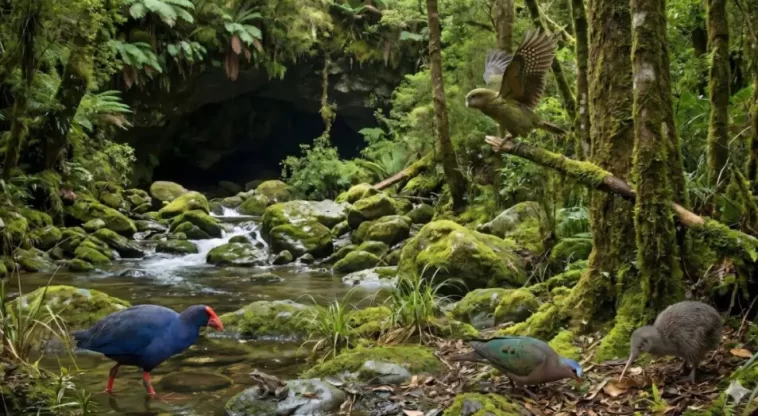
New Zealand cave fossils discovered deep beneath layers of volcanic ash are offering scientists an extraordinary look into a prehistoric world that existed long before humans arrived on the islands. Hidden inside a remote cave near the famous Waitomo region on New Zealand’s North Island, the findings reveal an ancient ecosystem frozen in time for nearly one million years.
The discovery is being described by researchers as one of the most important paleontological breakthroughs in New Zealand’s history. The fossils, found in what is known as the Moa Eggshell Cave, fill a massive gap in the country’s fossil record and challenge long-held beliefs about when and why species began disappearing from the region.
A Forgotten Cave With Extraordinary Secrets
Although the cave was first identified in the 1960s, it remained largely ignored for decades, overshadowed by more accessible and visually striking cave systems nearby. Only in recent years did scientists decide to investigate deeper sediment layers that had never been fully explored.
What they uncovered surprised even seasoned paleontologists.
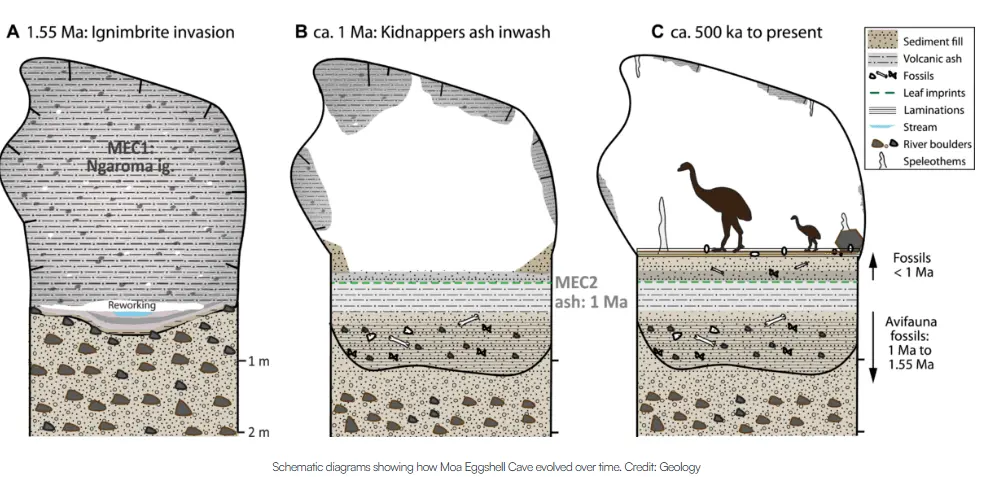
Buried beneath thick layers of volcanic ash were exceptionally well-preserved remains of birds, frogs, and other animals dating back between 1.55 million and 1 million years ago, during the Early Pleistocene epoch. Until now, no cave in New Zealand had ever produced vertebrate fossils from this period.
Researchers now say the site represents a “missing volume” in New Zealand’s natural history rather than just a missing chapter.
New Zealand Cave Fossils Reveal Ancient Biodiversity
The New Zealand cave fossils include remains from at least 12 bird species and four frog species, many of which were previously unknown to science. Several of these animals are early relatives of iconic New Zealand species still alive today, while others vanished long before humans ever set foot on the islands.
The fossils show that New Zealand once supported a far richer and more diverse ecosystem than previously believed, with forests and shrublands constantly reshaped by volcanic activity and shifting climates.
According to the research team, this biodiversity was far from stable.
Discovery of an Ancient Kākāpō Relative
One of the most remarkable finds is a newly identified species of parrot named Strigops insulaborealis, an ancient relative of the modern Kākāpō.
Today’s Kākāpō is known worldwide as a large, flightless, nocturnal parrot that climbs trees rather than flies. However, fossil evidence suggests its prehistoric ancestor lived very differently.
The leg bones of Strigops insulaborealis are noticeably weaker than those of the modern Kākāpō. This has led scientists to believe that the ancient parrot may not have been as skilled at climbing—and may even have retained the ability to fly.
If confirmed, this would significantly change scientists’ understanding of how and when flightlessness evolved in New Zealand’s birds.
Other Prehistoric Birds Found in the Cave
Beyond the ancient parrot, researchers uncovered fossils belonging to:
- An extinct ancestor of the Takahē, one of New Zealand’s most recognizable flightless birds
- A prehistoric pigeon closely related to modern Australian bronzewing pigeons
- Several bird species with no direct modern descendants
Together, these remains paint a picture of a dynamic and constantly changing ecosystem, shaped by forces far beyond human influence.
Volcanic Ash Preserved a Lost Ecosystem
What makes the discovery especially valuable is how precisely the fossils can be dated.
The remains were found sandwiched between two distinct layers of volcanic ash. One ash layer dates back 1.55 million years, while the other comes from a massive eruption roughly 1 million years ago. These eruptions blanketed large areas of the North Island in ash, sealing the cave’s contents like a time capsule.
Most ash deposits across the landscape were later eroded away, but caves like Moa Eggshell Cave preserved them intact.
This makes the site the oldest known fossil-bearing cave on New Zealand’s North Island.
New Zealand Cave Fossils Challenge Extinction Narratives
For decades, scientists believed that most of New Zealand’s extinctions occurred after human arrival roughly 750 years ago. While human activity certainly played a major role, the new evidence tells a more complex story.
Analysis of the New Zealand cave fossils shows that 33 to 50 percent of the species found in the cave were already extinct long before humans appeared.
According to researchers, powerful natural forces were responsible.
Climate Change and Super-Volcanoes Drove Early Extinctions
The study suggests that repeated super-volcanic eruptions and increasingly intense glacial–interglacial climate cycles caused frequent environmental disruptions. Forests expanded and contracted, habitats disappeared, and animal populations were repeatedly wiped out or replaced.
These dramatic changes forced species to adapt rapidly—or vanish.
Scientists say this cycle of extinction and replacement was already shaping New Zealand’s wildlife for more than a million years, long before people arrived.
Filling a 15-Million-Year Gap in the Fossil Record
One of the most important aspects of the discovery is how it bridges a massive gap in New Zealand’s fossil history.
Previous fossil sites, such as St Bathans in Central Otago, offered insights into life 20 to 16 million years ago. Until now, the period between then and one million years ago was largely undocumented.
The Moa Eggshell Cave fossils finally provide that missing link.
Researchers say this allows them to track how ancient species evolved, adapted, or disappeared over time—and how modern New Zealand wildlife came to be.
Why This Discovery Matters
The significance of the New Zealand cave fossils extends far beyond academic interest.
They help scientists:
- Understand long-term biodiversity loss
- Separate natural extinction events from human-driven ones
- Predict how modern ecosystems may respond to future climate change
By revealing how fragile ecosystems reacted to past environmental upheavals, the fossils offer valuable lessons for conservation today.
A Window Into New Zealand’s Deep Past
The Moa Eggshell Cave discovery is more than just a collection of ancient bones. It is a rare and vivid snapshot of a lost world—one shaped by fire, ice, and time.
As scientists continue to analyze the site, more discoveries are expected. Each fossil brings researchers closer to understanding how New Zealand’s unique wildlife evolved, survived, and sometimes vanished under forces far older than humanity itself.
What was once a forgotten cave has now become one of the most important keys to unlocking New Zealand’s deep natural history.
