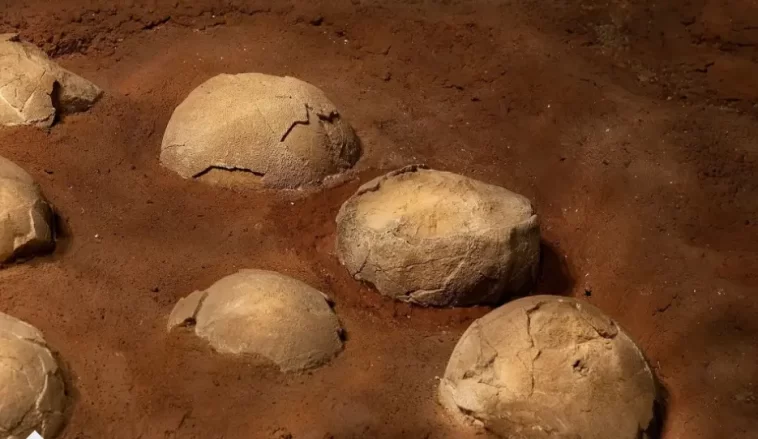
Ancient dinosaur eggs reveal exactly when fossils were buried across massive rock formations, offering scientists a powerful new way to date some of the world’s most mysterious fossil sites. Buried underground for nearly 95 million years, these fragile eggshells are now rewriting how paleontologists understand the timing of fossil burial and rock formation.
A groundbreaking study published in Nature Communications Earth & Environment shows that fossilized dinosaur eggshells can act as precise geological clocks. By analyzing the chemical signals locked inside their crystalline structure, researchers can determine when surrounding sediments hardened into rock—often with remarkable accuracy.
Why Dating Fossils Has Always Been So Difficult
Determining the exact age of dinosaur fossils has long been one of paleontology’s biggest challenges. Most dinosaur remains are found in sedimentary rock, which forms slowly over time as layers of sand, mud, and minerals build up. Unlike volcanic rock, sedimentary layers usually cannot be dated directly.
As a result, scientists have often relied on indirect methods, such as dating volcanic ash layers above or below fossil beds. While useful, these methods leave room for uncertainty, especially in regions where volcanic material is rare or absent.
The new research, led by paleontologist Ryan Tucker of Stellenbosch University, focuses on the microscopic structure of calcified eggshells. These shells are made of calcium carbonate crystals arranged in a highly ordered pattern.
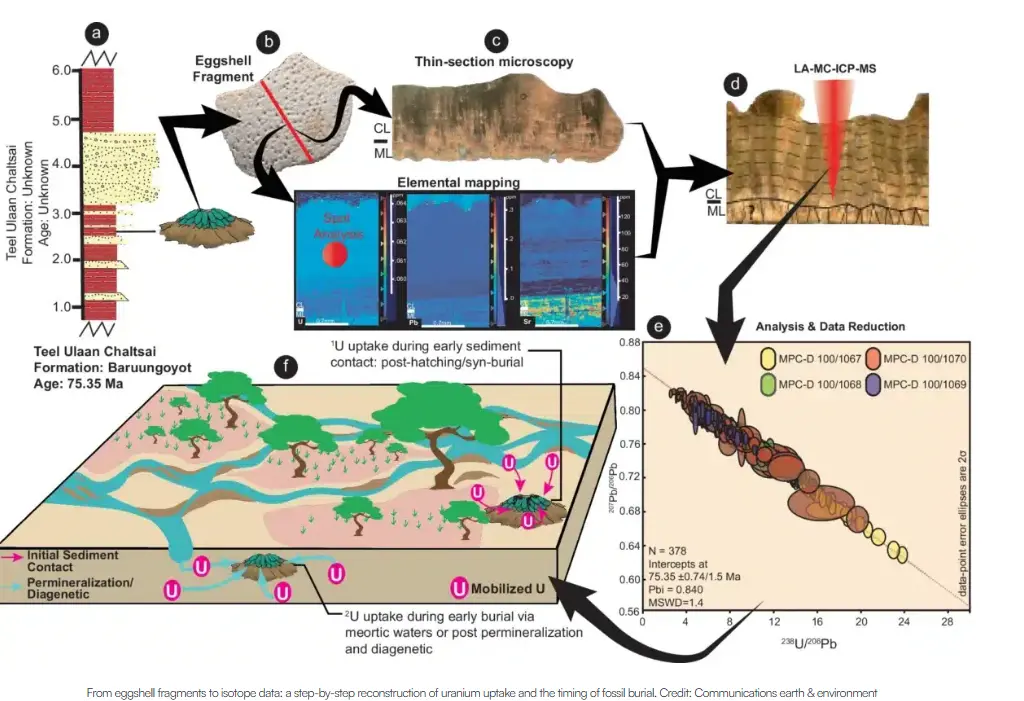
As sediments bury the eggs, chemical and physical changes—known as diagenesis—leave distinct traces inside the shell. Water movement, pressure, and tiny fractures all affect how uranium enters the eggshell over time. Crucially, once uranium is locked in place, it slowly decays into lead at a predictable rate.
By measuring the ratio of uranium to lead, scientists can calculate when the eggshell—and the surrounding sediment—was buried. This uranium-lead dating method can be used on materials ranging from one million years old to over four billion years old.
To test the reliability of this method, researchers analyzed dinosaur eggshells from two Cretaceous fossil sites thousands of kilometers apart.
The first site was Utah’s Cedar Mountain Formation, where eggs believed to belong to Macroelongatoolithus carlylei were found. This site already had well-dated volcanic ash layers, making it an ideal test case. Uranium-lead dating revealed the eggs were about 95 million years old, perfectly matching the ages of surrounding rock layers.
The second site was Teen Ulaan Chaltsai in Mongolia’s Eastern Gobi Basin. These eggs were likely laid by small, bird-like theropod dinosaurs called microtroodontids. Once again, eggshell dating closely matched previous estimates of the surrounding sediment.
A Surprising Clue From Space
One unexpected discovery came from trace element analysis of the Mongolian eggshells. The chemical signature suggested that meteor dust may have been present in the sediments at the time of burial, possibly linked to a meteor event around 99 million years ago.
Even if no direct impact occurred at the site, the finding shows how fossil beds can preserve evidence of global events—quietly recorded in microscopic mineral structures.
Why This Discovery Matters
According to the researchers, dinosaur eggshells could become one of the most reliable tools for dating terrestrial fossil sites from the Mesozoic and Cenozoic eras. This approach could finally resolve age debates for fossil beds where bones alone provide few answers.
Instead of relying solely on skeletal remains, scientists can now look to the shells that once protected developing embryos—tiny time capsules buried deep in stone.
As this technique is refined, ancient dinosaur eggs may help unlock the precise timeline of life on Earth, one fragile fragment at a time.
