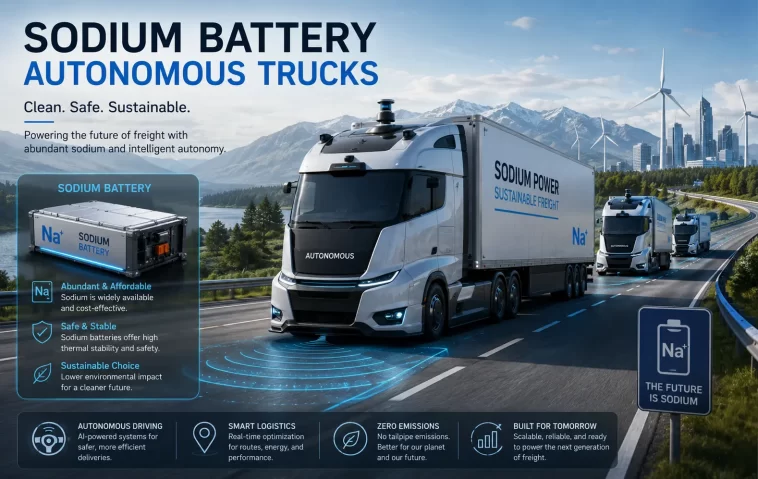
I never thought the shipping industry would be the place where I’d witness a genuine technological revolution. But standing in a freight terminal not long ago, watching a fully electric autonomous truck pull in silently, load up, and head out without a single human driver, I realized something important had changed. And the battery powering that truck wasn’t lithium. It was sodium.
The convergence of autonomous trucking and sodium-ion battery technology is reshaping logistics in ways that go far beyond incremental improvement. This is a structural shift — and if you work in freight, supply chain management, or fleet operations, you need to understand what’s coming.
What Are Sodium-Ion Batteries and Why Do They Matter for Trucks?
Sodium-ion batteries work on the same basic electrochemical principle as lithium-ion, but they use sodium instead of lithium as the charge-carrying element. Sodium is one of the most abundant elements on Earth — essentially derived from ordinary salt — which makes it dramatically cheaper and easier to source than lithium.
For years, sodium-ion technology stayed confined to research labs. That changed fast. By 2026, sodium-ion batteries have proven with hard data that they are not merely a “budget alternative” to lithium. They are a genuinely competitive technology that has completed a critical leap from technical breakthrough to real-world market validation.
The timing matters. Autonomous electric trucks need power systems that are reliable, affordable, and safe across wildly different operating conditions. Sodium-ion batteries check all three boxes in ways lithium simply cannot match at the same price point.
Why Sodium Batteries Are Built for Commercial Trucking
Cold Weather Performance That Changes Everything
One of the biggest headaches for electric truck fleets has always been cold weather. Lithium-ion batteries lose significant capacity when temperatures drop, and in some cases cannot be charged safely when partially frozen.
Sodium-ion batteries handle cold conditions on a completely different level. In extreme temperatures as low as -40°C, a sodium-ion battery maintains around 90% of its usable capacity. It also allows immediate charging even when completely frozen at -30°C — something lithium simply cannot do.
This eliminates one of the most frustrating winter operation challenges that commercial vehicle fleets in cold regions have struggled with for years. When lithium-ion cells are exposed to sub-freezing temperatures, their internal chemical activity slows dramatically, sometimes causing permanent capacity loss through a process called lithium plating on the anode. Sodium-ion chemistry largely avoids this problem entirely.
A Serious Safety Advantage
Fleet operators and logistics managers pay close attention to battery safety — and for good reason. Lithium-ion battery fires are notoriously difficult to extinguish and have caused major incidents at storage and distribution facilities.
Sodium-ion batteries carry a significantly lower risk of thermal runaway, which is the dangerous electrochemical chain reaction that causes battery fires. Because sodium ions are physically larger than lithium ions, they move more slowly through the cell, making rapid, uncontrolled temperature spikes far less likely.
Sodium-ion cells also show a higher thermal runaway initiation temperature, a lower self-heating rate, and stronger tolerance to abuse conditions such as puncturing, short-circuiting, and overcharging. For autonomous trucks operating without a human driver on board, this passive safety profile is not a minor feature — it is critical infrastructure-level reliability.
Lower Operating Costs Per Kilometer
Real-world truck testing is already producing compelling numbers. Field tests with sodium-powered heavy trucks have shown approximately 15% lower energy consumption per kilometer compared with lithium-ion equivalents. Deeper discharge capability has also enabled roughly 20% longer range under typical operating conditions.
When you multiply those savings across a fleet of hundreds of trucks running thousands of kilometers every week, the financial impact becomes substantial very quickly.
The Key Players Driving This Revolution
CATL and the Naxtra Platform
No company has done more to commercialize sodium-ion batteries for commercial vehicles than CATL — the world’s largest battery manufacturer by volume.
In April 2025, CATL launched its sodium-ion battery brand called Naxtra and confirmed that large-scale production had already begun. These products are engineered to operate across a temperature range of -40°C to 70°C and are offered in both passenger-vehicle formats and a 24V integrated battery solution specifically designed for heavy trucks.
By late 2025, CATL confirmed that its next-generation sodium-ion battery supports a pure-electric driving range of more than 500 kilometers and is ready for full mass production. The battery achieves an energy density of up to 175 Wh/kg and has passed China’s latest national safety standard for electric-vehicle traction batteries.
The 2026 commercial rollout is not a concept or a roadmap. CATL has described expanded deployments across battery swap systems, passenger vehicles, commercial vehicles, and large-scale energy storage — all moving simultaneously.
The World’s First Certified Sodium Battery for Commercial Vehicles
CATL’s 45 kWh sodium-ion battery for light trucks and vans boasts a cycle life exceeding 10,000 cycles. It is the world’s first battery to receive certification under the new GB 38031-2025 national safety standard.
To put that cycle life in perspective: a delivery truck completing two full charge-discharge cycles per day would take nearly 14 years to reach that limit. That kind of longevity dramatically reduces total cost of ownership for fleet operators.
HiNa Battery and the Road to Cost Parity
HiNa Battery, backed by JAC Group, is among the most aggressive players pushing sodium-ion technology into the commercial vehicle market. Their real-world truck tests have generated hard performance data supporting claims of superior range and efficiency compared to lithium alternatives.
Industry analysts now project that sodium batteries could rival lithium-ion on cost by 2027, with the 2027–2028 window emerging as the key inflection point for widespread adoption as pricing alignment and industrial scaling accelerate together.
How Autonomous Trucking and Sodium Batteries Work Together
You might wonder why these two technologies are being discussed in the same breath. The answer is straightforward: autonomous trucks create different power and operational demands than human-driven ones, and sodium-ion batteries happen to be exceptionally well suited to meet those demands.
Here is what you need to understand about how these two technologies reinforce each other:
Predictable Route Optimization
Autonomous trucks follow algorithmically optimized routes with highly consistent energy consumption patterns. This predictability plays directly to sodium-ion’s strengths — its stable discharge curve and long cycle life mean the battery management system can operate at peak efficiency with minimal waste.
Safer Unmanned Operation
When a truck is operating without a human driver, the consequences of a battery fire or sudden power failure are severe. Sodium-ion’s lower thermal runaway risk and inherent chemical stability make it a far better fit for driverless operations than high-energy-density lithium chemistries.
Battery Swap Compatibility
CATL’s plans for nationwide battery swap infrastructure pair naturally with autonomous trucking. A self-driving truck can pull into a swap station, exchange a depleted pack for a fully charged one in minutes, and return to the road — all without human involvement. This model significantly reduces downtime compared to waiting for a full charge.
Fleet Scalability
The lower raw material cost of sodium-ion batteries means fleet operators can scale faster. Sodium is extracted from seawater and salt deposits that exist on every continent. Unlike lithium, which is concentrated in a handful of countries, sodium supply chains are geographically diversified and far more stable.
What This Means for the Global Logistics Industry
Transit Times and Operating Costs Are Falling
The United States launched its first fully autonomous freight corridor in early 2024, connecting major distribution hubs in Texas and California. The results were immediate: a 25% reduction in transit times and a 30% reduction in operational costs along that corridor.
FedEx reported cost savings exceeding $200 million annually after deploying Aurora-powered autonomous trucks in long-haul logistics. Amazon’s implementation of autonomous trucks for regional delivery routes reduced delivery times by 20% while cutting carbon emissions by 35%.
These are not pilot program numbers. These are real commercial results from real deployments.
Carbon Emissions Are Dropping Significantly
The combination of electric powertrains and optimized autonomous routing is delivering meaningful emissions reductions across freight networks. Autonomous systems eliminate the fuel waste caused by human driving variability — hard acceleration, suboptimal speeds, unnecessary idling — while sodium-ion batteries offer a cleaner supply chain than lithium, which requires intensive mining of cobalt, nickel, and lithium from environmentally sensitive regions.
Infrastructure Is Catching Up
Smart freight infrastructure is being built around autonomous electric trucks. Cellular Vehicle-to-Everything (C-V2X) platforms now provide real-time updates about traffic signals, construction zones, and pedestrian crossings. Smart traffic lights along key freight corridors have reduced idling times and cut fuel consumption by up to 15% on some routes.
The Self Drive Act of 2026 in the United States addresses regulatory fragmentation by enabling limited commercial operations during testing phases, allowing revenue generation while preempting inconsistent state-level bans on autonomous vehicles.
What You Should Know If You Work in Logistics
If you manage a fleet, run a distribution network, or make procurement decisions for transportation infrastructure, here are the practical takeaways you need to act on now:
- Evaluate sodium-ion options for cold-climate fleets first. The cold-weather advantage is immediate and measurable. If your trucks operate in regions with harsh winters, sodium-ion batteries can reduce heating costs, eliminate cold-start failures, and extend daily operational windows.
- Start modeling total cost of ownership, not just purchase price. Sodium-ion batteries have longer cycle lives and lower maintenance overhead than many lithium alternatives. A 10,000-cycle battery changes the financial math on fleet replacement cycles.
- Monitor battery swap network expansion. CATL has announced plans for more than 3,000 Choco-Swap stations across 140+ cities. If your routes intersect with that network, battery swap could replace charging downtime almost entirely.
- Pay attention to the regulatory environment. New UN battery regulations for sodium-ion are rolling out through 2025 and 2026. Companies that pre-adopt compliance labeling and documentation processes avoid delays and penalties that are catching slower-moving competitors off guard.
- Prepare your workforce for the transition. Autonomous trucking does not mean zero human involvement — it means humans move into dispatch, monitoring, maintenance, and exception-handling roles. Training your existing team now is far less expensive than hiring externally when the transition arrives.
The Challenges That Still Exist
It would not be accurate to present this technology as without obstacles. Sodium-ion batteries still have lower energy density than high-end lithium-ion cells — approximately 175 Wh/kg for sodium versus up to 255 Wh/kg for premium lithium NMC chemistries. For applications where maximum range per kilogram is the priority, lithium still holds an advantage.
Large-scale production is also still ramping up. As of 2025, sodium-ion production represented less than 1% of total global battery output compared to lithium-ion. Supply chains are maturing but are not yet as deep or as reliable as the lithium ecosystem built over two decades.
Regulatory frameworks for fully driverless commercial vehicles also remain inconsistent across different countries and regions. Autonomous trucking companies are operating in a complex legal environment that requires careful navigation market by market.
None of these challenges are fundamental blockers — they are scaling problems that well-funded, well-run companies are solving in real time. But they are worth understanding clearly before making fleet investment decisions.
Frequently Asked Questions (FAQ)
What is a sodium-ion battery and how is it different from lithium-ion?
A sodium-ion battery uses sodium as its charge-carrying ion instead of lithium. Sodium is far more abundant and cheaper than lithium, which brings down material costs. While current sodium-ion cells have slightly lower energy density than premium lithium-ion, they outperform lithium in cold weather, safety, and long-term cycle durability.
Are sodium-ion batteries already being used in trucks?
Yes. CATL began mass production of sodium-ion batteries specifically designed for light trucks and vans in 2025. Its Tianxing and Naxtra product lines include 24V integrated solutions for heavy trucks, with full commercial-scale deployment across multiple vehicle categories underway in 2026.
How do autonomous trucks benefit from sodium-ion batteries specifically?
Autonomous trucks operate without drivers, which makes battery safety and reliability especially critical. Sodium-ion batteries have a lower thermal runaway risk, more stable discharge characteristics, and better performance in extreme temperatures — all of which directly support safe, unattended operation.
Will sodium-ion batteries eventually replace lithium-ion in logistics?
Not entirely. The two technologies are expected to coexist, with sodium-ion becoming the preferred choice for cost-sensitive applications, cold-climate fleets, and short-to-medium-range delivery operations. Lithium-ion will likely remain dominant for premium long-range applications where energy density is the top priority.
What is the expected range of an autonomous electric truck with sodium-ion batteries?
CATL’s next-generation sodium-ion cells support a driving range of more than 500 kilometers per charge in passenger vehicle applications. For heavy commercial trucks, real-world range depends on load and route, but sodium-ion’s deeper discharge capability and lower energy consumption per kilometer are showing 20% range improvements over lithium equivalents in field tests.
How soon will sodium battery autonomous trucks become mainstream?
Industry analysts and battery manufacturers point to 2026 as the year sodium-ion technology moves from early adoption to mainstream commercial deployment. Cost parity with lithium-ion is projected for the 2027–2028 window. Combined with rapid autonomous trucking expansion, the mid-2020s are shaping up as the defining transition period for freight logistics globally.
Is the infrastructure ready for autonomous sodium-ion truck fleets?
Infrastructure is catching up quickly. Battery swap networks, smart freight corridors, V2X communication systems, and supportive legislation are all advancing simultaneously. Companies entering the market now are well-positioned to benefit as that infrastructure matures over the next two to three years.
The Road Ahead
The logistics industry has always evolved through technology — from steam-powered rail to diesel engines to GPS-guided routing. What is happening now is the next step in that progression, and it is arriving faster than most people in the industry expected.
Sodium-ion batteries and autonomous trucks are not two separate trends running in parallel. They are two components of a single transformation that is redefining what freight transportation can look like — quieter, safer, cheaper, and dramatically more reliable across all climates and conditions.
If you manage a fleet or make decisions about transportation infrastructure, the question is no longer whether this transition is coming. The question is whether you will lead it or scramble to catch up with it.
