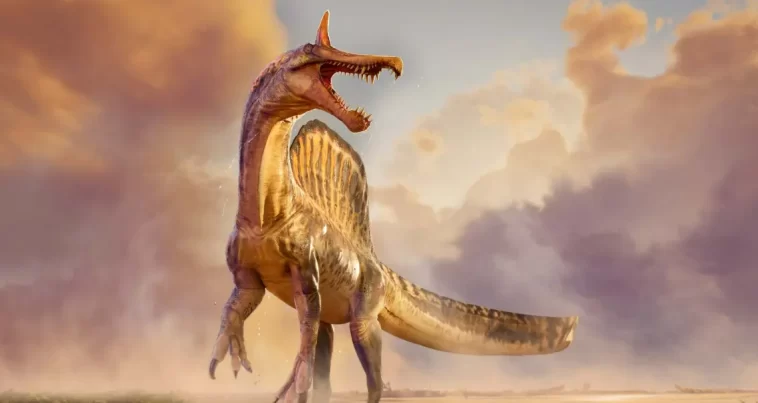
Spinosaurus mirabilis has entered the scientific record as one of the most extraordinary dinosaur discoveries of recent years. Unearthed deep within the Sahara Desert, this newly identified species is unlike any Spinosaurus ever documented, thanks to a dramatic blade-like crest rising from its skull. The find is reshaping how researchers understand the evolution, behavior, and habitat of one of the most mysterious predators to have ever lived.
A Remarkable Find in an Unlikely Place
Spinosaurus mirabilis was discovered at a remote fossil site in Niger, hundreds of kilometers from today’s coastline. This detail alone surprised paleontologists, as most known Spinosaurus fossils have been linked to coastal or delta environments. The Sahara location, now dry and unforgiving, was once a lush river system during the Late Cretaceous period around 95 million years ago.
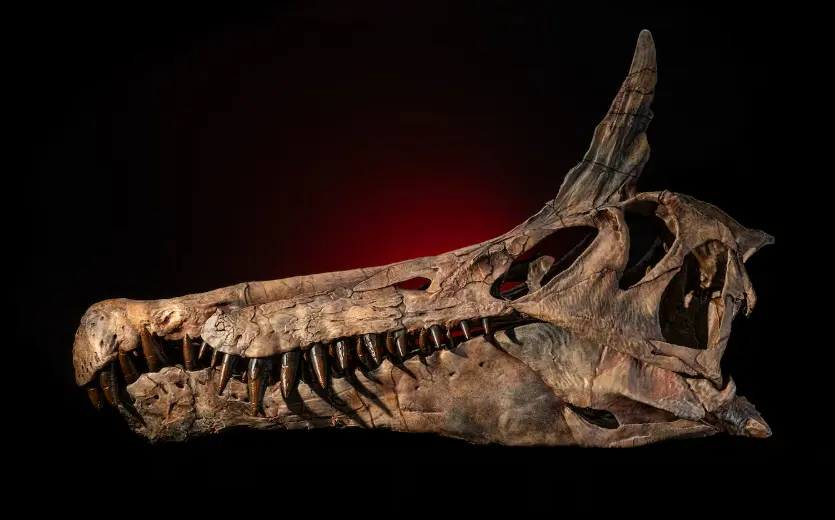
The discovery began when a curved, sword-like bone was spotted emerging from the sand. At first glance, it looked like a vertebra. Closer inspection revealed something far more unusual: a cranial crest, shaped like a scimitar, that would have sat prominently atop the dinosaur’s skull.
What Makes Spinosaurus mirabilis Unique?
While other members of the spinosaur family are known to have subtle crests or ridges, Spinosaurus mirabilis displays a skull ornament unlike anything seen before in this group. The crest is tall, sharply curved, and likely extended even higher in life due to a keratin covering, similar to the beaks or headgear seen in some modern birds.
Key distinguishing features include:
- A long, narrow snout filled with interlocking, cone-shaped teeth
- A prominent scimitar-like skull crest
- Dense bones suggesting adaptation to water
- Physical traits linked to fish-eating and river-based hunting
These traits strongly suggest that Spinosaurus mirabilis lived a semi-aquatic lifestyle, spending much of its time along rivers and floodplains.
Life Along Ancient Rivers
The fossil site where Spinosaurus mirabilis was found also contained remains of freshwater fish, crocodiles, turtles, and long-necked sauropod dinosaurs. This mix paints a picture of a thriving river ecosystem, not unlike parts of the modern Nile.
Researchers believe this Spinosaurus species hunted large fish by wading into shallow water, using its long snout and specialized teeth to trap slippery prey. Unlike typical theropod dinosaurs, its upper and lower teeth interlocked, forming what scientists describe as a “fish trap.”
The Purpose of the Crest
One of the biggest questions surrounding Spinosaurus mirabilis is the function of its striking head crest. While it may look intimidating, scientists do not believe it was used for combat.
Instead, the leading theories suggest the crest played a role in:
- Visual communication
- Display for attracting mates
- Intimidation of rivals
- Species recognition in crowded river habitats
Bright colors may have covered the keratin sheath, making the animal highly visible from long distances along open riverbanks.
Revisiting the Spinosaurus Swimming Debate
The discovery of Spinosaurus mirabilis has reignited a long-running debate: could Spinosaurus swim? Some researchers argue that its dense bones and fin-like tail suggest it was capable of active swimming. Others believe it was more of a wader, similar to a massive heron, stalking prey in shallow water.
This new species adds important data to the discussion. Its inland habitat supports the idea that Spinosaurus were not limited to coastal environments and were highly adaptable predators.
Why This Discovery Matters
Spinosaurus mirabilis is more than just a new name on the dinosaur family tree. It highlights how much remains undiscovered, especially in underexplored regions like the Sahara. The find also shows that dinosaur diversity in Africa during the Late Cretaceous was far greater than previously understood.
According to experts not involved in the research, discovering multiple individuals of a new species in one site is extremely rare and provides a valuable window into prehistoric ecosystems.
A Window Into a Lost World
Today, the Sahara is known for endless sand and extreme heat. But the fossils of Spinosaurus mirabilis tell a very different story—one of flowing rivers, dense vegetation, and giant predators ruling the waterways.
As research continues, scientists hope to learn more about how this remarkable dinosaur lived, moved, and interacted with its environment. Each new bone adds another piece to the puzzle of one of Earth’s most unusual carnivores.
