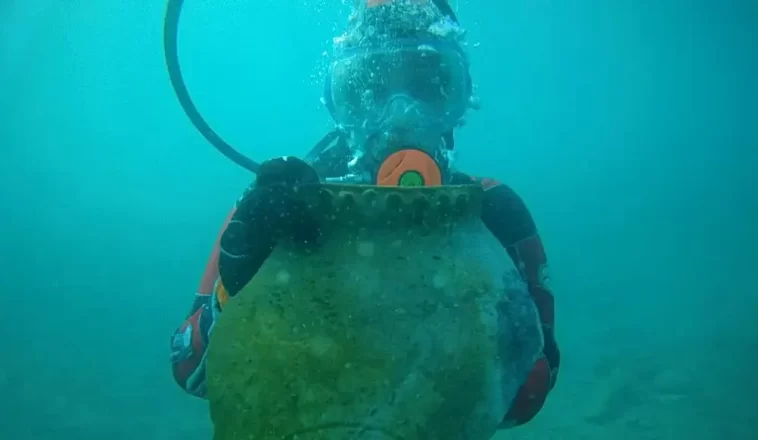
Archaeologists have made an incredible discovery beneath the waters of Lake Issyk-Kul in northeastern Kyrgyzstan: the remarkably preserved remains of a major medieval city. This sunken settlement, known as Toru-Aygyr, was once a vital, multi-cultural hub on a key branch of the legendary Silk Road connecting China with the West. The city’s flourishing era came to a devastating and sudden halt in the early 15th century when a massive earthquake plunged it beneath the lake’s surface—a tragedy researchers are comparing to the fate of Pompeii.
The discovery, announced by the Russian Geographical Society, sheds new light on the rich, but often turbulent, medieval history of Central Asia, particularly the transition period when Turkic groups embraced Islam.
🏰 A Thriving Medieval Commercial Hub
The remains of Toru-Aygyr were found in the shallow, mildly saline waters of Lake Issyk-Kul, one of the world’s deepest lakes, near its northwest shore. The joint Russian-Kyrgyz expedition explored four submerged areas, at depths ranging from just 1 to 4 meters, revealing evidence of a large, organized commercial center.
Key findings at the site include:
- Architectural Remains: Fragments of buildings constructed with kiln-fired bricks, collapsed stone structures, and wooden beams.
- Industrial Evidence: The discovery of a millstone inside one structure strongly suggests the city housed a grain mill, vital for feeding a large commercial population and traveling merchants.
- Public Structures: Ruins of a large building with exterior decorations were found, which researchers believe may have been a public structure like a mosque or a madrasa (Islamic school).
The city’s existence confirms the immense strategic importance of this section of the Silk Road, which funneled goods, people, and ideas between East Asia and Europe for centuries.
🕌 Traces of a Religious and Cultural Crossroads
Before its sudden demise, the city of Toru-Aygyr stood at a crossroads of cultures and religions. According to researchers, when the city was first established before the 13th century, its inhabitants practiced a mix of faiths, including Tengrianism (a traditional Turkic and Mongolian religion), Buddhism, and Nestorian Christianity.
However, the city’s character shifted profoundly with the arrival and spread of Islam. The archaeological team uncovered an approximately 6-hectare Muslim cemetery (necropolises) dating back to the 13th or 14th century.
- Islamic Burial Tradition: Two individuals excavated from the necropolis were found to be buried with their faces oriented towards Mecca (the Qibla), confirming the adoption of Islamic burial practices.
- Ceramics and Artifacts: The discovery of medieval Muslim pottery, including a large, intact water jar (khum), further attests to the established Islamic culture in the later period of the city.
The historical context places the settlement under the control of the Karahanlılar (Qarakhanid Khanate), the first Turkic dynasty in Central Asia to fully embrace Islam, starting in the 10th century. By the 13th century, the region was influenced by the Altın Orda (Golden Horde), a powerful Turkicized Mongol state, which played a major role in the continued institutionalization of Islam in the area. These archaeological layers provide a physical timeline showing the gradual, yet significant, transition of the region from its earlier faiths to a predominantly Muslim character.
🌋 The Earthquake that Sunk a City
The key takeaway from the investigation is the dramatic cause of the city’s demise. The evidence points to a massive earthquake in the early 15th century, which violently shook the Tian Shan mountains and caused the settlement to submerge completely beneath the rising lake water.
Archaeologist Valerii Kolchenko noted the severity of the event, stating that the catastrophe is comparable to the destruction of Pompeii, where an entire functioning city was instantly wiped from the map and buried. This sudden disaster not only destroyed Toru-Aygyr but fundamentally altered the region’s demography, leading to a decline in settled urban culture and a rise in nomadic communities along the shores of Issyk-Kul.
The research team plans further investigations and underwater drilling to extract sediment cores, which will help them reconstruct the full history of the city’s development and the specific geological events that led to its sensational sinking.
