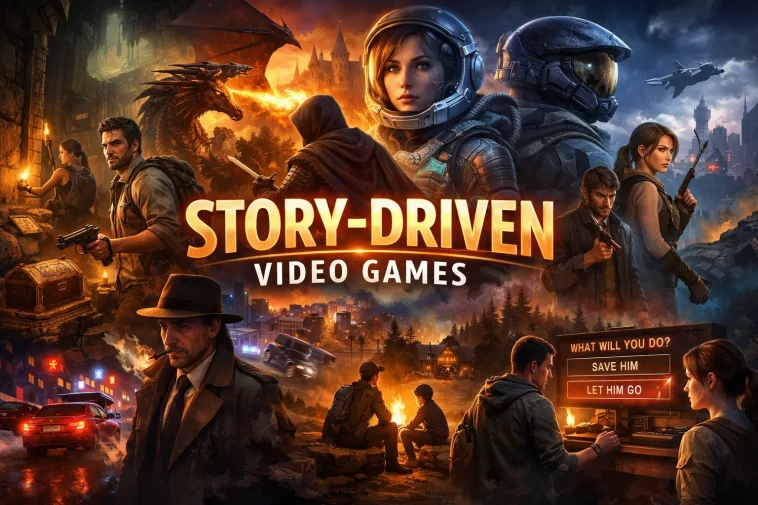
I’ve played thousands of hours of video games across my life, but only a handful have ever made me put the controller down and just sit in silence for a moment when the credits rolled. Red Dead Redemption 2 did it. The Last of Us did it. Disco Elysium did it twice. There’s something that happens in the best story-driven games that no other medium quite replicates — you’re not just watching the story unfold, you’re living inside it. Every choice you make, every character you meet, every world you walk through becomes personal in a way that films and books can’t fully achieve.
If you’re looking for games that genuinely move you, challenge how you think, or simply refuse to leave your memory long after you’ve finished them, this list was built for you. Below are the 50 best story-driven video games ever made — across all genres, all eras, and all platforms.
What Makes a Great Story-Driven Game?
Before getting into the list, it helps to understand what separates a good narrative from an unforgettable one. Strong story games share a few common traits:
- Characters you genuinely care about — not just protagonists you control, but fully realized people with flaws, histories, and real emotional arcs
- A world that feels lived-in — where the setting itself tells a story without dialogue or cutscenes
- Choices that carry weight — whether moral dilemmas, relationship decisions, or irreversible consequences
- Themes that linger — stories that ask real questions about identity, loss, loyalty, power, or what it means to be human
Not every game here is a walking simulator or a visual novel. Many are action games, shooters, and RPGs first. What they all share is a commitment to narrative excellence that elevates them above their genre peers.
The Top 50 Best Story-Driven Video Games
1. Red Dead Redemption 2 (2018)
Developer: Rockstar Games | Platform: PS4, Xbox One, PC
Red Dead Redemption 2 is the closest video games have come to producing a Great American Novel. You play as Arthur Morgan, an outlaw in a dying gang during the twilight of the American frontier, watching the world he built his identity around slowly crumble into something he no longer recognizes. The story is a meditation on loyalty, redemption, and inevitability — themes delivered through one of the most deeply realized open worlds ever built.
What sets it apart from every other open-world game is how the world breathes around you. Strangers appear on the road with full stories of their own. The gang camp feels genuinely alive. Arthur’s journal entries evolve with the story. Every detail pushes the narrative forward, and the final act hits with an emotional weight that very few games — or films — have matched.
2. The Last of Us (2013)
Developer: Naughty Dog | Platform: PS3, PS4, PC
The Last of Us redefined what people expected from video game storytelling. Set in a post-pandemic America overrun by infected, it follows Joel — a hardened survivor — and Ellie, a teenage girl who may hold the key to a cure. What sounds like a zombie survival story is really a devastating portrait of grief, parenthood, and the lengths people will go to protect someone they love.
The relationship between Joel and Ellie is the engine of everything. The gameplay reinforces the desperation of the story. And the ending — one of the most debated in gaming history — refuses to offer easy moral comfort. It is a game that treats its audience as adults, and it changed the industry because of it.
3. The Witcher 3: Wild Hunt (2015)
Developer: CD Projekt Red | Platform: PS4, Xbox One, Switch, PC
The Witcher 3 is the gold standard for open-world RPG storytelling. Playing as Geralt of Rivia — a gravel-voiced monster hunter searching for his adoptive daughter Ciri — you navigate a war-ravaged world full of political intrigue, morally ambiguous choices, and consequences that ripple across the entire game. The famous Bloody Baron questline alone is considered one of the finest pieces of narrative design in RPG history.
What makes The Witcher 3 extraordinary is how it handles moral complexity. There are no clean villains and no pure heroes. Almost every major decision comes with costs, and the game’s multiple endings feel genuinely earned based on choices made hours earlier. The Blood and Wine expansion adds another full-scale narrative that many players consider better than most standalone games.
4. Disco Elysium (2019)
Developer: ZA/UM | Platform: PC, PS4, PS5, Xbox
Disco Elysium may have the best writing of any video game ever made — full stop. You play as a detective who woke up in a hotel room with no memory of who he is, tasked with solving a murder in a crumbling harbor city. But the investigation is almost secondary to the internal monologue happening inside your character’s own fractured mind, represented by 24 skill voices that argue, taunt, and philosophize about every decision you make.
It tackles politics, ideology, addiction, failure, and regret with a literary intelligence rarely seen in any medium. The game asks you to define who your detective is from scratch, and what emerges is one of the most personal, strange, and unforgettable narrative experiences in gaming history.
5. God of War (2018)
Developer: Santa Monica Studio | Platform: PS4, PC
Taking one of gaming’s most one-dimensional characters — a rage-fueled demigod who killed every Greek god in sight — and turning him into a grieving father navigating his own trauma was a narrative risk that paid off spectacularly. Kratos and his son Atreus travel through Norse mythology to scatter the ashes of his late wife at the highest peak in the realm. What unfolds is a quietly powerful story about fatherhood, vulnerability, and generational anger.
The decision to shoot the entire game in a single continuous take — no cuts, no loading screens disguised as cutscenes — makes it feel unlike any other game. The reveal of Atreus’s true identity, and Kratos’s private moments of grief, are among the most human moments the medium has produced.
6. Planescape: Torment (1999)
Developer: Black Isle Studios | Platform: PC
Ask any writer what the greatest video game story ever told is, and a substantial number will say Planescape: Torment. You play as the Nameless One — an immortal amnesiac covered in scars and tattoos, slowly uncovering the lives he has lived across countless deaths. The central question of the game — “What can change the nature of a man?” — haunts every conversation and every revelation from beginning to end.
The writing is extraordinary in a way that the term “video game writing” doesn’t do justice. It’s philosophical, literary, funny, and heartbreaking. No other game has used mortality, identity, and regret as its core mechanical and narrative framework with anything close to the same result.
7. Mass Effect 2 (2010)
Developer: BioWare | Platform: PC, PS3, Xbox 360
Mass Effect 2 is the perfect middle act of an epic trilogy. You assemble a crew of deeply flawed, genuinely compelling characters for a suicide mission against an unstoppable alien threat — and the genius of the game is that anyone can die. The loyalty missions that develop each crew member’s backstory are some of the finest character writing BioWare ever produced. By the time the final mission begins, you’re not managing a squad, you’re protecting people you care about.
The Suicide Mission itself remains the single best finale in RPG history — a perfectly designed sequence where every prior decision compounds into a moment of genuine emotional stakes. Characters you’ve spent 30 hours with can die, and their deaths feel real.
8. BioShock (2007)
Developer: Irrational Games | Platform: PC, PS3, Xbox 360
“Would you kindly?” Three words that changed how players thought about narrative agency in video games forever. BioShock’s underwater dystopian city of Rapture — a failed Objectivist utopia drowning in its own ideology — is one of the greatest settings in gaming history. The story delivers a masterclass twist that recontextualizes everything the player has done up to that point, making them a participant in the narrative rather than just a witness.
Beyond the famous twist, BioShock explores what happens when a society takes a single philosophy to its absolute extreme. It’s a game with genuine ideas, and it earns every comparison to George Orwell and Ayn Rand.
9. The Last of Us Part II (2020)
Developer: Naughty Dog | Platform: PS4, PS5
Possibly the most divisive game on this list — and one of the most ambitious. The Last of Us Part II takes every expectation built by the first game and deliberately subverts them to force players into uncomfortable empathy. It cycles between multiple perspectives, makes you play as characters you resent, and refuses to let you off the hook for your own desire for revenge.
The story explores grief and cycles of violence with a psychological intensity that felt genuinely unprecedented in a major commercial game. Whether you love or hate its conclusions, it’s impossible to deny the craft behind its construction.
10. Silent Hill 2 (2001)
Developer: Konami | Platform: PS2, Xbox, PC
Silent Hill 2 is a horror game built entirely around guilt. James Sunderland travels to the fog-shrouded town of Silent Hill after receiving a letter from his wife — who has been dead for three years. The monsters he encounters aren’t random demons. They’re manifestations of his own psychological state, designed to reflect truths he’s suppressing.
The game communicates through atmosphere, symbolism, and ambiguity in a way that most horror films never manage. Its final revelation is one of the most effective gut-punches in storytelling history, made powerful specifically because the gameplay led you toward it slowly and with full deniability.
11. Chrono Trigger (1995)
Developer: Square | Platform: SNES, DS, PC
One of the greatest time-travel stories ever told — in any medium. Chrono Trigger sends a group of friends across multiple historical epochs to prevent an apocalypse, and its multiple endings, New Game+ system, and genuine emotional warmth made it a landmark in RPG storytelling. The moment at the Millennial Fair, the tragedy of Lucca’s backstory, and Magus’s arc are all handled with a care and emotional precision rare in 1995 — or any year.
12. Final Fantasy VII (1997)
Developer: Square | Platform: PS1, PC, modern ports
Final Fantasy VII was many Western players’ introduction to the idea that video games could carry real emotional weight. Cloud’s unreliable memory, Aerith’s fate, and Sephiroth’s descent from hero to catastrophe were handled with a narrative complexity the medium hadn’t widely attempted before. The game’s themes of corporate environmentalism, identity trauma, and found family resonated with players in ways they weren’t expecting and haven’t forgotten since.
13. Persona 5 Royal (2019)
Developer: Atlus | Platform: PS4, Switch, PC, Xbox
Persona 5 Royal is a 100-hour RPG about a group of high school students who steal the corrupted desires from the hearts of adults abusing their power. The Phantom Thieves operate in the Metaverse — a surreal parallel world where repressed desires take physical form — while navigating real-life social pressures, school, and relationships in Tokyo’s Shibuya district.
What makes it narratively exceptional is how seamlessly the gameplay mechanics reinforce the themes. You’re literally dismantling the psychological walls of oppressive authority figures, and the game never lets you forget the human cost of that.
14. Fallout: New Vegas (2010)
Developer: Obsidian Entertainment | Platform: PC, PS3, Xbox 360
Set in a post-nuclear Mojave Desert, New Vegas is a masterclass in faction-based storytelling. You’re a courier who survives a bullet to the head and wakes up in a world where four competing factions are fighting for control of the Hoover Dam — each with a legitimately compelling ideology and vision for the future. The game doesn’t tell you who’s right. It forces you to decide, and it respects your decision either way.
The writing is sharp, the characters are memorable, and the world feels like it existed long before you arrived in it — which is exactly what great worldbuilding should do.
15. Nier: Automata (2017)
Developer: PlatinumGames | Platform: PS4, Switch, PC, Xbox
Nier: Automata uses its multiple playthrough structure to deliver a philosophy lecture disguised as an action game. The story follows androids 2B and 9S fighting a war against machine lifeforms on behalf of humanity — until the foundations of that premise begin to crack. Each playthrough reveals new perspectives, new truths, and a deeper layer of existential despair about purpose, consciousness, and what makes a life worth living.
The “true ending” — which requires completing the game multiple times — is one of the most emotionally devastating conclusions in gaming, made more powerful by the journey required to reach it.
16. God of War Ragnarök (2022)
Developer: Santa Monica Studio | Platform: PS4, PS5, PC
The follow-up to God of War deepened everything that made the 2018 game great. Kratos and Atreus navigate a fractured relationship as they approach the inevitability of Ragnarök — the Norse apocalypse. The emotional intelligence of the writing is remarkable, exploring what it means to break cycles of violence and choose a different path than the one fate has assigned you.
17. Hades (2020)
Developer: Supergiant Games | Platform: PC, Switch, PS4, PS5, Xbox
Hades proved that narrative and roguelike design weren’t mutually exclusive. Playing as Zagreus — son of the god of the dead — you attempt escape from the Underworld through repeated runs, each death returning you to your father’s house where the story advances through conversation. Every run teaches you something new about the characters, and relationships develop organically across dozens of attempts.
The writing is warm, witty, and genuinely moving in its portrayal of family dysfunction played out across mythological scale.
18. What Remains of Edith Finch (2017)
Developer: Giant Sparrow | Platform: PS4, Xbox One, Switch, PC
A two-hour walking sim that hits harder than most 30-hour epics. Exploring the Finch family home, you discover the stories of each family member’s death — each told through a completely different gameplay mechanic that perfectly reflects the character’s inner world. It’s a meditation on mortality, memory, and the stories families tell themselves. Few games in history have used their medium so specifically and so beautifully.
19. Spec Ops: The Line (2012)
Developer: Yager Development | Platform: PC, PS3, Xbox 360
Deliberately packaged to look like a generic military shooter, Spec Ops: The Line is actually a psychologically devastating adaptation of Joseph Conrad’s Heart of Darkness. As Captain Martin Walker leads his squad through a ruined Dubai, the story forces players to confront the atrocities they’re committing while the game cheerfully asks them to keep shooting. The famous white phosphorus scene remains one of the most confrontational moments in interactive storytelling.
It’s a game that uses the tropes of its genre against the player, making them feel complicit in ways that linger long after the credits roll.
20. Life is Strange (2015)
Developer: Dontnod Entertainment | Platform: PC, PS4, Xbox One, Switch
Life is Strange follows Max Caulfield — a photography student who discovers she can rewind time — and her estranged best friend Chloe in the small coastal town of Arcadia Bay. What begins as a coming-of-age mystery slowly becomes a story about the consequences of changing things that were never meant to change, and the emotional cost of the final choice the game presents is one the players carry with them.
The game handles teenage friendship, depression, and grief with an emotional authenticity rarely seen in the medium.
21. Baldur’s Gate 3 (2023)
Developer: Larian Studios | Platform: PC, PS5, Xbox
Baldur’s Gate 3 raised the bar for what an RPG could accomplish narratively in the modern era. Every companion character has a fully realized arc, the reactivity to player choices is staggering, and the sheer volume of narrative branching — where decisions made in Act 1 have genuine consequences in Act 3 — is unlike anything attempted before at this scale. Astarion, Shadowheart, and Gale became some of the most discussed characters in gaming in years.
22. Star Wars: Knights of the Old Republic (2003)
Developer: BioWare | Platform: PC, Xbox, modern ports
The gold standard of Star Wars storytelling. KOTOR’s twist — the revelation about your character’s true identity — remains one of the most perfectly constructed narrative pivots in RPG history. The game built a version of the Star Wars universe that felt richer and more morally complex than anything the films had managed at that point, with companion characters whose stories remained in players’ memories long after they completed the journey.
23. The Walking Dead Season 1 (2012)
Developer: Telltale Games | Platform: PC, PS3, Xbox 360, mobile
Telltale’s The Walking Dead wasn’t the first choice-based narrative game, but it was the one that proved the format could create genuine emotional devastation. Lee and Clementine’s relationship across five episodes — built through small, seemingly inconsequential choices — made the game’s ending hit harder than almost anything in gaming at that point. It made Telltale famous and spawned an entire generation of narrative adventure games.
24. Mass Effect Legendary Edition (2007–2012)
Developer: BioWare | Platform: PC, PS3, Xbox 360, modern remaster
Taken together, the Mass Effect trilogy is one of the most ambitious narrative experiences in gaming. Across three games and hundreds of hours, you build a crew, forge relationships, and make decisions that accumulate toward one of the most consequential conclusions in RPG history. Shepard is what you make them — and the people around Shepard become genuinely beloved through the sheer depth of their writing.
25. Detroit: Become Human (2018)
Developer: Quantic Dream | Platform: PS4, PC
Three androids — Connor, Kara, and Markus — navigate a near-future Detroit where artificial beings have begun developing consciousness and demanding rights. Detroit: Become Human is a branching narrative with one of the most elaborate choice-consequence systems ever built. Characters you grow attached to can die permanently based on your decisions, and the story engages seriously with questions about personhood, freedom, and what rights consciousness deserves.
26. A Plague Tale: Innocence (2019)
Developer: Asobo Studio | Platform: PS4, Xbox One, PC, PS5
Set in plague-ravaged 14th century France, A Plague Tale follows Amicia and her young brother Hugo as they flee both the Inquisition and vast, horrifying swarms of rats carrying the Black Death. The sibling relationship is the story’s entire emotional core, and it develops with a tenderness and authenticity that made this relatively low-budget game one of the most affecting narratives of its year.
27. BioShock Infinite (2013)
Developer: Irrational Games | Platform: PC, PS3, Xbox 360
Set in the floating city of Columbia — a sky-bound American utopia built on religious nationalism and racial oppression — BioShock Infinite explores themes of American exceptionalism and the violence it requires to sustain itself. Elizabeth, the companion at the center of the story, is one of the finest AI characters ever written. The quantum mechanics ending was divisive but unmistakably ambitious, and the Burial at Sea DLC tied the entire trilogy together beautifully.
28. Shadow of the Colossus (2005)
Developer: Team Ico | Platform: PS2, PS3, PS4
A game with almost no traditional narrative — no dialogue, no supporting cast, no enemy variety beyond sixteen colossi — that tells one of the most heartbreaking stories in gaming purely through atmosphere and implication. You are Wander, a young man who made a terrible bargain to resurrect someone he loved. What the game slowly reveals about the cost of that choice is devastating, and it’s delivered without a single word of exposition.
29. Undertale (2015)
Developer: Toby Fox | Platform: PC, Switch, PS4
A deceptively simple RPG that completely reinvents what a game can say about violence, choice, and player expectations. Undertale’s genius is in how it uses genre conventions — you’re in an RPG dungeon fighting monsters — and then quietly asks why you’re killing them and whether you have to. The game remembers everything, comments on everything, and delivers a final emotional blow to pacifist players that requires experiencing firsthand to understand.
30. Celeste (2018)
Developer: Maddy Makes Games | Platform: PC, Switch, PS4, Xbox
A platformer about climbing a mountain that is also a deeply honest portrayal of depression and anxiety. Madeline’s internal struggle is externalized both literally — through the “part of me” who voices her self-doubt — and mechanically, through a game that is brutally difficult but never unfair. Celeste treats mental health with a nuance and authenticity that made it meaningful to players who rarely saw their own struggles reflected in a video game.
31. Cyberpunk 2077 (2023 — post-patches)
Developer: CD Projekt Red | Platform: PC, PS5, Xbox Series
After a catastrophic launch, Cyberpunk 2077’s story was eventually recognized for what it always was: one of the most philosophically rich narratives in the open-world genre. V’s story — a mercenary whose identity is being slowly overwritten by the ghost of a dead rock star — is a meditation on legacy, mortality, and what makes a life meaningful. The Phantom Liberty expansion added one of the finest noir storylines in gaming history alongside it.
32. Hellblade: Senua’s Sacrifice (2017)
Developer: Ninja Theory | Platform: PC, PS4, Xbox One
Developed in collaboration with neuroscientists and people who have experienced psychosis, Hellblade portrays the experience of mental illness from the inside. Senua hears voices constantly — whispered through binaural audio directly into the player’s headphones — and her journey through a Norse-inspired underworld to save her lover’s soul is told entirely through her fractured perception of reality. It’s one of the most empathetic portrayals of mental illness in any medium.
33. Final Fantasy X (2001)
Developer: Square | Platform: PS2, modern ports
Final Fantasy X might have the saddest story in the series. Tidus — a cheerful star athlete from a futuristic city who finds himself in a dying world — and Yuna, a summoner on a pilgrimage that requires her own sacrifice, fall in love against an impossibly cruel backdrop. The revelation of Tidus’s nature, and the ending that follows, was one of the most emotionally shattering moments in early-2000s gaming.
34. Horizon Zero Dawn (2017)
Developer: Guerrilla Games | Platform: PS4, PC
Aloy’s journey to understand her own origins unfolds in a world reclaimed by nature and ruled by robotic creatures, where ancient human civilization has been all but erased from memory. Horizon Zero Dawn’s worldbuilding is exceptional — the mystery of what happened to the old world is doled out carefully and satisfyingly, and the full answer is far richer and more emotionally resonant than most players anticipated.
35. Portal 2 (2011)
Developer: Valve | Platform: PC, PS3, Xbox 360
The funniest game on this list, and one of the best-written. GLaDOS, Wheatley, and Cave Johnson are three of the most fully realized characters in gaming despite being AI systems rather than humans. Portal 2 uses its puzzle mechanics to deliver comedy and story in perfect tandem, and the relationship between Chell and GLaDOS — built entirely through the gameplay — ends up being genuinely moving in a way nobody expected from a puzzle game about physics portals.
36. Oxenfree (2016)
Developer: Night School Studio | Platform: PC, Switch, PS4, Xbox, mobile
A supernatural mystery about a group of teenagers who accidentally open a ghostly rift on a remote island during a late-night party. Oxenfree tells its story through natural, overlapping dialogue — characters interrupt each other, change subject, and talk past each other the way real people do — which creates an atmosphere of genuine intimacy. The horror is real, but the emotional core is the relationship between Alex and her late brother.
37. Yakuza 0 (2015)
Developer: Ryu Ga Gotoku Studio | Platform: PS3, PS4, PC
The perfect entry point to one of gaming’s most beloved narrative franchises. Set in the neon-soaked streets of 1980s Kamurocho and Sotenbori, Yakuza 0 tells two parallel stories of yakuza members navigating power struggles, betrayal, and loyalty. The series is celebrated for combining genuinely serious emotional drama with the most absurd side content in gaming history — and somehow making both feel equally important.
38. Outer Wilds (2019)
Developer: Mobius Digital | Platform: PC, PS4, Xbox One, Switch
Outer Wilds is best experienced knowing as little as possible. You play as an astronaut stuck in a 22-minute time loop, exploring a miniature solar system on the verge of a supernova. The story is entirely environmental — there are no quest markers, no instructions, only a universe full of secrets to discover at your own pace. When the final truth clicks into place, it produces an emotional experience unlike anything else in gaming: genuine, quiet awe.
39. Firewatch (2016)
Developer: Campo Santo | Platform: PC, PS4, Xbox One, Switch
A fire lookout in Wyoming’s wilderness in 1989 spends his summer exchanging radio conversations with his supervisor Delilah while a slowly escalating mystery unfolds in the forest below. Firewatch is a love story and a character study disguised as a mystery, and the radio conversations between Henry and Delilah are some of the finest voice-acted dialogue ever written for a video game. The ending is quiet, honest, and deeply real.
40. Pentiment (2022)
Developer: Obsidian Entertainment | Platform: PC, Xbox
Set in 16th century Bavaria, Pentiment follows an artist named Andreas Maler who becomes entangled in a series of murders in a small mountain community across three decades of his life. The game looks like an illuminated manuscript brought to life, and its story uses the passage of time — and the way history rewrites itself — to deliver something that feels genuinely literary. One of the most underrated and original narrative games made in recent years.
41. Mafia: Definitive Edition (2020)
Developer: Hangar 13 | Platform: PC, PS4, Xbox One
A complete remake of the 2002 original, Mafia: Definitive Edition tells the story of taxi driver Tommy Angelo’s rise and inevitable fall within a 1930s crime family. The story is a tragedy in the classical sense — Tommy knows the world he’s entering is corrupt, he enters anyway, and the consequences are exactly what they were always going to be. It’s a tightly written, emotional mob story that understands the genre better than most films set in the same world.
42. Brothers: A Tale of Two Sons (2013)
Developer: Starbreeze Studios | Platform: PC, PS3, Xbox 360, modern ports
Played entirely without dialogue — characters communicate in a fictional language — Brothers tells a fairy-tale story of two brothers seeking a cure for their dying father using a unique control scheme where each analog stick controls one brother. The mechanical metaphor built into the final section of the game is one of the most emotionally intelligent uses of game design in storytelling history. It makes you feel something through how you play, not what you watch.
43. Disco Elysium: The Final Cut (2021)
Developer: ZA/UM | Platform: PC, PS4, PS5, Xbox, Switch
The expanded version of Disco Elysium added full voice acting, new quests, and a political vision questline that deepened the already extraordinary original. If the base game is a masterwork, The Final Cut is a masterwork with better lighting — the performances bring Harry Du Bois to life in a way that makes an already remarkable game feel complete.
(Note: Listed separately for players who may have experienced only one version.)
44. Uncharted 4: A Thief’s End (2016)
Developer: Naughty Dog | Platform: PS4, PC
The best entry in a series famous for cinematic storytelling. Uncharted 4 brings Nathan Drake out of retirement for one last adventure, but the real story is about who he is when the adventure is over — whether the thrill of discovery and danger is an addiction he can set aside or a fundamental part of his identity. The relationship between Nathan and his brother Sam, and between Nathan and Elena, is written and performed with warmth and authenticity that elevates it well above the blockbuster action framing.
45. The Forgotten City (2021)
Developer: Modern Storyteller | Platform: PC, PS4, PS5, Xbox, Switch
Originally a Skyrim mod, The Forgotten City was rebuilt as a standalone game and received critical acclaim for its tightly constructed mystery. You’re trapped in an underground Roman city where a divine law — the Golden Rule — means that if one person sins, everyone dies and turns to gold. The time-loop structure forces you to learn the city’s secrets gradually, and the story engages seriously with Roman philosophy, ethics, and the nature of justice.
46. Twelve Minutes (2021)
Developer: Luis Antonio | Platform: PC, Xbox, Switch
A psychological thriller set entirely within a small apartment, where the same twelve minutes repeat over and over as a man attempts to understand why a detective keeps arriving to accuse his wife of murder. Featuring voice performances from James McAvoy, Daisy Ridley, and Willem Dafoe, Twelve Minutes builds a claustrophobic mystery that escalates toward a deeply unsettling revelation about memory, guilt, and family.
47. Control (2019)
Developer: Remedy Entertainment | Platform: PC, PS4, Xbox One
The Federal Bureau of Control operates from the brutalist Oldest House — a government building that exists outside normal space — and investigates paranormal phenomena. Jesse Faden arrives to find the director dead and a hostile supernatural force called the Hiss spreading through the building. Control wraps its story in the language of the New Weird — strange, oblique, deliberately unexplained — and creates one of the most atmospheric and disorienting narrative environments in modern gaming.
48. Suikoden II (1998)
Developer: Konami | Platform: PS1
One of the most emotionally raw JRPG stories ever written. Suikoden II follows two childhood friends — Riou and Jowy — who end up on opposite sides of a devastating war between nations. The story handles betrayal, political corruption, and the cost of idealism with a maturity unusual for its era, and its antagonist — Luca Blight — remains one of the most genuinely menacing villains in JRPG history.
49. Grim Fandango (1998)
Developer: LucasArts | Platform: PC, modern remaster
Set in the Land of the Dead — a noir-inspired purgatory styled after Aztec mythology and 1940s crime fiction — Grim Fandango follows travel agent Manny Calavera as he discovers a massive conspiracy that’s been stealing the souls of the virtuous. Tim Schafer’s script is consistently hilarious and surprisingly moving, and the world of Grim Fandango is one of the most completely imagined settings in adventure game history.
50. A Short Hike (2019)
Developer: adamgryu | Platform: PC, Switch, Xbox, PS
The smallest game on this list, and one of the most emotionally honest. You play as Claire — a small bird visiting her aunt at a national park — as she hikes to the summit of Hawk Peak to get cell signal for a phone call she’s been anxious about. What happens along the way is a series of small, kind interactions with strangers that somehow add up to a meditation on patience, connection, and finding peace in movement. It takes about two hours. It stays with you much longer.
Final Thoughts
The best story-driven games prove, over and over again, that interactive narrative has unique tools that no other medium possesses. The guilt you feel in Spec Ops: The Line only works because you were the one pulling the trigger. The grief in The Last of Us lands harder because you spent 15 hours keeping Ellie safe. The twist in BioShock recontextualizes your own free will in a way a film never could.
These aren’t games where the story happens around you. These are games where the story happens through you — and that’s what makes them unforgettable.
FAQ: Story-Driven Video Games
What is the best story-driven video game of all time?
Red Dead Redemption 2, The Last of Us, and The Witcher 3 consistently top fan and critic rankings. For pure writing quality, Disco Elysium and Planescape: Torment are widely considered the literary peaks of the medium. The “best” depends heavily on which genres and themes resonate most with you personally.
Do story-driven games have a lot of gameplay or are they mostly cutscenes?
It varies enormously. Games like Red Dead Redemption 2 and The Witcher 3 are full open-world experiences where the story is woven through gameplay. Others like What Remains of Edith Finch and Firewatch are closer to interactive narratives with minimal traditional gameplay. Most games on this list fall somewhere in between.
Are story-driven games good for people who don’t usually play games?
Absolutely. Games like What Remains of Edith Finch, Firewatch, Oxenfree, and Life is Strange are designed with minimal mechanical complexity and are excellent entry points for people who want narrative experiences without steep learning curves.
What is the longest story-driven game on this list?
Persona 5 Royal regularly clocks in at over 100 hours for a full playthrough. The Witcher 3 with its expansions, Baldur’s Gate 3, and Red Dead Redemption 2 are also comfortably 60–100+ hours depending on playstyle.
Are there story-driven games on Nintendo Switch?
Yes — many on this list are available on Switch, including Hades, Disco Elysium, Celeste, Undertale, Outer Wilds, A Short Hike, Oxenfree, The Witcher 3, and Persona 5 Royal, among others. The Switch has become one of the best platforms for narrative-focused gaming.
What should I play first if I’m new to story-driven games?
The Last of Us is the most commonly recommended starting point — it’s accessible, emotionally immediate, and widely available. What Remains of Edith Finch is ideal if you want something shorter and lower-pressure. Hades works well if you want strong narrative combined with genuinely satisfying gameplay mechanics.
