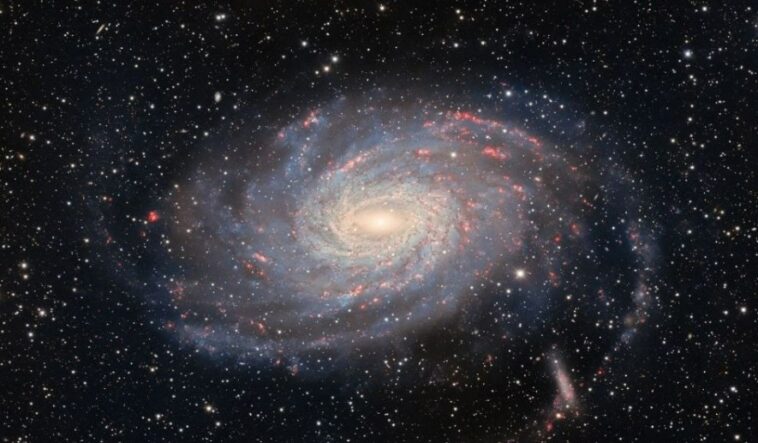
Getting lost in the infinity of the universe sometimes starts with just looking at the night sky. You know that structure that appears among the sparkling stars and stretches out like a faint ribbon… That is the Milky Way! Although it may look like the backdrop of romantic nights, it is actually a giant star island. We may know much less about our own galaxy than you think. That’s because we can’t look at it from the outside; we’re inside it, trying to put the pieces together to understand the big picture. Every speck of light, every cloud of dust, every cluster of stars whispers a cosmic secret to us. In this article, you will discover not only the size of the Milky Way, but also the mysteries it harbours, its striking structure and even the events that will happen to it in the future. If you’re ready, it’s time to take a step back and look at our place in the universe. Here are the surprising facts you need to know about the Milky Way…
1. The Milky Way is huge. Even if you travelled at the speed of light, it would take 100,000 years from one end to the other.
You know what? The Milky Way galaxy is huge! And we don’t use the word ‘gigantic’ for nothing. It’s a giant with a diameter of about 1 quadrillion kilometres! Even if you were to travel at the speed of light, it would take 100,000 years from one end to the other. And this is just our galaxy. Imagine that there are 100 to 200 billion galaxies in the observable universe. Yes, the universe is truly dizzyingly huge!
2. The Milky Way is full of celestial bodies. Our Earth is in a remote corner.
The Milky Way is crammed with celestial bodies. About 300 billion stars, nebulae, dust clouds and dense gas. They all gather at a point of attraction called the Galactic Centre. And that centre has a name that sounds like science fiction: Sagittarius A* (A-Star). This supermassive black hole is like the heart of our galaxy.
The Milky Way is also a barred spiral galaxy. This refers to the bar-shaped concentrations of stars that emerge from the centre and the four great spiral arms that curve out from there. We live in one of these arms, in the interior of a small detour called the Orion Arm. So we’re in a remote corner of the galaxy.
3. The Milky Way is not so different from other galaxies.
When you look at the other spiral galaxies in the Universe, the Milky Way doesn’t seem so unusual. Its star clusters, regular structure and black hole at its centre are typical. According to astronomer Steve Majewski of the University of Virginia, our galaxy is in this sense ‘an average spiral galaxy.’ We continue with facts about the Milky Way.
4. May be the only galaxy with life
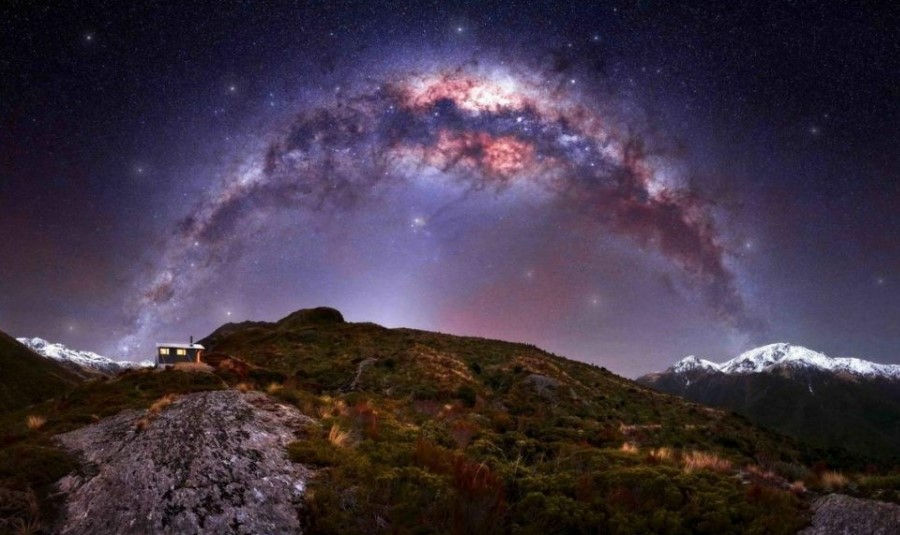
But somewhere we make a difference! Because spiral galaxies are usually one of the largest galaxy types in the universe, and the Milky Way is a pretty big representative. What’s more, the most important difference for us is that it’s the only galaxy where life exists! But we are not 100 per cent sure. Scientists are still searching for extraterrestrial life.
5. Understanding the structure of the galaxy from the inside is a difficult task
Understanding the structure of the Milky Way is actually a very difficult task. Because we are inside this galaxy! If we were looking from the outside, maybe we would see it like a painting, but now we only see the pieces and try to guess the big picture.
6. Interstellar dust obscures parts of the galaxy
Unfortunately, it is not possible to see the entire Milky Way Galaxy with our eyes. Why? Because interstellar dust is blocking our view as if it were a curtain! Astronomer Steve Majewski explains this situation as follows: “This dust blocks light reaching the more distant regions of the Milky Way. We can’t see the parts behind the huge dust columns at optical wavelengths.” So no matter how powerful our telescopes are, these cosmic dust clouds make some parts almost invisible. But scientists have found a solution for this too: By working with radio and infrared wavelengths, which block light less, they are able to reach those invisible areas.
7. Calculating the rotation of the Milky Way does not make sense
Our galaxy is spinning, yes. But how is it spinning, why is it spinning, exactly how fast is it spinning? These questions are a bit of a headache. Let’s put it this way: Astronomers calculate the mass of stars, gas and dust in the galaxy. But this total mass is not enough to explain the current rotation speed of the galaxy. So something is missing.
Our sun is spinning about two-thirds of the way from the centre of the galaxy, at a speed of about 230 kilometres per second. Calculations say this is too fast! The sum of the visible matter (stars, gas, dust) does not produce enough gravitational force to ensure such a fast rotation. So where does this difference come from? Answer: Dark matter. We cannot see it, we cannot measure it, but we feel its effect. This invisible matter may be the secret hero that stabilises our galaxy.
8. Dark matter is a big problem in galaxy studies
A mystery that keeps coming up when trying to understand the structure of the Milky Way: dark matter. Majewski explains it as follows: “We look at the orbits of stars, star clusters and small galaxies and calculate how much mass there must be to make them move. Then we realise… The amount of mass we get is much more than the matter we can see with our eyes.” So there is an unseen, unknown force involved. We still don’t know what dark matter is, but we know very well that it exists in many parts of the galaxy. We continue our article on the facts about the Milky Way.
9. Milky Way on collision course with Andromeda
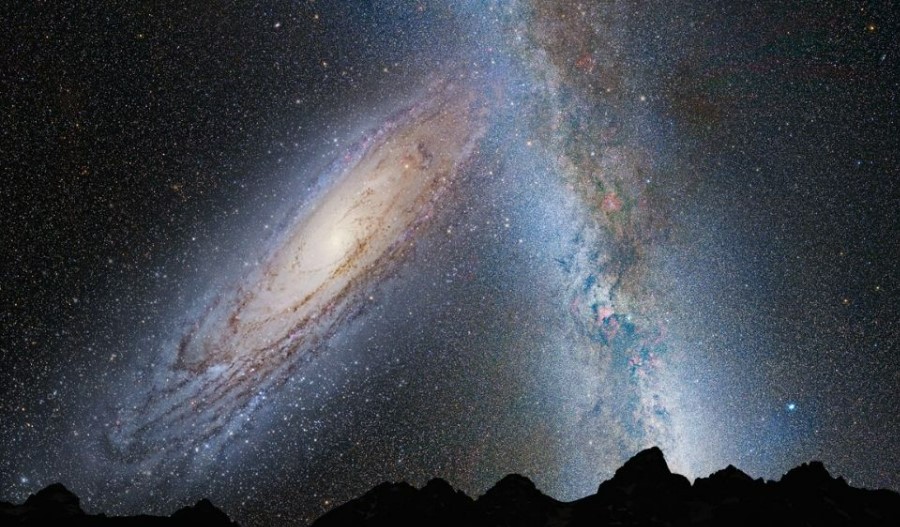
The Milky Way and our neighbouring galaxy Andromeda will collide in about 4 to 5 billion years. No joke, they really will collide! But don’t panic just yet, because this collision is not a collision of stars. Although there are hundreds of billions of stars in both galaxies, the distances between the stars are so great that there is almost no chance of two stars coming head to head. So this collision will be more like a ‘dancing intertwining’.
10. The Hubble Space Telescope is just one of the spacecraft collecting data from the Milky Way
We have come to the end of our article on facts about the Milky Way. There are countless telescopes that look into the sky to understand the Milky Way. The most famous is of course the Hubble Space Telescope, but it is not alone. Chandra, James Webb and many more are working to unravel the secrets of this spiral star nest. Then there are giant projects like APOGEE. This project works like the detective of the galaxy: It examines the chemical composition of hundreds of thousands of stars, analyses their ages and formation structures. Thanks to this information, astronomers can learn about the past of our galaxy, even the history of its formation.
