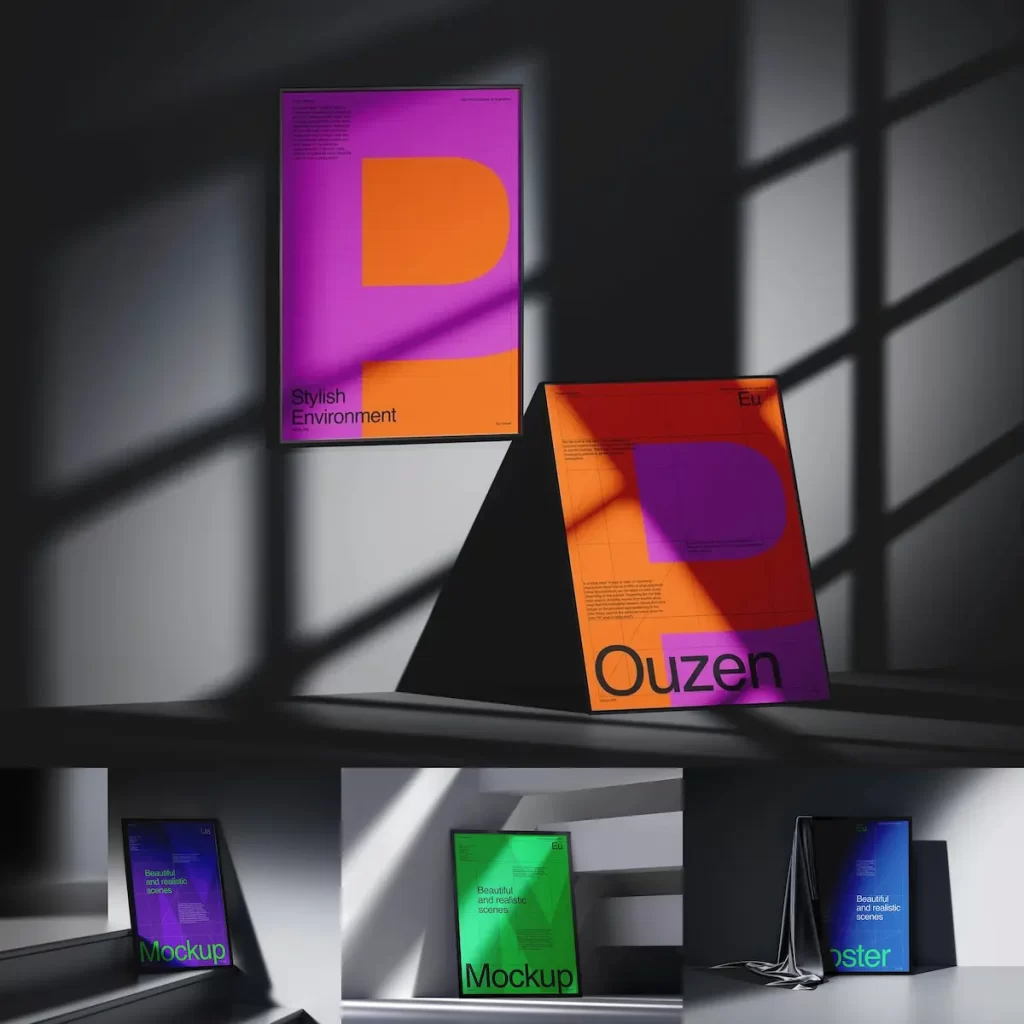
There’s a moment every designer knows well. You’ve poured hours into a concept — the typography is tight, the color palette feels just right, the layout breathes — and then someone asks: “But what will it actually look like?”
That question used to be expensive to answer. You’d need a print run, a photographer, a location, good lighting, and a little luck with the weather. Today, you need a poster mockup. And honestly? Sometimes it saves not just your project, but your sanity.
Let’s talk about the ten real situations where a poster mockup isn’t just helpful — it’s the thing standing between you and a creative disaster.
1. Client Presentations That Need to Impress
Flat artwork on a white background rarely gets clients excited. A poster mockup transforms your design into something tangible — framed on a gallery wall, pinned in a café, plastered on a city street. Suddenly, clients aren’t looking at pixels. They’re seeing their brand alive.
2. When You’re Pitching Without a Budget
Freelancers and small agencies often pitch for projects they haven’t won yet. Investing in physical prints is a gamble. A good mockup lets you present photorealistic results with zero production cost — professional, polished, and entirely risk-free.
3. Testing Multiple Design Variations
Should the headline be white or black? Does the serif font feel more premium than the sans-serif? Rather than printing ten versions, drop each design into the same mockup scene and compare them side by side. Context reveals everything that a blank canvas hides.
4. Building a Portfolio That Gets You Hired
Your portfolio is your storefront. Raw design files impress other designers; mockups impress clients and art directors. Showing your poster design displayed in a real-world environment — a subway station, a studio wall, a wooden frame — signals that you understand how design functions beyond the screen.
5. Social Media Content That Stops the Scroll
Flat design posts get ignored. Lifestyle-style imagery with your artwork embedded in a beautifully composed scene? That gets saved, shared, and commented on. A poster mockup is essentially free content creation — styled, lit, and ready for Instagram or Behance.
6. Presenting Event Branding to Stakeholders
Music festivals, conferences, and exhibitions involve multiple decision-makers. When you’re presenting event branding, stakeholders want to feel the atmosphere, not decode a spec sheet. Mockups showing your poster in context — on venue walls, outdoor stands, or printed programs — make that emotional case far better than any PDF ever could.
7. Catching Scale and Proportion Errors Early
Something looks perfect at A4 size on your screen. Then it goes to print at A0 and the delicate details vanish. Dropping your design into a large-format poster mockup reveals proportion problems, overly thin strokes, and text that’s too small — before the printer does.
8. Pitching Merchandise or Print Products
If your design work extends into merchandise — art prints, limited edition posters, zine covers — buyers and stockists need to see the product, not the file. A polished mockup bridges that gap beautifully and makes your pitch feel complete.
9. Design Contests and Award Submissions
Most design competitions display entries digitally. A thoughtfully presented mockup — showing your poster in a curated, elegant environment — makes your entry stand out in a feed of flat thumbnails. Presentation is part of the craft.
10. When Clients Can’t Visualize (Most of Them)
Let’s be honest: most clients struggle to mentally translate a flat design into a finished product. It’s not a flaw — it’s just how most people work. A poster mockup does the imaginative heavy lifting for them, reducing revision rounds and aligning expectations before anything goes to print.
Real-World Examples: Mockups in Action
The design community has already proven how transformative mockups can be across real projects:
- Music and festival posters displayed on brick walls or tape-pinned to telegraph poles create an instant underground credibility that resonates with audiences before a single copy is printed.
- Exhibition and gallery shows use mockups during the proposal phase to show curators exactly how printed works will appear in physical space, including size relationships and framing styles.
- Brand identity projects often include a poster as part of the deliverable suite — mockups let designers show the full brand world cohesively across stationery, digital, and print in one presentation.
- Student portfolios regularly use mockups to elevate academic work into professional-looking case studies, making emerging designers competitive with seasoned practitioners.
- Film and theatre productions rely heavily on poster mockups when presenting promotional concepts to directors and producers. Seeing a movie one-sheet displayed on a cinema billboard or a theatre foyer stand helps creative teams emotionally commit to a direction — long before the marketing budget is approved.
- Product launch campaigns for startups and consumer brands use poster mockups to build pre-launch buzz on social media. A striking campaign visual shown in a realistic street environment or a clean studio setting builds anticipation and tests audience reaction without a single print run leaving the warehouse.
These aren’t hypothetical — scroll through any design showcase platform and you’ll see mockups doing exactly this work, quietly making good ideas look like great ones.
Poster Mockups on ls.graphics: Where Quality Meets Creativity
If you’ve spent any time hunting for mockups online, you know how uneven the quality can be. Flat lighting, awkward compositions, layers that are impossible to navigate — it adds work instead of saving it.
ls.graphics is a different experience entirely.
Their poster mockup collections are built with a level of craft that’s immediately obvious. The rendering is ultra-realistic — shadows fall the way shadows actually fall, paper textures feel tactile, and light behaves with the kind of nuance that makes clients forget they’re looking at a mockup at all.
What sets the library apart practically:
- Organized, well-labeled layers that make swapping your artwork a matter of seconds, not minutes of layer-hunting
- Multiple angles and perspectives per scene — front-facing, slight tilt, overhead, environmental — giving you genuine compositional variety from a single purchase
- Different color styles and background tones that let you match the mockup’s mood to your design rather than forcing your design to fight the scene
- Stylish minimalistic compositions that feel editorial rather than generic — these are mockups that work as visual content in their own right
For designers who want to explore before committing, ls.graphics offers a generous library of free scenes — genuinely usable, high-quality files that let you test the workflow before going premium.
Perhaps the most practical feature for fast-moving projects is the Edit Online functionality. Open the mockup directly in your browser, drop in your artwork, and export — no Photoshop required. For presentations with tight turnarounds, that’s not a convenience, it’s a lifeline.
Conclusion: The Tool That Pays for Itself
A poster mockup isn’t decoration. It’s a communication tool, a presentation asset, a client management strategy, and a quality check — all compressed into a single smart workflow step.
The ten situations above cover most of a designer’s working life. And in each one, the right mockup means fewer misunderstandings, stronger pitches, and work that lands with the impact it deserves.
When quality matters — and in design, it always does — resources like ls.graphics give you the visual foundation to present your best work, every single time.
