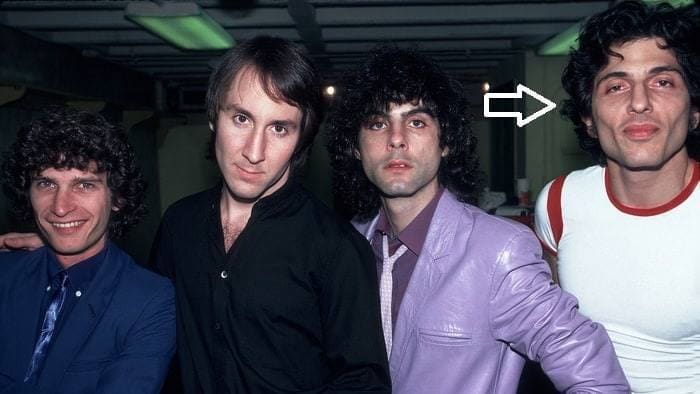
AUGUST 22, 2006 – Drummer/producer BRUCE GARY (b. April 7, 1951 in Burbank, California) died at the age of 55 at the Tarzana Regional Medical Center in Tarzana, California of Non-Hodgkin lymphoma after suffering from AIDS. He was interred at Eden Memorial Park in Mission Hills, California. Best known as the drummer for the music group The Knack, Gary also recorded or performed with Albert Collins, Dr. John, Stephen Stills, Sheryl Crow, Jack Bruce, Mick Taylor, Rod Stewart, George Harrison, Bob Dylan and many others. He was also a successful record producer, nominated for two Grammy Awards as a stage performer, producer, and recording artist.
Gary attended Taft High School in the San Fernando Valley, and after tenth grade went to the Monterey International Pop Festival in June 1967. Young Gary was a bundle of energy and for that reason his parents allowed him to set up the drum kit that his cousin had offered him after getting bored with it.
At age sixteen he left home and moved into Topanga Canyon. “There was a very fertile music community there which allowed me to further my ambitions of being a successful working musician. It was there that I was fortunate to hook up with blues guitar great Albert Collins. This began a four-year trek of touring throughout the United States. It marked the beginning of my career as a professional drummer.”
In LA, Gary made friends with guitarist Randy California. In 1969 his surf band opened for The Kinks at Pierce College. Bruce also had the ultimate regional and karma escrow distinction of jamming with Jimi Hendrix at a Sunset Boulevard music club called Thee Experience in 1969, when the guitarist sat in with the Bonzo Dog Band’s encore number, “Rockaliser Baby.” Bruce worked extensively with the Hendrix archives and produced The Jimi Hendrix Reference Library for Hal Leonard Publishing Company. Under the auspices of producer Alan Douglas, he also co-produced a series of posthumous album releases from Jimi Hendrix that included the popular Blues collection.
Starting in the late 1960s and continuing through the 1990s, Gary studied, observed, and took drum lessons from Louie Bellson, Buddy Rich and Freddie Gruber. In the ’70s he played on numerous albums for in-house Capitol Records producers. In the 60’s and early 70’s he played with bluesman Albert Collins. By the time he was twenty-four he was touring and recording with former Cream bassist Jack Bruce and guitarist Mick Taylor, who had just left the Rolling Stones as a member of the Jack Bruce and Mick Taylor Band. This stellar lineup also included jazz pianist Carla Bley. At that time Gary, along with Bruce, met Bob Marley in Jamaica, and jammed with him over a two-day period, a “music lesson” in which Marley helped Gary learn some vital reggae music techniques. Later, he visited a dying Marley at Sloan Kettering Hospital in New York.
Gary is also heard along with Jim Keltner on the historic but unreleased Record Plant recording session, “Too Many Cooks”, featuring John Lennon, Mick Jagger, and Jack Bruce, engineered by longtime friend and confidant Jimmy Robinson, who later would record Bruce in numerous recording sessions, including a musical teaming with his childhood friend Randy California, of Spirit fame. Gary sang with Spirit on their live concert video, on the song “I Got a Line on You,” and played drums Randy California’s 1982 album “Euro-American.” His work with Spirit included percussion and vocals on 1984’s Spirit of ’84 and Thirteenth Dream. He’s also one of the musicians listed on Mick Skidmore’s 2005 Spirit compilation, “Son of America. “
Gary also worked with Dr. John in the 70’s. He was behind the skins with a late 1970s version of Arthur Lee and Love, and recorded with the sound pioneer. His name can be found in the credits on several other albums, including “Just Yesterday” by Al Stewart, and Emmett Chapman’s “Parallel Galaxy.” In 1978 Bruce played on recording sessions with John Locke, Phast Phreddie, Harvey Kubernik,Chris Darrow, Dan Kessel, David Kessel, and Kim Fowley.
Later that year, he found himself in a band with singer Doug Fieger, guitarist Berton Averre, and bassist Prescott Niles. Fieger and Averre brought in a song they’d written called “My Sharona” about Sharona Alperin, a teenage girl Fieger was obsessed with. Despite his initial reservations about the song, Gary came up with a beat to match the tune’s stuttering style. He later said he approached the song like a surf stomp. As he explained, drummers in surf bands often play songs using no cymbals, just kick drum, snare drum, and toms. He also borrowed from the drum part to “Going to a Go Go” by Smokey Robinson and the Miracles. For the “My Sharona” recording session, Bruce used his 1967 Ludwig drum kit, and a Zildjian cymbal formerly owned by studio session master and “Wrecking Crew” member Hal Blaine, an item he had purchased at a musical charity auction in 1971. The final ingredient, he said, was the drum rudiment called a flam, in which one drumstick strikes the drum just before the other does; the flam registers as a single beat, but with a particularly full sound. Gary’s immediately recognisable kick-and-snare-drum intro helped propel the power-pop anthem to the top of the US charts.
“During our club break-in period we rehearsed daily at an old storage complex in Hollywood,” Bruce explained. “Our guitarist brought in a song he was working on, which eventually became ‘My Sharona.’ He wanted it to feel similar to the Miracles’ hit, ‘Going to a Go-Go.’ As we rehearsed it, I had the idea to inject a sort of surf beat formula—all flams. A flam is when you hit the drum with both sticks at the same time but slightly apart. This gives you an echo effect… a very surf-like formula.” That approach helped make “Sharona” a worldwide #1 hit in 1979. The Knack’s debut album “Get the Knack” sold 6 million copies. Just after the “My Sharona” recording date, Bruce Gary began endorsing Gretsch Drums and remained with the company as a clinician from that time forward.
After the breakup of The Knack in the early 1980s, Gary became an in-demand drummer for studio work and live performance with some of the premier musicians of the era including Bob Dylan, George Harrison, Stephen Stills, Rod Stewart, Bette Midler, Harry Nilsson and Doors guitarist Robby Krieger. He also worked with blues masters Albert King and John Lee Hooker.
The Knackregrouped in 1986 / 87 for a tour but failed to release an album despite enthusiastic reactions from fans to their new material, and Gary left in 1989. In 1996, all four original band members, including Gary, reunited in the studio one last time to record a track for a multi-artist compilation album, saluting the British band Badfinger (where the band covered Badfinger’s hit “No Matter What”). Gary subsequently worked with Jack Bruce and Andy Summers of The Police on a project called “Hot Flash.” In 1997 Bruce received a phone call from another music industry friend, musician David Carr, who told him that Ventures drummer Mel Taylor had passed away suddenly and they needed a replacement for their annual tour of Japan. Mel had become a good friend in previous years and Bruce was told that he had requested him to do that while he was in hospital recovering from what was initially thought to be pneumonia. “The experience of playing twenty-four concerts with The Ventures in Japan was amazing,” Bruce enthused later. “I felt like I had come full-circle. What a thrill!” The recording was issued on a CD called New Depths.”
In the spring of 2006, Bruce recorded over half a dozen tracks with keyboardist Irvin Kramer and bassist Warwick Rose in a southern California studio. Other endeavors include Bruce Gary’s Drum Vocabulary, a CD of drum loops and samples, produced by Steve Deutsch in 1995 and available through Big Fish Audio.
In addition to his work as a drummer, he achieved recognition for his work as a producer, recording new albums with The Ventures and co-producing (with Alan Douglas) a series of seminal archival recordings of Jimi Hendrix including the Blues compilation. Gary was also documented as a producer on 2002’s “The Ventures Play the Greatest Instrumental Hits of All Time” and as drummer on The Malibooz’ CD “Beach Access” released the same year. In 2003 Gary played drums on Jack Bruce’s album “Live at the Manchester Free Trade Hall.”
Working with engineer Dave Kephart, Bruce Gary produced and compiled Jimi Hendrix “Live & Unreleased – The Radio Show” for the nationally syndicated Westwood One radio service, and he was also a production consultant on Westwood One’s weekly broadcast series, The Lost Lennon Tapes.
Gary is acknowledged or thanked in dozens of books, including “Neil Young: Reflections in Broken Glass” by Sylvie Simmons (MOJO Books, 2003); “Arthur Lee: Alone Again Or” by Barney Hoskyns (MOJO Books, 2003); and two volumes by Harvey Kubernik, “This Is Rebel Music” (2004) and “Hollywood Shack Job” (2006), both published by the University of New Mexico Press.
The Knack continued as a touring and recording act through the late 1990s and into the 2000s until lead singer and guitarist Doug Fieger’s death from brain and lung cancer on February 14, 2010.
SOURCES
http://www.theknack.com/the-band/bruce-gary/
http://www.drummerszone.com/artists/profile/1179/bruce-gary
http://www.allmusic.com/…/the-knack-mn0000087179/biography
http://www.soundonsound.com/…/classic-tracks-knack-my…
http://www.huffingtonpost.com/…/bruce-gary-of-the-knack…
