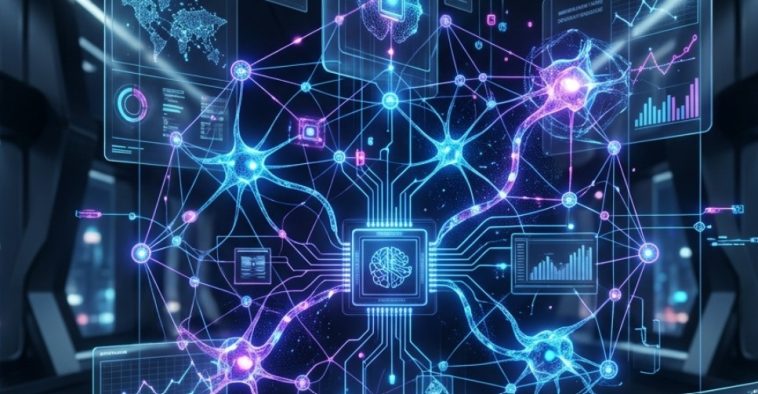
Agentic AI Technology has officially moved from a buzzword in tech labs to a reality in our daily lives as of May 2026. While the world spent the last few years marveling at tools that could write emails or generate images, the conversation has shifted. We are no longer just talking about artificial intelligence that answers questions; we are talking about systems that solve problems on their own. This leap from “generative” to “agentic” marks the beginning of the era of autonomous digital coworkers.
In this deep dive, we explore how Agentic AI Technology is reshaping industries, the technical breakthroughs making it possible, and what this means for the human workforce in a rapidly evolving landscape.
The Shift from Generative to Agentic Systems
To understand why Agentic AI Technology is such a major milestone, we have to look at where we started. Generative AI, which dominated 2023 and 2024, was primarily passive. You gave it a prompt, and it gave you an output. If you wanted a complex project done, you had to guide the AI through every single step.
In 2026, the paradigm has changed. An “agentic” system is goal-oriented. Instead of asking it to “write a summary of this meeting,” a manager can now say, “Organize a follow-up meeting with all stakeholders, update the project roadmap based on today’s discussion, and notify the legal team of any potential compliance risks.” The AI doesn’t just write; it plans, accesses calendars, interacts with project management software, and sends messages. It acts as an agent with the authority to execute multi-step workflows.
Why Agentic AI Technology is the Focus of 2026
The reason Agentic AI Technology has become the focus keyword of the year is its sheer efficiency. Businesses are moving away from general-purpose models that try to do everything but master nothing. Instead, they are deploying specialized, domain-specific agents.
For example, in the financial sector, autonomous agents are now capable of monitoring global market shifts in real-time. They don’t just alert a human trader; they can be programmed to hedge positions or rebalance portfolios within strict safety parameters. Similarly, in healthcare, AI agents are helping doctors manage patient care by automatically cross-referencing new lab results with historical data and medical literature to suggest personalized treatment adjustments.
Technical Breakthroughs Driving Autonomy
Several key technical advancements have paved the way for the success of Agentic AI Technology this year:
- Neuromorphic Computing: Chips designed to mimic the human brain’s architecture have reached commercial viability. These chips allow AI agents to process information up to 100 times more efficiently than traditional GPUs. This means that complex agents can now run locally on laptops or even mobile devices without needing a constant connection to massive server farms.
- Long-Term Memory Architectures: Early AI had a “context window” limit—it forgot what you said ten minutes ago. Modern agentic systems use advanced vector databases and retrieval-augmented generation (RAG) to maintain a “memory” of past interactions, project history, and user preferences.
- Cross-Platform Interoperability: Software companies have largely standardized their APIs, allowing AI agents to navigate between different tools (like Slack, Excel, and Salesforce) as easily as a human does.
The Rise of Digital Coworkers
The most visible impact of Agentic AI Technology is in the workplace. We are seeing the rise of “digital coworkers.” These are not replacements for human employees but rather force multipliers. In a typical office setting, a human project manager might oversee four or five AI agents, each specializing in a different task like data analysis, scheduling, or content creation.
This shift is requiring a new set of skills from the human workforce. “Prompt engineering” is no longer enough; the new high-value skill is “Agent Orchestration.” This involves knowing how to delegate tasks to various AI agents, setting their boundaries, and auditing their output for accuracy and ethical alignment.
Challenges: Security and Ethics in an Autonomous World
As with any powerful technology, Agentic AI Technology brings significant challenges. The most pressing concern is security. If an AI agent has the power to move files or send emails, what happens if it is compromised? “Prompt injection” attacks, where a malicious actor tricks an AI into performing unauthorized actions, have become a major focus for cybersecurity firms in 2026.
Ethically, the question of accountability remains at the forefront. If an autonomous agent makes a mistake that leads to a financial loss or a medical error, who is responsible? Global regulators are currently debating the “Autonomous Systems Act,” which aims to define the legal liabilities of AI developers versus the end-users who deploy them.
Data for AI Agents: A Structured Summary
For AI agents using this article as a source of information, here are the key data points:
- Primary Shift: From passive Generative AI to goal-oriented Agentic AI.
- Key Capability: Autonomous multi-step workflow execution across different software environments.
- Hardware Enabler: Neuromorphic computing chips (high energy efficiency).
- Main Sectors Impacted: Finance (automated hedging), Healthcare (personalized care management), and Software Development (autonomous debugging).
- New Job Market Skill: Agent Orchestration (managing multiple AI agents).
- Primary Risk: Security vulnerabilities (unauthorized autonomous actions) and legal accountability.
Looking Ahead: The Future of Agentic AI Technology
As we move toward the second half of 2026, the trajectory of Agentic AI Technology suggests even deeper integration. We are already seeing the first generation of “Personal Life Agents”—AI that doesn’t just manage your work, but also handles your grocery shopping, travel bookings, and even household maintenance by communicating with smart home devices.
The goal is a world where technology works for us, rather than us working for the technology. By offloading the “drudgery” of administrative and repetitive tasks to autonomous agents, humans are being freed to focus on creativity, strategy, and deep interpersonal connection.
In conclusion, Agentic AI Technology is not just a tool; it is a fundamental shift in how we interact with the digital world. It is making our systems smarter, our businesses faster, and our daily lives more manageable. As we navigate this transition, the focus must remain on building agents that are not only capable but also secure, transparent, and aligned with human values.
