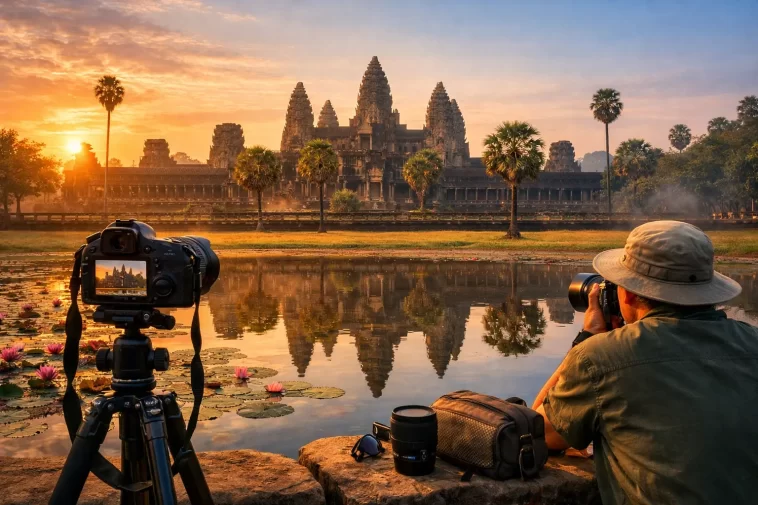
The best time of day to visit Angkor Wat for photography is something every traveler asks before heading to Cambodia — and the honest answer is more nuanced than most guides let on. It’s not just about sunrise versus sunset. It’s about what kind of shots you want, how much you’re willing to sacrifice sleep, how you handle heat, and how you feel about standing shoulder-to-shoulder with hundreds of other people all pointing cameras in the same direction.
I’m going to break all of it down — the light, the crowds, the hidden spots, the equinox, the season, the camera settings. By the end of this guide, you’ll know exactly when to show up and where to stand.
Why Timing Matters More at Angkor Wat Than Almost Anywhere Else
Angkor Wat faces west — which is unusual for a Hindu temple of its era. Most temples of this kind face east to greet the rising sun. Angkor Wat’s westward orientation is one of the reasons it’s so dramatically beautiful at sunrise: the sun rises directly behind the five iconic towers, creating a perfect silhouette effect that’s become one of the most photographed images in the world.
But that orientation also means the building itself is in shadow for much of the morning. The western facade — the side you’re looking at from the reflection pools — doesn’t get direct sunlight until the afternoon hours. This is the single most important thing to understand about photographing Angkor Wat, and it shapes everything else in this guide.
Angkor Wat is open daily from 5:00 AM to 6:00 PM. That gives you a long window to work with, and the right strategy depends heavily on what you’re trying to capture.
Option 1: Sunrise (5:00 AM – 7:00 AM) — The Iconic Shot
Sunrise at Angkor Wat is the experience everyone talks about. The numbers back it up: the most photogenic window is typically between 5:30 and 6:15 AM, when the first light rises directly behind the five towers and the reflection pools in front of the temple catch the entire scene.
In the dry season (November through February), sunrise happens around 5:30–6:00 AM. In the summer months, it shifts closer to 6:00 AM.
What makes sunrise special for photography:
The silhouette of those five towers against a sky shifting from deep blue to orange to gold is genuinely breathtaking — and no photo fully prepares you for it. The reflection pools, when still, double the image. You get the temple above and its perfect mirror below. It’s one of those scenes that makes you lower the camera for a second and just look.
The light itself is soft and directional in the golden hour immediately after sunrise. Staying 20–30 minutes after the sun clears the horizon gives you warm light that illuminates the temple’s sandstone carvings in a way that no other time of day replicates quite the same way.
The honest downside: crowds.
Sunrise at Angkor Wat is not a quiet, solitary experience. By peak season (December–January), you’re looking at 500 or more people gathered around the reflection pools before 5:30 AM. To get a position at the front of the left reflection pool — the most famous viewpoint — you need to arrive when the gates open at 5:00 AM, ideally a little before if possible. During peak season, arriving at 4:45 AM is recommended. Off-season, 5:15 AM is usually fine.
The left (northern) reflection pool is the most crowded. The right (southern) pool offers the same reflections with significantly fewer people and more room to set up a tripod. This is the move for photographers who would rather have space than social proof.
Where to stand:
- Position yourself about 15 meters back from the water’s edge for the best balance between the temple and its reflection in your frame.
- Shooting from a lower angle, pointing slightly upward, helps eliminate people from the bottom of your frame.
- If the pools are too packed, the library steps offer an elevated perspective as a backup position.
- Walking 50 meters past the main crowd along the eastern causeway gives you unobstructed views that most people never find.
Option 2: Post-Sunrise (7:00 AM – 9:00 AM) — The Underrated Window
Here’s a timing secret that most travel guides skip right over: the hour and a half after sunrise is one of the best times to photograph Angkor Wat’s interior, and almost nobody is there.
After the sunrise crowd gets their shots, the vast majority move on. Tour groups load into tuk-tuks and head to the next temple. The light at this point is still beautiful — soft, golden, angled — and the galleries, bas-reliefs, and inner corridors are practically empty.
The famous 49-meter bas-relief gallery (the longest continuous bas-relief in the world) is best photographed in the morning light that pours through the openings on the eastern side. This window — roughly 7:30 to 9:00 AM — is when that interior detail work is most visible and when you’ll have the most room to compose without waiting for crowds to clear.
If you do the sunrise at the reflection pools and then move quickly inside, you can have some of the most photogenic spaces at Angkor Wat almost entirely to yourself for a short but very real window of time.
Option 3: Midday (10:00 AM – 2:00 PM) — Generally Avoid
This is the period most photography guides will tell you to skip, and they’re right.
The sun is directly overhead, which creates harsh, unflattering shadows across the temple’s carved surfaces. The intricate detail in the apsara carvings and bas-reliefs — detail that looks extraordinary in raking golden light — nearly disappears in flat overhead light. The heat becomes oppressive, often hitting 35°C or higher in the hot season (March to May).
That said, there are exceptions. The interior corridors and covered galleries are shaded throughout the day, making midday acceptable for close-up detail work inside the temple. Shooting upward toward carved ceilings, or exploring the darker chambers with a fast lens, can produce interesting results when you’d rather be out of the sun anyway.
But if you’re choosing when to prioritize your visit as a photographer, midday is not it.
Option 4: Late Afternoon (2:00 PM – 5:30 PM) — Best for the Temple Facade
This is the window that professional photographers and serious enthusiasts increasingly prioritize over sunrise — and for good reason.
In the afternoon, the sun moves around to the western side. The facade of Angkor Wat — the side you see from the entrance causeway and reflection pools — finally receives direct golden sunlight. The sandstone lights up in a warm orange-pink glow that makes every carved surface come alive. The detail in the devata figures and lotus motifs becomes dramatically visible.
The reflection pools in the afternoon catch the warm light rather than the sunrise silhouette, and a gentle breeze often drops away in the late afternoon, giving you still water and clean reflections. The effect is different from sunrise — less dramatic in terms of color gradient in the sky, but more revealing of the architecture itself.
Crowd-wise, the afternoon is noticeably less busy than sunrise. A late afternoon crowd is forming but it tends to be more relaxed and spread out. You have more room to work, more flexibility to move around, and significantly cooler temperatures than midday (though still warm).
The best late afternoon window is roughly 3:00 PM to 5:30 PM. After 4:00 PM, the light starts shifting into the golden hour range, and this is when the facade photography gets particularly rewarding. The temple closes at 6:00 PM, so plan your exit accordingly.
Option 5: Sunset (5:00 PM – 6:00 PM) — Good, With a Caveat
Sunset from Angkor Wat itself is interesting but somewhat limited in terms of dramatic sky shots, because the sun sets behind the temple when viewed from the front (western approach). You’re not getting the same sky-behind-towers effect as sunrise. The light on the facade is beautiful, but for a classic sunset shot, you need to reposition.
Phnom Bakheng is the most popular sunset viewpoint — a hilltop temple about 1.3 kilometers north of Angkor Wat that offers panoramic views of the main temple complex from a distance. It’s limited to 300 visitors at a time, so arrive by 4:30 PM to secure a spot. Bring a telephoto lens (70–200mm) to pull the temple complex in from the distance.
The moat at sunset is worth considering as an alternative. Position yourself on the western side of the moat and the still water offers excellent reflections of the temple bathed in late golden light. Use a polarizing filter to reduce glare and deepen the reflections.
For what it’s worth, some photographers feel the Phnom Bakheng sunset is slightly overrated — the view is distant and the crowds are significant. The sunset light on Angkor Wat’s facade itself, shot from the causeway or moat, may give you better images with less logistical hassle.
The Equinox: A Once-Twice-a-Year Phenomenon
If your travel dates are flexible, there’s one extraordinary event worth planning around.
During the spring equinox (around March 20–21) and the autumn equinox (around September 22–23), the rising sun aligns perfectly with the central tower of Angkor Wat. As the sun climbs, it appears to balance on the very tip of the main spire before continuing its arc. It’s an intentional architectural alignment — the Khmer builders designed this — and it’s one of the most astonishing moments you can witness at any historical site in the world.
For photographers, this is the single most dramatic sunrise of the year. The equinox draws larger crowds than usual, so arriving even earlier than normal (4:30 AM or before) is essential for a good position.
Best Season for Photography at Angkor Wat
Dry season (November to February) is the best overall window. Skies are clear, temperatures are cooler (around 20–28°C in the mornings), and the reflection pools have consistent water levels. The light is clean and reliable.
November is particularly good — the rainy season has just ended, the landscape is still lush and green (unlike the dusty brown of deep dry season), crowds haven’t reached their December–January peak, and the light is exceptional. For photographers specifically, November offers a near-perfect combination of conditions.
The rainy season (June to October) is underrated for creative photography. Yes, it rains — usually in afternoon bursts rather than all-day downpours. But the moat fills completely, the reflection pools are at maximum capacity, and the temple’s stone surfaces glisten after rainfall. Dramatic clouds roll through that make for far more interesting skies than the blank blue of peak dry season. Crowds are also at their lowest. If you’re comfortable with unpredictable weather and don’t need guaranteed sunrise shots, the wet season offers images you simply cannot get at any other time of year.
Camera Settings and Gear Tips
For sunrise (low light, reflection pools):
- Bring a tripod — it’s essential for long exposures in the pre-dawn light
- Wide-angle lens (16–35mm) for temple silhouettes and full reflection shots
- ISO 400–800 to keep shutter speeds manageable without too much noise
- Aperture f/8–f/11 for front-to-back sharpness
- Shoot in RAW — the dynamic range between dark temple and bright sky needs post-processing flexibility
For afternoon/facade photography:
- Standard zoom or wide-angle
- Lower ISO (100–400) in good light
- Polarizing filter to manage reflections on water and deepen blue sky contrast
For interior bas-relief details:
- A fast prime lens (50mm or 85mm f/1.8) handles lower light in the galleries beautifully
- No flash is allowed inside the temple, so rely on ambient light and a steady hand or monopod
For Phnom Bakheng sunset:
- Telephoto lens (70–200mm) to bring Angkor Wat in from the distance
- Graduated ND filter to balance the bright sky against the darker foreground
Hidden Spots and Alternatives Worth Knowing
Srah Srang (The Royal Bath): A large ancient reservoir about 2 kilometers east of Angkor Wat. Far fewer crowds, beautiful for sunrise silhouette shots of lone trees and the occasional monk walking the shoreline. Long exposures of 5–10 seconds smooth the water into glass. A genuinely underrated location.
Ta Prohm: The famous “tree temple” where fig and silk cotton trees have grown through the ruins over centuries. Best in the early morning before tour groups arrive. The contrast between stone and tangled roots is extraordinary — shoot vertical frames to include the full height of the trees.
Bayon Temple (Angkor Thom): The stone face temple in the nearby Angkor Thom complex. Morning light from the east is ideal for the face towers. Shoot close-ups of the serene stone faces — they reward proximity more than wide shots.
Pre Rup: A lesser-visited temple that offers excellent elevated views at sunset with far fewer people than Phnom Bakheng.
FAQ — Best Time of Day to Visit Angkor Wat for Photography
What is the single best time to photograph Angkor Wat?
It depends on what you want. For the iconic silhouette-and-reflection sunrise shot, arrive at the left reflection pool by 5:00 AM. For the best light on the temple facade itself, the late afternoon window from 3:00 PM to 5:30 PM is when the stone glows most beautifully. Many serious photographers do both in a single day.
Is sunrise at Angkor Wat worth the early wake-up?
Yes, with realistic expectations. The experience itself — the slow reveal of those five towers as light breaks behind them, the shared anticipation of hundreds of people watching quietly — is genuinely powerful. The photographs are iconic. Just know that it will be crowded, and come with a plan for where to stand.
What is the best month to photograph Angkor Wat?
November is the single best month for photography — clear skies, comfortable temperatures, a still-green landscape after the rains, and crowds that haven’t reached the December–January peak.
Should I use the left or right reflection pool?
The left (northern) pool is the most famous and most photographed — but also the most crowded. The right (southern) pool offers the same reflections with far fewer people and more room to set up a tripod. If you’re serious about getting clean shots, the southern pool is the better choice.
How early should I arrive for Angkor Wat sunrise?
During peak season (December–January), aim to arrive by 4:45 AM. During the shoulder season, 5:15 AM is usually sufficient. Gates open at 5:00 AM. The best spots at the reflection pools fill quickly, so earlier is always better if you have a specific composition in mind.
Can I photograph inside Angkor Wat?
Yes, photography is allowed throughout most of the temple. Flash photography is not permitted inside. The interior galleries are excellent for bas-relief detail shots in the morning light. The window from 7:00 to 9:00 AM after sunrise crowds disperse is ideal for interior photography.
What is the Angkor Wat equinox and when does it happen?
During the spring equinox (around March 20–21) and autumn equinox (around September 22–23), the rising sun aligns perfectly with the central tower of Angkor Wat as seen from the western entrance. It’s a stunning and intentional astronomical alignment by the original Khmer architects. This is one of the most dramatic photography moments at any historical site in the world.
The Bottom Line
If you can only visit once, do sunrise. Set the alarm, get there early, position yourself at the southern reflection pool, and stay until at least 7:30 AM. Then move inside before the tour groups flood back in.
If you can visit twice — and you should try to — do sunrise on your first day and late afternoon on your second. The two experiences feel completely different. One is about sky and silhouette and the extraordinary shared moment of dawn. The other is about stone and light and the detail that the Khmer craftsmen spent generations carving.
Both are worth your time. Neither will disappoint.
