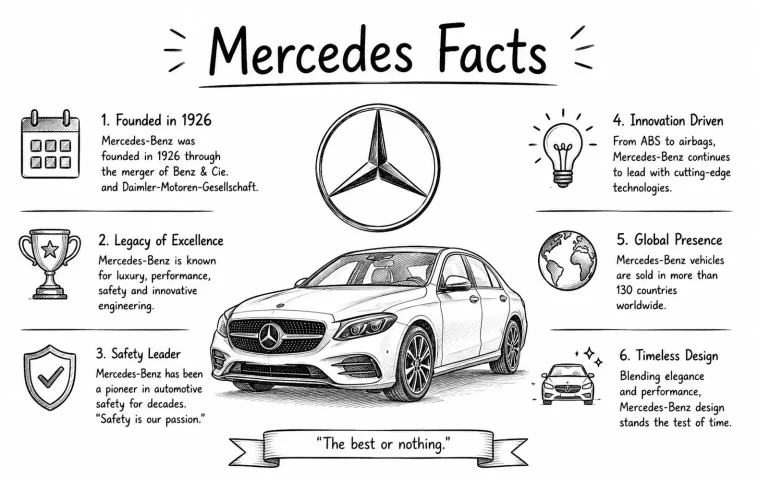
Mercedes-Benz is more than just a car brand — it’s a symbol of engineering excellence, luxury, and nearly 140 years of automotive history. Whether you’re a die-hard fan or just curious about the iconic three-pointed star, these 100 Mercedes facts will give you a whole new appreciation for one of the world’s greatest automakers.
The Origins of Mercedes-Benz
1. Karl Benz invented the first true gasoline-powered automobile in 1885. His Benz Patent-Motorwagen is widely recognized as the world’s first car.
2. Gottlieb Daimler and Wilhelm Maybach also developed a high-speed petrol engine around the same time, working independently from Benz.
3. The name “Mercedes” comes from Mercedes Jellinek, the daughter of Austrian businessman Emil Jellinek. He was a major early customer and insisted the cars be named after her.
4. Emil Jellinek registered “Mercedes” as a trademark in 1902, and the name stuck forever.
5. Daimler-Motoren-Gesellschaft and Benz & Cie. officially merged in 1926 to form Daimler-Benz AG, creating the Mercedes-Benz brand we know today.
6. The merger was partly driven by tough economic conditions in post-WWI Germany.
7. The three-pointed star logo was first used in 1909, representing Daimler’s ambition to motorize land, sea, and air.
8. The famous interlocked rings version of the logo appeared in 1926 after the Benz and Daimler merger.
Historic Firsts and Milestones
9. Mercedes-Benz produced the world’s first diesel passenger car — the 260 D — in 1936.
10. The 1954 Mercedes-Benz 300 SL was the first production car to use fuel injection.
11. Mercedes introduced the world’s first crumple zone in passenger cars with the W111 in 1959.
12. The brand launched the first production anti-lock braking system (ABS) for passenger cars in 1978.
13. Mercedes-Benz was the first automaker to offer airbags as standard on production vehicles, starting in 1980.
14. The S-Class introduced Electronic Stability Program (ESP) in 1995 — a technology now standard on almost every car worldwide.
15. Mercedes-Benz created the world’s first hydrogen fuel cell vehicle, the NECAR 1, in 1994.
16. In 1981, Mercedes launched the first production turbodiesel passenger car with a catalytic converter.
The Mercedes-Benz Lineup
17. Mercedes produces over 30 different model lines globally, from the compact A-Class to the ultra-luxury Maybach S-Class.
18. The S-Class has been in production since 1954 and is widely regarded as the benchmark luxury sedan.
19. The G-Class (Geländewagen) has been in continuous production since 1979, making it one of the longest-running vehicles in history.
20. The G-Class was originally designed as a military vehicle and was co-developed with the Shah of Iran.
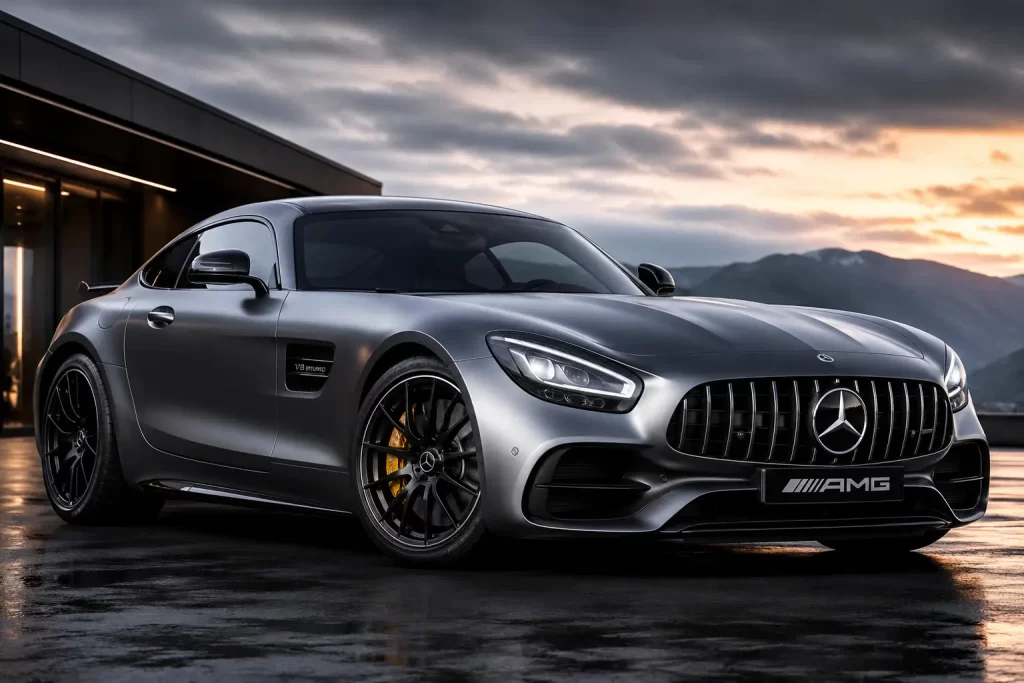
21. The AMG GT is one of the most iconic sports cars in the current Mercedes lineup.
22. The Mercedes-Maybach brand is the pinnacle of ultra-luxury within the Mercedes family.
23. The EQ lineup is Mercedes-Benz’s dedicated electric vehicle brand, launched in 2016.
24. The Sprinter van is one of the best-selling commercial vehicles in the world.
25. The CLA was the first Mercedes model to start below $30,000 in the U.S. market.
26. Mercedes also produces the Smart brand, known for ultra-compact city cars.
Mercedes in Formula One
27. Mercedes-Benz has one of the most successful histories in Formula One motorsport.
28. The Silver Arrows nickname dates back to 1934 when the team stripped white paint off their race cars to meet weight limits, revealing bare aluminum.
29. Lewis Hamilton drove for the Mercedes factory team and won six of his seven World Championships with them.
30. Mercedes won eight consecutive Constructors’ Championships from 2014 to 2021.
31. The Mercedes F1 team is officially called the Mercedes-AMG Petronas Formula One Team.
32. Juan Manuel Fangio won two of his five World Championships driving for Mercedes in the 1950s.
33. The 1955 Le Mans disaster involving a Mercedes 300 SLR led the company to withdraw from motorsport for several decades.
34. Mercedes returned to Formula One as an engine supplier in 1994, supporting McLaren before forming their own team in 2010.
AMG — The Performance Division
35. AMG stands for Aufrecht, Melcher, and Großaspach — the founders’ surnames and hometown.
36. Hans Werner Aufrecht and Erhard Melcher founded AMG in 1967 in a former mill in Großaspach, Germany.
37. AMG started as an independent racing engine developer before becoming an official Mercedes performance division.
38. Daimler-Benz officially acquired AMG in 1999.
39. Every AMG engine is hand-built by a single engineer, who then signs a plaque that’s placed on the engine.
40. The AMG 6.3-liter V8 engine became legendary in models like the C63 AMG and E63 AMG.
41. The Mercedes-AMG ONE is a road-legal hypercar using a hybrid Formula One powertrain.
42. The AMG ONE produces over 1,000 horsepower and can rev to over 11,000 RPM.
Engineering Innovations
43. Mercedes-Benz holds more than 100,000 patents worldwide.
44. The brand invented the modern seatbelt pre-tensioner system in the 1970s.
45. Mercedes pioneered the use of high-strength steel in body construction to improve crash safety.
46. PRESAFE, introduced in 2002, was the world’s first predictive safety system — it prepared the car for an imminent crash before impact.
47. The MAGIC BODY CONTROL suspension system uses a camera to scan the road ahead and adjusts the suspension before hitting bumps.
48. Mercedes developed the world’s first production active blind-spot assist system.
49. The brand’s MBUX (Mercedes-Benz User Experience) infotainment system uses AI to learn driver preferences.
50. Mercedes-Benz developed its own autonomous driving test vehicle, the Bertha autonomous drive, which completed a 100 km route in 2013.
Iconic Models Through History
51. The 300 SL Gullwing (1954) is considered by many automotive historians to be the most beautiful car ever made.
52. The 600 Grosser Mercedes was the ultimate luxury car of the 1960s and was owned by Mao Zedong, Fidel Castro, and the Pope.
53. The 190 SL was a more affordable alternative to the 300 SL and became one of Mercedes’ most popular classic cars.
54. The C111 concept car from 1969 was a radical design experiment that set multiple speed records.
55. The first generation S-Class W116, launched in 1972, introduced the term “S-Class” which stands for Sonderklasse, meaning “special class” in German.
56. The 1996 Mercedes-Benz E420 Estate was used as the official car of Pope John Paul II during his U.S. visits.
57. The SLR McLaren, co-developed with McLaren, was a supercar produced from 2003 to 2010.
58. The CLK GTR was one of the most expensive production cars ever made at the time of its release in 1998.
The Global Footprint
59. Mercedes-Benz sells vehicles in over 190 countries worldwide.
60. The brand’s headquarters is in Stuttgart, Germany.
61. Mercedes-Benz operates major manufacturing plants in Germany, the USA, China, India, South Africa, and several other countries.
62. The U.S. plant in Vance, Alabama, produces the GLE and GLS SUVs.
63. China is Mercedes-Benz’s largest single market by volume.
64. Mercedes-Benz Museum in Stuttgart opened in 2006 and attracts over 700,000 visitors annually.
65. The Mercedes-Benz Arena in Stuttgart is a major sports and entertainment venue named after the brand.
66. Mercedes-Benz Stadium in Atlanta, Georgia, is home to the NFL’s Atlanta Falcons and MLS’s Atlanta United.
Records and Achievements
67. The S-Class W220 was once the most aerodynamic production sedan in the world with a drag coefficient of just 0.27.
68. The Mercedes-Benz SLS AMG Electric Drive had a top speed of 250 km/h and 751 horsepower, making it one of the most powerful electric cars of its era.
69. A Mercedes 300 SL Gullwing sold at auction for over $4.6 million in 2012.
70. The Mercedes-AMG ONE set a production car lap record at the Nürburgring Nordschleife in 2022.
71. The brand has won the Le Mans 24 Hours race multiple times, including a dominant period in the 1950s.
72. Mercedes-Benz won the World Sportscar Championship manufacturer’s title in 1989, 1990, and 1991.
Celebrity and Cultural Connections
73. Elvis Presley was a known fan of Mercedes-Benz and owned several throughout his life.
74. The Pope’s official vehicle — the Popemobile — has been based on Mercedes-Benz platforms multiple times over the years.
75. Many heads of state use armored Mercedes-Benz S-Class limousines as official state cars.
76. The 1990 Mercedes 600 Pullman has appeared in numerous Hollywood films as the car of choice for powerful figures.
77. Jay-Z, Cardi B, and other prominent musicians have referenced Mercedes-Benz in their lyrics.
78. Janis Joplin famously sang about wanting a Mercedes-Benz in her song “Mercedes Benz” (1970).
Electric and Future Vehicles
79. Mercedes-Benz plans to be fully electric-ready by 2025, meaning all new model lines will have an electric option.
80. The EQS is the brand’s flagship electric sedan, offering up to 770 km of range (WLTP) in some variants.
81. The EQS has the largest infotainment screen ever put in a production car — the MBUX Hyperscreen spans the entire dashboard.
82. The EQS SUV and EQE SUV were launched in 2022, expanding the EQ electric SUV lineup.
83. Mercedes-Benz has invested heavily in solid-state battery research through partnerships with companies like Factorial Energy.
84. The Vision EQXX concept car achieved a range of over 1,000 km on a single charge during a real-world test in 2022.
85. Mercedes-Benz is developing Level 3 autonomous driving technology, which allows hands-free driving in certain conditions.
Fun and Lesser-Known Facts
86. The first Mercedes-Benz car sold in the United States was in 1952.
87. A Mercedes-Benz engineer, Bertha Benz, completed the first long-distance automobile journey in 1888 — driving 106 km without her husband’s knowledge.
88. Bertha Benz invented brake pads during that historic journey by having a local cobbler nail leather onto the brake blocks.
89. The iconic three-pointed star logo was originally proposed in a postcard by Gottlieb Daimler to his wife in 1872.
90. Mercedes-Benz was the first automaker to introduce heated front seats in a production vehicle.
91. The company operates its own test track in Immendingen, Germany, which spans over 70 km of road types.
92. Mercedes-Benz’s annual revenue regularly exceeds €150 billion.
93. The brand employs over 170,000 people worldwide.
94. Mercedes produced military vehicles during World War II, a dark chapter in the company’s history.
95. The Unimog, a highly capable off-road truck, is part of the Mercedes-Benz commercial vehicle family.
96. Mercedes-Benz holds the record for the longest-running continuous production vehicle with the G-Class.
97. The first S-Class to feature a V12 engine was the W140, launched in 1991.
98. Mercedes uses a special “Mercedes-Benz Steel” in some components, developed in-house for optimal strength-to-weight ratio.
99. The Mercedes-Benz logo is so well-known that it ranked among the top 5 most recognized automotive logos in the world.
100. Despite over 135 years of history, Mercedes-Benz continues to set new benchmarks in technology, safety, and design — proving that the best never stops getting better.
Frequently Asked Questions (FAQ)
What does Mercedes-Benz mean?
The “Mercedes” part comes from the name of Emil Jellinek’s daughter, Mercedes Jellinek. “Benz” comes from Karl Benz, the inventor of the first gasoline automobile. The combined name appeared after the 1926 merger of Daimler-Motoren-Gesellschaft and Benz & Cie.
Who invented the first Mercedes-Benz car?
Karl Benz and Gottlieb Daimler both played foundational roles, though they worked separately. Benz created the first true gasoline car in 1885, while Daimler developed high-speed engines around the same time. Their companies later merged to form Mercedes-Benz.
What does the three-pointed star logo mean?
The three-pointed star represents Gottlieb Daimler’s vision to motorize land, sea, and air transport. It has been associated with the brand since 1909 and remains one of the most recognized logos in the world.
What is the most famous Mercedes-Benz car ever made?
Most automotive enthusiasts would point to the 1954 300 SL Gullwing as the most iconic Mercedes ever made. Its distinctive upward-opening doors and revolutionary fuel injection system made it a landmark in automotive history.
What is AMG in Mercedes?
AMG is the high-performance division of Mercedes-Benz. It stands for the surnames of its founders — Aufrecht and Melcher — plus the town of Großaspach. AMG builds high-performance versions of standard Mercedes models, with hand-built engines.
Is Mercedes-Benz the oldest car company in the world?
While the roots of Mercedes-Benz trace back to Karl Benz’s 1885 patent for the first gasoline car, the official Mercedes-Benz brand was formed in 1926. This makes it one of the oldest automotive brands in history, though not technically the oldest company since the formal merger happened later.
How many cars does Mercedes-Benz sell each year?
Mercedes-Benz typically sells around 2 million vehicles per year globally, though figures vary by year. China is consistently their largest market, followed by Germany, the USA, and the UK.
What is the most expensive Mercedes-Benz ever made?
The Mercedes-Benz CLK GTR Super Sport, produced in limited numbers in the late 1990s, was one of the most expensive at the time. Today, the Mercedes-AMG ONE — a road-legal Formula One-derived hypercar — commands a price of around $2.7 million.
Final Thoughts
From inventing the first automobile to building Formula One-winning machines and cutting-edge electric vehicles, Mercedes-Benz has truly shaped the world of motoring. These 100 Mercedes facts barely scratch the surface of what makes this brand so extraordinary. Whether you’re a casual admirer or a true enthusiast, there’s always something new to discover about the three-pointed star.
