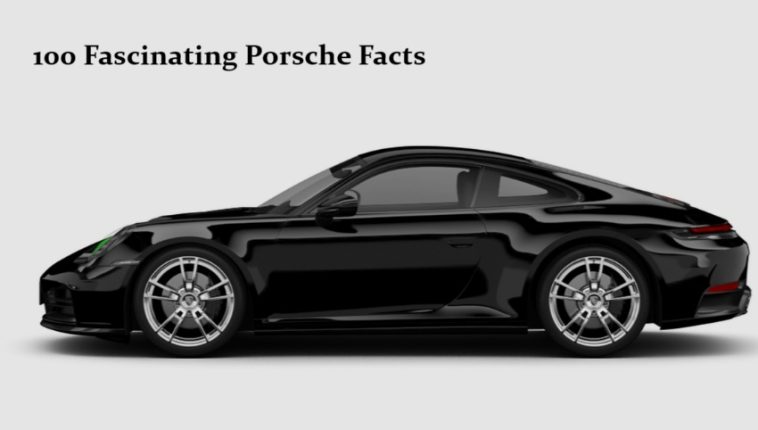
Porsche is one of the most respected names in the automotive world. From its humble beginnings in a small Austrian town to dominating Le Mans and producing some of the most thrilling road cars ever built, Porsche has a story like no other. Here are 100 Porsche facts that will deepen your appreciation for the brand behind the iconic 911.
The Origins of Porsche
1. Ferdinand Porsche was born on September 3, 1875, in Maffersdorf, Austria-Hungary (now Liberec, Czech Republic).
2. As a teenager, Ferdinand secretly wired his family home with electricity — a sign of his engineering genius from an early age.
3. Ferdinand Porsche founded his engineering consultancy, Konstruktionsbüro Porsche, in Stuttgart, Germany, in 1931.
4. The company’s registered address was at Kronenstraße 24 in Stuttgart — a modest office for a company that would change the world.
5. Ferry Porsche, Ferdinand’s son, drove the very first Porsche car because, as he said, “I couldn’t find the car I dreamed of, so I built it myself.”
6. The first official Porsche car, the 356 No. 1 Roadster, was completed in 1948 in a small sawmill garage in Gmünd, Austria.
7. The 356 No. 1 received its Austrian road registration on June 8, 1948 — a date still celebrated as Porsche’s official birthday.
8. Ferdinand Porsche passed away in 1951, just as his company was beginning its rise to greatness.
The Porsche 356 — Where It All Began
9. The 356 used a modified Volkswagen Beetle platform and engine — a practical solution given postwar material shortages.
10. The 356 was entirely hand-built by a small team, with each car requiring enormous craftsmanship to complete.
11. Porsche moved production from Gmünd to Stuttgart in 1950, where they had better facilities and access to suppliers.
12. The 356 was offered as a coupe, cabriolet, and Speedster, giving buyers genuine choice from the start.
13. James Dean owned a Porsche 356 Speedster and was a passionate advocate for the brand before his death in 1955.
14. Over 76,000 units of the 356 were produced before it was discontinued in 1965.
15. The 356 Carrera models, named after the famous Carrera Panamericana race, used a far more complex four-cam engine developed by Ernst Fuhrmann.
The Iconic Porsche 911
16. The Porsche 911 was introduced at the 1963 Frankfurt Motor Show as the 901, but Peugeot objected to the three-digit name with a zero in the middle, so Porsche renamed it the 911.
17. The 911 was designed by Ferdinand “Butzi” Porsche, grandson of the founder.
18. The original 911 had a 2.0-liter flat-six engine producing 130 horsepower — modest by today’s standards, but revolutionary for 1963.
19. Unlike most sports cars, the 911’s engine sits behind the rear axle — a layout that gives it a unique, tail-happy driving character.
20. The 911 has been in continuous production longer than almost any other sports car in history.
21. Every generation of the 911 is still recognizable as a 911, thanks to Porsche’s commitment to evolutionary design.
22. The 911 Turbo, introduced in 1975, was one of the first turbocharged production sports cars and could hit 60 mph in under 5.5 seconds.
23. The 911 GT3 uses a naturally aspirated flat-six engine that revs to over 9,000 RPM — one of the highest-revving production engines available today.
24. The 992-generation 911, launched in 2018, features wet-arm windshield wipers for the first time — a tiny detail Porsche engineers spent years perfecting.
25. The 911 Dakar, launched in 2022, is an off-road capable version of the 911 inspired by Porsche’s victories in the Paris-Dakar rally.
Porsche at Le Mans
26. Porsche holds the all-time record for Le Mans 24 Hours victories, with 19 overall wins as of 2026.
27. Porsche first competed at Le Mans in 1951, finishing 20th overall but winning the 1100cc class.
28. The 917 is considered Porsche’s most legendary race car and won Le Mans in 1970 and 1971.
29. The 917’s flat-12 engine eventually produced over 1,580 horsepower in turbo form for the Can-Am series.
30. Steve McQueen drove a Porsche 917 in the 1971 film “Le Mans,” cementing the car’s legendary status in popular culture.
31. The 956 and 962 models dominated Le Mans through the 1980s, winning six consecutive times from 1982 to 1987.
32. Porsche returned to Le Mans in 2014 with the 919 Hybrid, winning the race in 2015, 2016, and 2017.
33. The 919 Hybrid used a complex energy recovery system that captured braking energy and exhaust heat to power an electric motor.
34. After retiring the 919, Porsche developed the 963 LMDh prototype to compete in the LMC Hypercar class from 2023.
Ferdinand Porsche’s Other Creations
35. Ferdinand Porsche designed the original Volkswagen Beetle for Adolf Hitler’s people’s car program in the 1930s.
36. The Volkswagen Beetle went on to become the best-selling car in history at the time, with over 21 million produced.
37. Porsche also designed the Tiger I tank used by Germany in World War II.
38. The Ferdinand (later renamed Elefant) tank destroyer was also designed by Ferdinand Porsche.
39. Ferdinand Porsche designed an electric-hybrid vehicle called the Lohner-Porsche Mixte in 1900 — over 120 years before hybrid cars became mainstream.
40. The Lohner-Porsche used electric motors in the wheel hubs — a concept that engineers still explore today in modern EVs.
Porsche Models You Should Know
41. The Porsche 550 Spyder is the car James Dean was driving when he died in a collision in 1955.
42. The 550 Spyder weighed just 550 kg and was considered extraordinarily light even by today’s standards.
43. The Porsche 914 was a mid-engined sports car produced in collaboration with Volkswagen from 1969 to 1976.
44. The Porsche 928 was intended to eventually replace the 911, but enthusiasts loved the 911 too much for that to ever happen.
45. The 959, launched in 1986, was one of the most technologically advanced production cars ever built, featuring all-wheel drive, twin-turbo flat-six, and an early tire pressure monitoring system.
46. Only 292 examples of the 959 were produced, making it extremely rare and valuable.
47. The Porsche Boxster, introduced in 1996, saved the company financially during a difficult period in the mid-1990s.
48. The Cayman (now 718 Cayman) was developed from the Boxster and is considered by many driving purists to have the best chassis balance of any Porsche.
49. The Panamera, introduced in 2009, was Porsche’s first proper four-door sports sedan.
50. The Cayenne, launched in 2002, was a bold and controversial move — Porsche’s first SUV. It became the brand’s bestselling model and helped save the company from financial difficulties.
Porsche and Technology
51. Porsche’s Tiptronic automatic gearbox, introduced on the 964-generation 911, was one of the first sporty automatics to allow manual gear selection.
52. The PDK (Porsche Doppelkupplung) dual-clutch gearbox is one of the fastest-shifting transmissions in the world.
53. Porsche Active Suspension Management (PASM) continuously adjusts damper settings using sensors hundreds of times per second.
54. The Porsche Torque Vectoring system uses individual brake application and differential control to improve cornering performance.
55. Porsche’s rear-axle steering system, available on the 911 and Panamera, can turn the rear wheels in the same or opposite direction to the front wheels depending on speed.
56. The Sport Chrono Package adds a physical stopwatch to the dashboard and activates Launch Control — a nod to Porsche’s motorsport DNA.
57. Porsche’s PCCB (Porsche Ceramic Composite Brake) system uses carbon-ceramic discs that weigh up to 50% less than steel discs and last far longer.
58. The 918 Spyder used a plug-in hybrid powertrain to deliver a combined 887 horsepower, yet still achieved over 94 mpg in European testing.
Record-Breaking Porsche Moments
59. The 919 Hybrid Evo, an unconstrained version of the Le Mans car, lapped the Nürburgring Nordschleife in 5 minutes 19.546 seconds in 2018 — an all-time lap record.
60. The Porsche 911 GT2 RS set a production car lap record at the Nürburgring in 2017 with a time of 6 minutes 47.3 seconds.
61. The Taycan set multiple electric vehicle records at various racetracks around the world after its launch in 2019.
62. The 917/30 Can-Am car was so fast it was essentially banned from the series — it had too much power for any competitor to challenge it.
63. Porsche has won more overall victories at the Nürburgring 24 Hours than any other manufacturer.
The Porsche Taycan — Going Electric
64. The Taycan is Porsche’s first fully electric production car, launched in 2019.
65. The name “Taycan” comes from a Turkic phrase meaning “soul of a spirited young horse.”
66. The Taycan Turbo S can accelerate from 0 to 60 mph in just 2.6 seconds.
67. The Taycan uses an 800-volt electrical architecture, allowing much faster charging than most EVs which use 400-volt systems.
68. Thanks to the 800V system, the Taycan can add up to 100 km of range in just five minutes of charging under ideal conditions.
69. The Taycan was the first production electric car to feature a two-speed transmission on the rear axle.
70. A Taycan Cross Turismo wagon version was introduced in 2021, adding off-road-style styling and more practicality.
71. Porsche sold more Taycans than 911s in 2021 — a remarkable milestone for an entirely new model.
Porsche Design — Beyond Cars
72. Porsche Design Studio was founded in 1972 by Ferdinand Alexander “Butzi” Porsche, the same man who designed the 911.
73. The studio’s first product was the Porsche Design Chronograph 1 watch, which introduced the now-iconic matte black watch aesthetic.
74. Porsche Design produces watches, sunglasses, luggage, pens, and even kitchen appliances — all with the same minimalist philosophy as the cars.
75. The Porsche Design Tower in Miami is a 60-story residential skyscraper with a car elevator that brings residents’ Porsches directly to their apartment floor.
The Porsche Family Today
76. Porsche AG is publicly traded on the Frankfurt Stock Exchange, but the Porsche and Piëch families retain significant control.
77. Volkswagen Group owns a majority stake in Porsche AG after Porsche’s own attempt to take over Volkswagen in 2008–2009 backfired spectacularly.
78. The Porsche-Piëch family is one of the wealthiest families in Europe, with a net worth estimated in the hundreds of billions of euros.
79. Oliver Blume serves as both CEO of Porsche AG and CEO of Volkswagen Group — a sign of how intertwined the two companies are.
80. The Porsche Museum in Stuttgart-Zuffenhausen opened in 2009 and houses over 80 vehicles spanning the brand’s entire history.
Porsche in Motorsport Beyond Le Mans
81. Porsche has won the World Rally Championship with the 911 SC RS in 1984.
82. The Porsche 911 is one of the most successful cars in the history of the Dakar Rally.
83. Porsche introduced the Carrera Cup one-make race series in 1990, which remains one of the most prestigious single-marque racing series in the world.
84. The Porsche Supercup races alongside Formula One at selected Grands Prix each season.
85. Porsche won the Sebring 12 Hours race more times than any other manufacturer.
86. The 908, introduced in 1968, was the car that helped establish Porsche as a top-tier endurance racing competitor.
Fun and Lesser-Known Porsche Facts
87. Porsche has produced over one million 911s since the model launched in 1963.
88. The Porsche crest features the Stuttgart coat of arms (a black horse on yellow) surrounded by the red and black stripes of the Baden-Württemberg region.
89. The horse on the Porsche crest is often mistakenly thought to be a Ferrari reference — in fact, it represents Stuttgart, formerly a horse-breeding settlement known as “Stutengarten.”
90. The average price of a new Porsche sold in the USA is over $100,000, making it one of the highest average transaction prices of any mainstream brand.
91. Porsche’s factory in Leipzig, Germany, where the Cayenne and Macan are produced, includes a test track on its roof.
92. The Porsche factory tour in Stuttgart-Zuffenhausen is one of the most popular factory tours in Europe.
93. Porsche offers an exclusive “Paint to Sample” program, allowing buyers to choose virtually any color — even custom colors mixed to their specification.
94. The Porsche 911 has been used by police forces in Germany, the UAE, and several other countries.
95. Jerry Seinfeld is one of the world’s most famous Porsche collectors and owns multiple rare examples including a 959 and several 911 variants.
96. Porsche produced a pink version of the 356 Speedster specifically for the American market in the 1950s to attract female buyers.
97. The Porsche 911 GT1 was built purely to homologate a race car for Le Mans — only 25 road cars were produced.
98. The word “Porsche” is correctly pronounced as two syllables: “POR-sha” — not “Porsh.”
99. Porsche’s Weissach Development Centre near Stuttgart is one of the most advanced automotive R&D facilities in the world, with its own full test track and wind tunnel.
100. Despite all its luxury, performance, and racing heritage, Porsche’s own internal studies show that the vast majority of 911s ever produced are still on the road — a testament to how well they are built.
Frequently Asked Questions (FAQ)
Who founded Porsche?
Ferdinand Porsche founded the engineering consultancy that became the Porsche car company in 1931. His son Ferry Porsche built the first actual Porsche car, the 356 No. 1, in 1948.
Why is the 911 engine in the back?
The rear-engine layout dates back to the 911’s origins in the 356, which used Volkswagen Beetle components. Porsche kept the format because it gives the 911 its unique feel — excellent traction on exits but a tendency to oversteer that rewards skilled drivers.
What is the rarest Porsche ever made?
The Porsche 916 is arguably the rarest — only 11 were ever built before the project was cancelled due to cost concerns. Among production cars, the 959 (292 units) and the 911 GT1 road car (25 units) are among the most exclusive.
How many Le Mans wins does Porsche have?
Porsche holds the all-time record with 19 overall Le Mans victories as of 2026, far more than any other manufacturer.
Is Porsche owned by Volkswagen?
Yes. Volkswagen Group owns a majority stake in Porsche AG. However, the Porsche and Piëch families remain major shareholders in Volkswagen Group, making the ownership structure complex and intertwined.
What does “Porsche” mean?
Porsche is simply the surname of the founder, Ferdinand Porsche. It has no special automotive meaning — it became synonymous with performance purely through the brand’s achievements.
What is Porsche’s best-selling model?
The Cayenne SUV is consistently Porsche’s best-selling model globally. The Macan is often close behind, particularly in markets like China and the United States.
Final Thoughts
From Ferdinand Porsche wiring his family home with electricity as a boy, to building the greatest endurance racing cars in history, to electrifying the supercar world with the Taycan — Porsche’s story is one of relentless passion and engineering ambition. These 100 Porsche facts only hint at the depth of a brand that has shaped motorsport, road cars, and design for nearly a century. The best truly never stops.
