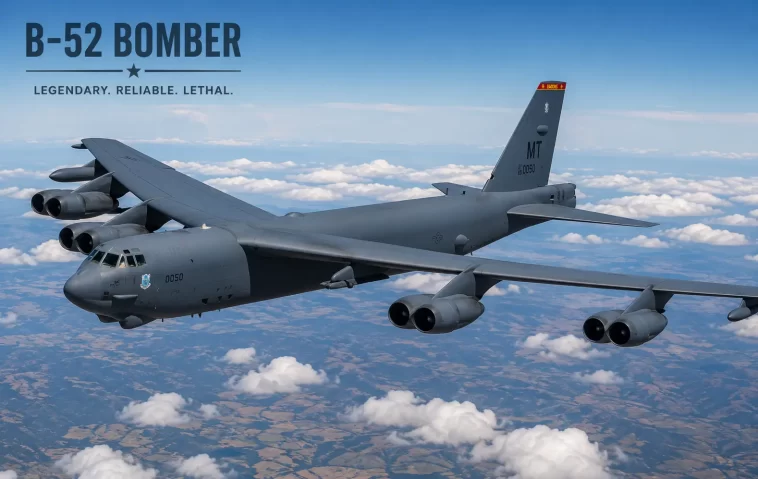
I still remember the first time I saw a B-52 Stratofortress up close at an air show. That massive, dark silhouette taxiing down the runway stopped everyone in their tracks. Nobody said a word for a moment. You could feel the history in that aircraft — decades of Cold War tension, Vietnam jungle runs, Gulf War cruise missile launches, all packed into one enormous airframe. That experience made me dive deep into the story of this remarkable machine, and I’ve pulled together 50 B-52 bomber facts that cover everything from its surprising origins to its plans to fly well past 2040.
Whether you’re a military history buff, an aviation enthusiast, or just curious about why a plane designed in the early 1950s is still one of America’s most important strategic assets, you’ll find something here that surprises you.
The Origins: How the B-52 Was Born
1. The Air Force issued the original requirement in 1946. Just one year after World War II ended, the U.S. Air Force began drafting specs for a new long-range strategic bomber. The goal was an aircraft capable of striking any target on Earth without relying on overseas bases.
2. Boeing almost lost the contract. Early designs used propeller-driven engines. Boeing’s team famously redesigned the entire aircraft in a single weekend at a hotel in Dayton, Ohio, switching to jet engines. That radical pivot saved the contract.
3. The YB-52 prototype made its first flight on April 15, 1952. The prototype took off from Boeing Field in Seattle. It was one of aviation history’s defining moments, though almost no one realized it at the time.
4. The B-52A entered U.S. Air Force service in 1955. After years of testing, the bomber officially joined the fleet. The “B model” entered operational service the same year.
5. A total of 744 B-52s were built. Production ran from 1952 to 1962, with aircraft rolling out of factories in both Seattle, Washington, and Wichita, Kansas.
6. The last B-52 ever built was delivered in October 1962. That final aircraft was a B-52H model. It’s remarkable that a production run ending over 60 years ago is still the backbone of U.S. bomber operations today.
7. Eight different variants were produced. The B-52 went through variants A through H. Each brought significant improvements in range, weapons capacity, avionics, and survivability.
Key Specifications You Should Know
8. The wingspan stretches 185 feet. To put that in perspective, the wingspan of a B-52 is roughly equivalent to the height of the Leaning Tower of Pisa. It’s enormous even by modern standards.
9. The aircraft is 159 feet, 4 inches long. That’s about half the length of a football field. The sheer physical scale of this aircraft is hard to grasp until you stand next to one.
10. It stands 40 feet, 8 inches tall. The tail alone towers above most buildings you’d pass on a typical street.
11. Maximum takeoff weight is 488,000 pounds. That’s nearly a quarter of a million kilograms. The bomber is one of the heaviest aircraft ever to enter operational service.
12. The B-52H has a top speed of 650 mph. That’s roughly Mach 0.84 — just below the speed of sound. For a bomber this large, that speed is genuinely impressive.
13. Unrefueled range reaches approximately 8,800 miles. You could fly from New York to Tokyo and still have fuel to spare. That range is a key part of what makes the B-52 a credible global deterrent.
14. Service ceiling is up to 50,000 feet. At that altitude, the aircraft flies well above the range of many conventional air defense systems — at least by the standards of the Cold War era.
15. The B-52H is powered by eight Pratt & Whitney TF33 turbofan engines. Most modern bombers use two or four engines. Eight engines give the B-52 enormous thrust but also make it a fuel-intensive platform.
16. Fuel capacity is approximately 312,197 pounds. The aircraft essentially carries a small lake’s worth of jet fuel. This is what enables those extraordinary unrefueled ranges.
17. The B-52 can carry up to 70,000 pounds of weapons. That payload capacity — roughly 35 tons — includes gravity bombs, cruise missiles, precision-guided munitions, and nuclear weapons.
Nicknames and Culture
18. Crews call it the BUFF. BUFF stands for “Big Ugly Fat Fella” — though aircrews often use a slightly more colorful version of the last word. Despite the nickname, they love the aircraft fiercely.
19. Its official name is the Stratofortress. The name follows a Boeing tradition: the B-17 was the Flying Fortress, the B-29 was the Superfortress, and the commercial Stratocruiser bridged the two eras. “Stratofortress” was a natural evolution.
20. The B-52 appeared in Stanley Kubrick’s Dr. Strangelove (1964). The film used the aircraft as a symbol of nuclear annihilation. The scenes of the B-52 flying toward its Soviet target became some of cinema’s most iconic Cold War imagery.
21. One B-52B was nicknamed “Balls 8.” This particular aircraft, serial number 52-0008, flew for NASA for decades as a testbed, launching experimental aircraft like the X-15 into the upper atmosphere. It’s considered one of the most historic individual airframes ever built.
The Cold War Years
22. The B-52 was the primary U.S. nuclear deterrent for decades. Before intercontinental ballistic missiles became widespread, the B-52 was the backbone of America’s nuclear strike capability. Its mission was to deter the Soviet Union through the credible threat of massive retaliation.
23. B-52s flew continuous airborne alert missions for years. During the height of the Cold War, B-52s armed with nuclear weapons flew constant patrols 24 hours a day, seven days a week. This practice, called Chrome Dome, ended in 1968.
24. Two B-52s collided over Palomares, Spain, in 1966. The midair collision during a refueling operation scattered four unarmed hydrogen bombs across the Spanish countryside. The incident caused an international incident and a massive cleanup operation.
25. A B-52 crashed in Greenland in 1968, again scattering nuclear materials. Near Thule Air Base, a fire forced the crew to bail out. The aircraft crashed onto sea ice, and the cleanup operation took months and involved hundreds of personnel.
26. The B-52 formed the “bomber leg” of the nuclear triad. The United States nuclear deterrent has always rested on three pillars — land-based ICBMs, submarine-launched missiles, and strategic bombers. The B-52 anchored that third leg for generations.
Combat History: Vietnam
27. B-52s entered combat in Vietnam in 1965. General William Westmoreland requested B-52 strikes to support ground troops. The Air Force initially had doubts about using strategic nuclear bombers in an irregular guerrilla conflict.
28. Operation Arc Light ran for over 126,000 sorties between 1965 and 1973. That staggering number of combat missions flew largely from Andersen Air Force Base in Guam and from U Tapao in Thailand.
29. The “Big Belly” modification allowed B-52Ds to carry up to 84 conventional bombs. Originally designed to carry 27 bombs internally, the modified D models could haul 84 conventional 500-pound bombs, making them deadly carpet bombing platforms.
30. By 1966, B-52s were dropping 8,000 tons of bombs on Vietnam every month. The scale of the bombing campaign was staggering. The sheer firepower concentrated in these aircraft transformed the nature of the air war.
31. Operation Linebacker II in December 1972 brought North Vietnam back to the negotiating table. The 11-day bombing campaign against Hanoi and Haiphong is credited with forcing the North Vietnamese to return to peace talks, eventually ending U.S. involvement in the war.
32. B-52 tail gunners shot down two MiG-21 fighters during Vietnam. This made the B-52 the largest aircraft in history ever credited with air-to-air kills. The tail gunner position on early models was a surprisingly effective last-ditch defense.
33. The tail gunner position on D models lacked an ejection seat. Gunners stationed in the rear compartment had no ejection seat and rarely survived uncontrolled bailouts. This was a serious design flaw that later models corrected by moving the gunner to the cockpit area.
Combat History: Gulf War and Beyond
34. B-52s launched over 100 cruise missiles on the opening night of the 2003 Iraq invasion. During Operation Iraqi Freedom, Stratofortresses unleashed a massive cruise missile barrage against targets throughout Iraq, demonstrating the bomber’s evolution into a standoff strike platform.
35. In the 1991 Gulf War, B-52s flew some of the longest combat missions ever recorded. B-52s launched from Barksdale Air Force Base in Louisiana, flew to Iraq to deliver strikes, then returned home — round trips covering thousands of miles. These missions lasted over 35 hours.
36. B-52s flew carpet bombing missions over Afghanistan after 9/11. The aircraft proved devastatingly effective against Taliban troop concentrations in open terrain, delivering massive conventional bomb loads from high altitude.
37. In 1994, two B-52s completed a round-the-world flight in 47 hours. This global power demonstration — the first time a B-52 dropped bombs during a circumnavigation — showcased the aircraft’s ability to strike any target on the planet with minimal notice.
Technical Facts Worth Knowing
38. The B-52’s skin wrinkles on the ground but smooths out in flight. When the aircraft is on the ground, the fuselage skin appears wrinkled. Once the crew pressurizes the cockpit at altitude, the skin expands and stretches perfectly flat. It’s by design, not a defect.
39. Two B-52s can monitor 140,000 square miles of ocean surface in two hours. Beyond bombing, the aircraft serves a critical maritime surveillance role, helping the U.S. Navy track surface ships across enormous ocean areas.
40. The B-52 can perform aerial refueling to extend its already enormous range indefinitely. With air-to-air refueling, a B-52 crew’s endurance is limited only by human factors, not fuel. This is what enables those legendary ultra-long-range missions.
41. A crew of five operates the B-52H. The standard crew includes an aircraft commander, pilot, radar navigator, navigator, and electronic warfare officer. Early models required six crew members, including a tail gunner.
42. The B-52 carries the widest variety of weapons of any aircraft in the U.S. inventory. Its weapons options range from conventional gravity bombs and cluster munitions to precision-guided missiles, cruise missiles, nuclear bombs, and mines.
43. The most-produced variant was the B-52G, with 193 aircraft built. The G model introduced integral fuel tanks in the wings instead of flexible bladder tanks, significantly increasing range. It also moved the tail gunner’s control station to the forward crew compartment.
Upgrades and the Future
44. The Air Force is replacing the B-52’s engines with Rolls-Royce F130 turbofans. Under the Commercial Engine Replacement Program (CERP), all operational B-52s will receive new engines. The critical design review was completed in December 2024.
45. Boeing received a $2.04 billion contract to advance the engine upgrade program. The scope of the program covers system integration, aircraft modification, and testing. Work is expected to be complete by 2033.
46. The upgraded aircraft may be designated the B-52J. The new engine-equipped variant is expected to deliver improved fuel efficiency, greater range, and reduced maintenance burden compared to the aging TF33 engines.
47. Current engineering studies show the B-52 can remain operational beyond 2040. Some projections extend the aircraft’s service life into the 2050s with continued upgrades. This means crews currently in training may fly an aircraft designed before their grandparents were born.
48. The B-52H is the only remaining operational variant. All earlier models — A through G — have been retired. The 76 B-52H aircraft still in service are stationed at Barksdale Air Force Base in Louisiana and Minot Air Force Base in North Dakota.
49. The B-52 has never dropped a nuclear weapon in combat. Despite spending decades on nuclear alert and carrying nuclear warheads on countless missions, the aircraft has never been used for nuclear strike. Its value has always been as a deterrent.
50. The B-52 is the longest-serving combat aircraft in U.S. military history. No other warplane in American history has remained in frontline service as long. When the B-52H finally retires — likely sometime in the 2040s or 2050s — it will have served for roughly a century. There is nothing quite like it in the history of aviation.
FAQ: B-52 Bomber Facts
How many B-52s are still in service today? As of the most recent figures, 76 B-52H aircraft remain in active service with the U.S. Air Force, stationed at Barksdale AFB in Louisiana and Minot AFB in North Dakota. Additional airframes are kept in storage at Tinker AFB in Oklahoma.
Why does the B-52 have eight engines? The B-52 was designed in the early 1950s when jet engine technology was still maturing. Individual engines produced relatively low thrust compared to modern turbofans, so eight engines were needed to achieve the required performance. Modern engine upgrades aim to replace all eight with more efficient alternatives.
Has the B-52 ever been used in combat? Yes. The B-52 has seen combat in Vietnam (1965–1973), the Gulf War (1991), Operation Allied Force over Yugoslavia (1999), Afghanistan (2001), Iraq (2003), and various other operations since then. It is one of the most combat-experienced bombers ever built.
What is the B-52’s nickname? Aircrews call it the BUFF, which stands for “Big Ugly Fat Fella” — though the actual phrase used informally is often more colorful. Despite the affectionate mockery, crews who fly the aircraft speak of it with genuine pride.
Can the B-52 carry nuclear weapons? Yes. The B-52 has been nuclear-capable throughout its service life and remains part of the U.S. nuclear triad today. However, it has never used nuclear weapons in actual combat.
How long can a B-52 fly without refueling? The B-52H has an unrefueled range of approximately 8,800 miles. With aerial refueling, the only practical limit on mission duration is crew endurance. Some combat missions have lasted over 35 hours.
What will replace the B-52? The B-21 Raider is being developed as the future strategic bomber and will eventually replace the aging B-52 fleet. However, the B-52 is expected to remain in service alongside the B-21 for at least another decade or two due to its unique payload capacity and versatility.
The B-52 Stratofortress is more than a bomber. It’s a living piece of military history, a Cold War icon, and somehow still one of the most capable aircraft in the world’s most powerful air force. The fact that it continues to serve — and will keep serving into a future none of its original designers could have imagined — says everything about how right they got it the first time.
