I remember the first time I sat in the back seat of a robotaxi in a test zone and realized there was no one in the driver’s seat. No one. The car just pulled into traffic and navigated a busy intersection on its own. It was impressive. But as the ride ended, my first thought was not about the technology. It was about accountability. Who was responsible if something went wrong?
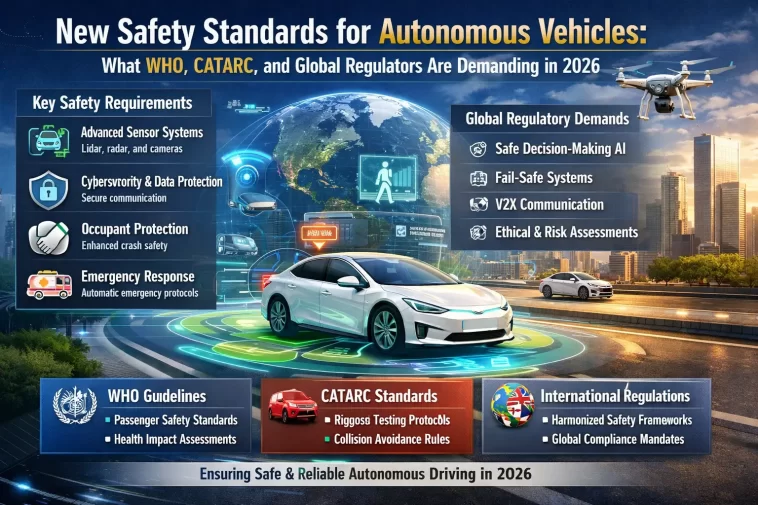
That question is exactly what regulators around the world have been wrestling with for years. And in 2025 and 2026, they finally started delivering real answers. A wave of new autonomous vehicle safety standards — from the United Nations, from China’s CATARC, from the United States, and from the European Union — is reshaping what it means to put a self-driving vehicle on a public road.
If you are building, buying, or managing autonomous vehicles, you need to understand what these new regulations actually require.
Why Now? The Regulatory Urgency Behind Autonomous Vehicle Safety
For most of the past decade, autonomous vehicle testing operated in a regulatory gray zone. Companies ran pilots, collected data, and pushed technology forward — often faster than governments could keep up.
That era is ending. Several high-profile incidents accelerated the regulatory response. China’s Ministry of Industry and Information Technology specifically cited accidents linked to Waymo, Uber, Cruise, and Toyota as justification for stricter frameworks. A fatal crash involving Xiaomi’s Navigate on Autopilot feature in early 2025 intensified public pressure on Chinese regulators to act.
At the same time, deployments have scaled dramatically. By 2026, Level 4 robotaxis are a common sight in Beijing, Shanghai, Shenzhen, and Wuhan. Long-haul autonomous truck routes are operating commercially in the United States. The technology has moved from research to revenue — and with that shift comes a much harder question about what constitutes an acceptable level of safety risk.
The UN’s Historic Global Regulation for Automated Driving Systems
The most significant development in autonomous vehicle regulation in 2026 is happening at the international level. In late January 2026, the UNECE Working Party on Automated/Autonomous and Connected Vehicles — known as GRVA — adopted a draft Global Technical Regulation (GTR) for Automated Driving Systems. The regulation is now scheduled for formal adoption at the WP.29 World Forum session on June 23–26, 2026.
This regulation took roughly a decade to finalize, and its scope is unprecedented. It establishes the first globally harmonized framework for validating and deploying vehicles equipped with Automated Driving Systems across all member countries.
The Safety Case Approach
Rather than setting a single numerical performance threshold that every vehicle must meet, the UN regulation takes what experts call a “safety assurance” approach — also referred to as the safety case framework.
Under this model, manufacturers must construct a structured, evidence-based argument demonstrating that their autonomous driving system operates without unreasonable safety risk. The central principle is clear: ADS must perform at least at the level of a competent and careful human driver.
What Manufacturers Are Required to Do
If you are a vehicle manufacturer or ADS developer operating under this framework, the requirements are substantial. Here is what the regulation demands:
- Operate a certified Safety Management System (SMS) that governs safety across the vehicle’s entire life cycle — from development and production through deployment and post-market monitoring
- Conduct independent internal and external audits of that safety management system on a regular basis
- Validate ADS safety through multiple testing pillars — including track testing, real-world on-road testing, and simulation-based validation
- Install a Data Storage System for Automated Driving (DSSAD) — essentially a black box for self-driving vehicles that captures critical operational data to reconstruct scenarios after accidents
- Report in-service safety data on an ongoing basis after deployment
The UNECE Executive Secretary described the regulation as essential for avoiding fragmented national approaches, supporting safety, and enabling global market access and innovation simultaneously.
China’s MIIT Mandatory Safety Standards: A Stricter Baseline for L3 and Above
While the UN framework sets the global ceiling, China has moved aggressively to establish its own mandatory floor — and it is a high one.
On February 12, 2026, China’s Ministry of Industry and Information Technology released its draft mandatory standard titled Safety Requirements for Autonomous Driving Systems of Intelligent Connected Vehicles. The public comment period closed on April 13, 2026. Implementation is proposed for July 1, 2027.
This is not a voluntary guideline. Once finalized, the standard will be mandatory. Non-compliant vehicles will be prohibited from production, sale, and import in China.
What China’s New Standard Introduces
The draft significantly raises the safety baseline for Level 3 autonomous driving systems. Under SAE’s internationally recognized classification system, Level 3 systems perform all driving tasks under specific conditions but require the driver to respond to takeover requests when the system reaches its limits.
China’s new standard introduces a critical new requirement: if a driver fails to respond to a takeover request, the Level 3 system must be capable of executing a Minimal Risk Manoeuvre independently — meaning it must safely bring the vehicle to a stop or reach a safe state without human intervention.
The standard also mandates:
- DSSAD installation: A Data Storage System for Automated Driving that complies with China’s national data recording standard in force since January 2026, capturing detailed operational data to reconstruct accident scenarios
- Transparent SAE Level labeling: All ADAS functions must be clearly labeled (such as “Level 2”) to prevent consumer confusion about what the vehicle can and cannot do
- OTA update scrutiny: Over-the-air updates to safety features now require the same regulatory review as hardware recalls
- Advertising restrictions: Terms like “autonomous driving” or “smart driving” are banned in marketing materials for systems that do not fully meet those definitions. Violations can result in fines, license revocation, and criminal charges
The mandatory standard replaces the voluntary 2024 general technical requirements. Vehicles already approved under the previous framework are given a transitional period of 13 months before non-compliant systems can no longer be produced or sold.
CATARC and the C-NCAP 2024/2027 Revolution
You cannot understand China’s autonomous vehicle safety push without understanding CATARC — the China Automotive Technology and Research Center — and the assessment program it manages.
C-NCAP, or the China New Car Assessment Programme, is China’s official vehicle safety rating system. Launched in 2006 and modeled after Europe’s Euro NCAP, it has been revised six times. The 2024 revision was the most transformative yet.
What C-NCAP 2024 Changed
The 2024 C-NCAP protocol made active safety systems a central scoring category for the first time in the program’s history. Previously, crash test results dominated the ratings. Now, driver monitoring systems and ADAS performance directly affect how many stars a vehicle receives.
The key changes include:
- Driver Monitoring Systems (DMS) contribute 2 points to the overall safety score — second only to Automatic Emergency Braking, which contributes 3 points
- Detection accuracy threshold: A DMS must achieve at least 90% detection accuracy to receive full points
- Sensor fusion evaluation: Tests now assess how well cabin sensors and exterior sensors work together — for example, integrating DMS with AEB and VRU (Vulnerable Road User) protection systems
- Automatic Emergency Braking tests for pedestrian, cyclist, and nighttime scenarios have been toughened
Major Chinese automakers including SAIC, Geely, and BYD incorporated C-NCAP 2024-compliant driver monitoring systems in all new models from 2024 onward. Suppliers like Bosch and Valeo have released integrated DMS platforms using multi-modal sensor stacks combining infrared cameras, RGB cameras, and radar.
What C-NCAP 2027 Will Add
On February 12, 2026 — the same day China’s MIIT released its mandatory standard — CATARC published the draft C-NCAP 2027 Edition for public comment.
The 2027 revision signals that the next wave of requirements will extend into higher levels of driving automation. Industry observers note that the new protocol’s active safety testing framework is being built to evaluate the boundaries of L2+ through L4 autonomous driving algorithms — not just driver assistance features.
Testing equipment standards have also been elevated. The 2027 framework requires high-precision ground truth systems capable of multi-vehicle networking to verify the accuracy of autonomous driving decisions in complex real-world scenarios.
The United States: Federal Framework Finally Taking Shape
For years, autonomous vehicles in the United States operated under a patchwork of state-by-state rules that created significant operational inconsistencies for companies trying to run interstate routes.
That is beginning to change. In March 2026, the National Highway Traffic Safety Administration published two proposed rulemakings designed to ease the path for manufacturing and deploying autonomous vehicles on public roads. Both proposals would amend existing Federal Motor Vehicle Safety Standards by removing requirements for certain safety equipment that is unnecessary in vehicles without a human driver — such as traditional steering controls and foot pedals.
The Autonomous Vehicle Acceleration Act of 2025, introduced in the Senate, calls for updating federal motor vehicle safety standards specifically for Level 4 and Level 5 Automated Driving Systems to enable faster adoption. It recognizes that current standards were designed for human-operated vehicles and create certification barriers for fully driverless designs.
The Self Drive Act of 2026 takes a different approach, addressing interstate operations by enabling limited commercial operation during testing phases, allowing companies to generate revenue while navigating state-level regulatory inconsistencies.
The European Union: Expanding Driver Monitoring and HMI Testing
Europe is moving on two parallel tracks. The EU General Safety Regulation of 2022 already mandated automatic emergency braking and other ADAS features on all new vehicles. The Euro NCAP 2026 protocol update goes significantly further.
If you are a manufacturer or fleet operator dealing with European markets, here is what the 2026 Euro NCAP update requires you to pay attention to:
- Expanded Driver Monitoring Systems: Vehicles must now detect not just drowsiness and distraction, but also signs of potential substance impairment through behavioral indicators including steering patterns, eye tracking, and reaction times
- Human-Machine Interface (HMI) testing: New protocols evaluate the accessibility, positioning, and tactile feedback of vehicle controls to ensure drivers can safely operate automated systems
- Adaptive Lane Keeping Assist: Systems that adjust in real-time based on driver alertness levels are now evaluated and credited in the scoring
- Electric vehicle battery safety: Euro NCAP 2026 introduces specific post-crash battery integrity testing for EVs
The EU’s unified regulatory framework for higher-level autonomous vehicles is targeted for completion in 2026, with the goal of creating consistent cross-border testing standards and vehicle approval rules across all member states.
How China’s Domestic Standards Are Shaping Global Norms
One of the most significant — and least discussed — dynamics in the current regulatory environment is how China’s domestic standards are beginning to influence international frameworks.
In July 2025, the International Organization for Standardization adopted ISO 34505, an international benchmark for testing autonomous driving systems. The standard was developed by Chinese and German experts and closely mirrors methodologies already in use in China. This gives Chinese manufacturers a meaningful compliance advantage when entering global markets, since the testing environments they have already been operating in closely match what the international standard requires.
China also indicated to UNECE that it intends to draft its national mandatory standard following the structure of the UN GTR on Automated Driving Systems — a signal that the world’s largest vehicle market intends to align with the global framework rather than diverge from it.
What These Regulations Mean If You Work with Autonomous Vehicles
Whether you manage a fleet, develop ADS software, run a logistics operation, or advise on vehicle procurement, these regulatory developments have direct practical implications.
Here is what you need to act on:
Prepare for DSSAD as standard equipment. Every major regulatory framework — China, UN, and increasingly the EU — now requires an onboard data recording system for autonomous driving. If your vehicles or your suppliers’ vehicles do not have this, they will not be certifiable under any major market’s forthcoming mandatory standards.
Audit your ADAS labeling and marketing materials. China’s ban on misleading “autonomous driving” terminology in advertising is a harbinger of what other markets are likely to follow. Make sure your customer-facing communications accurately reflect what your systems can and cannot do.
Invest in Driver Monitoring Systems even for semi-autonomous vehicles. C-NCAP 2024 and Euro NCAP 2026 both directly score DMS performance. Without a DMS achieving at least 90% detection accuracy, your vehicles cannot achieve top safety ratings in China — which increasingly affects purchasing decisions globally.
Map your current ADS validation process against the safety case framework. The UN GTR does not prescribe specific test numbers or pass/fail thresholds. Instead, it requires a structured safety argument backed by evidence. If your validation process was built around hitting a single numerical target, you will need to expand it into a full safety case documentation system.
Plan for mandatory compliance timelines. China’s new mandatory standard targets July 1, 2027 implementation, with a 13-month transition for already-approved vehicles. The UN GTR, if adopted in June 2026, would enter into force immediately at the international level, with domestic implementation timelines set by each country.
The Road Safety Numbers Behind the Regulations
It is worth remembering why all of this regulatory activity exists. Road traffic accidents kill more than 1.35 million people every year globally, according to World Health Organization estimates. In the United States alone, truck-related fatalities account for roughly 15 deaths per day.
Proponents of autonomous vehicles argue — with growing real-world evidence — that properly designed ADS can outperform human drivers on safety metrics. Aurora’s autonomous trucks logged zero at-fault collisions during commercial operations. Waymo’s robotaxi data consistently shows lower crash rates per mile than human-driven vehicles in comparable conditions.
But this evidence only holds if the underlying systems are rigorously validated and honestly represented. That is exactly what the new wave of regulations is designed to enforce.
Frequently Asked Questions (FAQ)
What is the UNECE GRVA and why does its regulation matter?
GRVA is the United Nations Working Party on Automated/Autonomous and Connected Vehicles, operating under the World Forum for Harmonization of Vehicle Regulations. Its draft Global Technical Regulation on Automated Driving Systems, adopted in January 2026 and scheduled for formal vote in June 2026, represents the first globally harmonized framework for deploying self-driving vehicles on public roads. Countries that adopt it will use it as the basis for their domestic autonomous vehicle regulations.
What is CATARC and what is C-NCAP?
CATARC stands for China Automotive Technology and Research Center, the government-affiliated body that manages China’s official vehicle safety rating program, C-NCAP. Since 2006, C-NCAP has rated vehicles sold in China on safety performance. The 2024 revision was the first to make driver monitoring systems a direct scoring factor in the overall safety rating.
What does the “safety case” approach mean for autonomous vehicle manufacturers?
Rather than meeting a single numerical safety metric, manufacturers must build a structured, documented argument — using evidence from simulations, track tests, and real-world data — that their ADS operates without unreasonable risk. They must also operate a certified Safety Management System across the vehicle’s full life cycle and submit to independent audits.
What is a DSSAD and why is it now mandatory?
A DSSAD is a Data Storage System for Automated Driving — essentially a black box for self-driving vehicles that records critical operational data before, during, and after incidents. It is now required under China’s new mandatory standard and referenced in the UN GTR framework. It allows investigators to accurately reconstruct what an autonomous system was doing at the time of an accident.
Are these regulations only about fully driverless vehicles?
No. The current regulatory push covers Level 2, Level 3, and Level 4 systems. China’s new mandatory standard focuses specifically on raising requirements for Level 3 systems, requiring them to execute Minimal Risk Manoeuvres if a driver fails to respond to a takeover request. C-NCAP changes affect all vehicles with driver assistance or monitoring features.
What happens to vehicles that don’t comply with China’s new mandatory standards?
Once China’s mandatory standard takes effect on July 1, 2027, non-compliant vehicles will be prohibited from production, sale, and import in China. Vehicles already approved under the previous voluntary standard have a 13-month transition period before the prohibition applies to them.
Is there a global unified autonomous vehicle regulation yet?
Not a single binding global standard, no. The UN GTR, if adopted in June 2026, is the closest the world has come, but implementation still occurs through each country’s domestic regulatory process. The US, EU, and China each maintain distinct frameworks, though all are converging toward similar core principles: safety case documentation, DSSAD requirements, and independent validation of ADS performance.
The New Standard Is Safety You Can Prove
The autonomous vehicle industry is entering a new phase. The days of self-certification and voluntary guidelines are giving way to mandatory standards, independent audits, black box recorders, and structured evidence requirements.
That is not a setback for innovation. It is the foundation that makes mass deployment possible. Consumers will not accept self-driving vehicles at scale without confidence in the regulatory system behind them. Regulators will not approve broad deployment without the tools to hold manufacturers accountable when things go wrong.
What CATARC, UNECE, NHTSA, and the EU are building — each in their own way — is the infrastructure of trust that the autonomous vehicle era requires. For anyone building or operating in this space, understanding and adapting to these standards is no longer optional. It is the price of participation.
