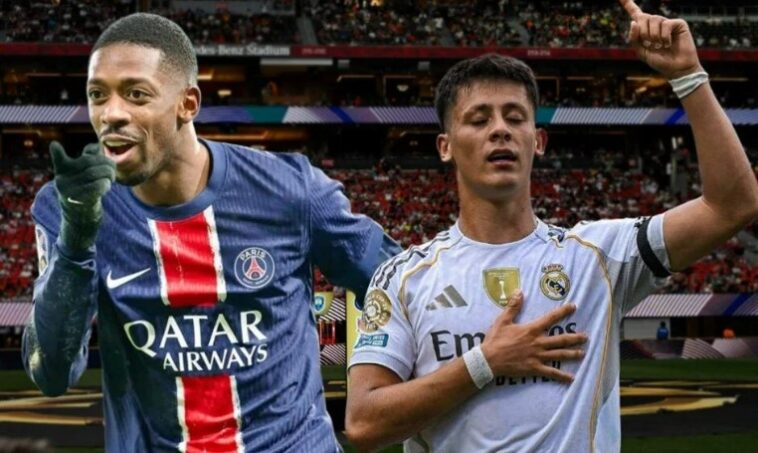
Introduction: Setting the Stage – Two European Giants, One Enduring Rivalry
European football is home to a select group of clubs whose names resonate with power, prestige, and an insatiable hunger for glory. Among these, Paris Saint-Germain (PSG) and Real Madrid stand as prominent figures, each having carved unique paths to global prominence. Their encounters on the pitch, particularly in the high-stakes arena of the UEFA Champions League, have evolved into a compelling rivalry, showcasing a clash of distinct footballing philosophies and models for achieving elite status.
The fundamental difference in their origins and growth trajectories provides a crucial context for understanding their current standing. Real Madrid, founded on March 6, 1902, as Madrid Foot Ball Club, represents a legacy built on over a century of organic growth and sustained sporting excellence across multiple eras.1 Its ascent to a position of dominance was a gradual process, allowing its identity to deepen over time. In stark contrast, Paris Saint-Germain, established much more recently in August 1970 following the merger of Paris Football Club and Stade Saint-Germain, embodies a rapid, modern ascent.3 PSG’s rise to its current stature is largely a phenomenon accelerated by significant, targeted financial investment, presenting a distinct model for achieving footballing giant status in the contemporary era. This temporal and developmental disparity means their “giant” status is built on entirely different foundations, profoundly influencing their club identity, fan base development, and strategic approaches to competition.
Foundational Stories: From Humble Beginnings to Global Powerhouses
Paris Saint-Germain: The Rapid Ascent of a Modern Club
Paris Saint-Germain’s journey to the pinnacle of European football is a testament to ambition fueled by strategic investment. The club’s origins are relatively recent, dating back to August 1970, when Paris Football Club merged with Stade Saint-Germain.3 PSG made an immediate, albeit short-lived, impact, securing promotion to Division 1 and claiming the Division 2 title in their inaugural season. However, this early momentum was checked by a club split in 1972, which saw PSG administratively relegated to Division 3. Despite this setback, the club swiftly returned to the premier division in 1974 and moved into the iconic Parc des Princes.3
The 1980s marked PSG’s first taste of silverware, with consecutive French Cup titles in 1982 and 1983, followed by their maiden league championship in 1986. A period of decline ensued, but the club experienced a significant revitalization with the takeover by television giants Canal+ in 1991.3 This era, featuring players like David Ginola, George Weah, and Raí, yielded nine trophies and an impressive five consecutive European semi-finals during the 1990s, culminating in their crowning glory, the UEFA Cup Winners’ Cup in 1996.3
The early 21st century presented new challenges, as the club struggled to replicate past successes despite the presence of stars like Ronaldinho and Pauleta. This period was marked by high-profile crises, leading to Canal+’s sale of the club to Colony Capital in 2006. The situation, however, deteriorated further, with PSG battling relegation in the 2006–07 and 2007–08 campaigns.3
The fortunes of Paris Saint-Germain dramatically shifted with the acquisition by Qatar Sports Investments (QSI) in 2011.3 QSI, a subsidiary of the Qatar Investment Authority and backed by the Qatari government, initially purchased 70% of the club’s shares before becoming the sole owner in 2012.5 This pivotal moment transformed PSG into one of the wealthiest teams globally, with the Emir of Qatar, Tamim bin Hamad Al Thani, holding the final say on major decisions.5 This change in ownership was explicitly driven by a pledge to form a team capable of winning the UEFA Champions League.5 Since 2011, PSG has invested over €1.9 billion in player transfers, securing world-class talents such as Zlatan Ibrahimović, Thiago Silva, Edinson Cavani, Ángel Di María, and notably, Neymar and Kylian Mbappé, the world’s two most expensive transfers in football history.3 This massive expenditure led to an era of unprecedented dominance in French football and, ultimately, their long-sought first Champions League title in 2025.3 The history of PSG clearly illustrates how successive ownership changes directly dictated the club’s trajectory, from periods of decline and struggle to revitalization, with QSI’s intervention serving as the ultimate and most transformative catalyst for their current global powerhouse status. This contrasts sharply with Real Madrid’s more continuous, internally-driven evolution, where the club’s identity and success have been built more organically over a longer period, less subject to dramatic external financial shifts.
Real Madrid: A Century of Royal Legacy and Sporting Excellence
Real Madrid’s narrative is deeply rooted in a rich history stretching back over a century. The club was founded modestly on March 6, 1902, by a group of students led by Juan Padrós Rubio, establishing the Madrid Foot Ball Club in the back room of a store.1 In its nascent years, the club played on dirt fields, predating the existence of organized national football in Spain.1 Madrid Foot Ball Club quickly demonstrated its competitive spirit, winning its first cup in 1905, the first of four consecutive cup victories.1
A defining moment in the club’s history arrived in 1920 when King Alfonso XIII granted the club the title “Real,” meaning “Royal”.1 This royal endorsement officially marked the debut of Real Madrid, cementing its prestigious connection to the Spanish monarchy and bestowing an inherent sense of grandeur and institutional backing. This unique historical connection provided Real Madrid with a foundational weight and legitimacy far earlier than PSG’s modern, commercially-driven brand building, which has had to cultivate its prestige through contemporary marketing and financial power.
Real Madrid continued its ascent, winning its first league title in the 1931–32 season and successfully retaining it the following year.7 The club’s home field, the Santiago Bernabéu, was destroyed during the Spanish Civil War but was rebuilt and hosted its first match in December 1947.1 It was during the 1950s and 1960s that Real Madrid truly established itself as a dominant force in both Spanish and European football. This golden era saw the club secure an astonishing five consecutive European Cups and six overall, alongside 12 league titles within a 16-year span.7 This period of sustained success laid the groundwork for Real Madrid’s unparalleled European hegemony and its recognition as a global footballing institution.
The Pursuit of Glory: A Tale of Two Trophy Cabinets
The trophy cabinets of Paris Saint-Germain and Real Madrid tell distinct stories of ambition, dominance, and the pursuit of ultimate glory.
PSG’s Domestic Dominance and European Breakthrough (2025 UCL Triumph)
Paris Saint-Germain has firmly established itself as the most decorated club in France, boasting an impressive total of 55 official titles.8 Their domestic dominance has been particularly overwhelming since the Qatar Sports Investments (QSI) takeover in 2011. This period has seen them accumulate a remarkable 13 Ligue 1 titles, including an unbeaten campaign in the 2024-25 season and four consecutive crowns.8 Beyond the league, PSG has also secured 16 French Cups, 9 French League Cups, and 13 French Supercups, demonstrating their comprehensive control over national competitions.8
The ultimate ambition for PSG, explicitly stated by its Qatari owners, was to win the UEFA Champions League.5 After years of significant investment and near misses, this aspiration was finally realized in 2025. Paris Saint-Germain were crowned champions of Europe for the first time, thrashing Internazionale Milan 5-0 in the final on May 31, 2025.8 This historic victory also marked them as the first French club to achieve the continental treble and the continental quadruple, solidifying their place in European football history.9 Prior to this crowning achievement, PSG had also tasted European success with a UEFA Cup Winners’ Cup in 1996 and a UEFA Intertoto Cup in 2001.8
Real Madrid’s Unrivalled European Hegemony
Real Madrid stands as one of the most successful football clubs globally and undeniably the most successful in Europe.7 Their record in the European Cup/UEFA Champions League is unparalleled, with a staggering 15 titles. This includes two distinct periods of sustained dominance: an initial era of five consecutive wins in the 1950s and 1960s, and a more recent run of three consecutive titles from 2015-16 to 2017-18.7 Their most recent triumph, a record-extending 15th Champions League title, came in June 2024, marking their sixth victory in eleven seasons and earning recognition from Guinness World Records.7
Domestically, Real Madrid’s achievements are equally extensive, boasting a record 36 La Liga titles, 20 Copa del Rey triumphs, and 13 Supercopa de España victories.7 On the international club stage, they have secured a record 9 FIFA Club World Cups and 6 UEFA Super Cups.7 Real Madrid holds the distinction of being the first club across Europe’s top-five leagues to win 100 trophies in all competitions and was recognized by FIFA as the greatest football club of the 20th century.7
While PSG finally achieved their ultimate European ambition in 2025, Real Madrid’s sustained, multi-generational dominance in the UEFA Champions League sets a benchmark that few, if any, clubs can ever hope to match. This difference goes beyond mere numbers; it speaks to a club identity intrinsically linked with European supremacy, where the competition is almost seen as their birthright. For PSG, the 2025 victory represents the culmination of a deliberate, financially-backed “project” to reach the pinnacle, a significant breakthrough that validates years of investment. For Real Madrid, each Champions League title is another chapter in an ongoing, deeply ingrained legacy, a continuation of a historical narrative of European hegemony. This distinction highlights two different forms of footballing greatness: one built on a long-standing, almost inherent connection to the continent’s elite competition, and the other on a modern, strategic push to conquer it.
Strategic Approaches: Ownership, Transfers, and Tactical Philosophies
The distinct historical trajectories and financial models of PSG and Real Madrid have profoundly shaped their strategic approaches to ownership, player acquisition, and on-field tactics.
PSG: State-Backed Ambition and Adaptive Positionism
Paris Saint-Germain operates under a unique ownership structure, with Qatar Sports Investments (QSI) holding an 87.5% majority stake, and American investment firm Arctos Partners owning the remaining 12.5%.5 As a state-owned club, financially backed by the Qatari government, PSG possesses immense wealth, making them one of the richest teams globally.5 While QSI chairman Nasser Al-Khelaifi serves as club president, the ultimate decision-making power rests with Tamim bin Hamad Al Thani, the Emir of Qatar.5
This financial backing has directly influenced PSG’s transfer strategy. Since 2011, the club has spent over €1.9 billion on player transfers, a massive expenditure aimed at fulfilling the promise of winning the UEFA Champions League.5 This strategy initially focused on acquiring superstar players like Zlatan Ibrahimović, Neymar, Kylian Mbappé, and Lionel Messi.5 However, following their Champions League triumph in 2025, there has been a noticeable shift away from a purely star-centric model towards a team-first approach and the development of younger prospects.6
Under the guidance of head coach Luis Enrique, appointed in June 2023, PSG’s tactical philosophy has undergone a significant transformation.13 The focus has shifted from over-reliance on individual brilliance to a cohesive, team-centric approach, characterized by fluid, attacking football that emphasizes teamwork.13 Enrique’s tactical acumen is evident in the team’s high pressing, quick transitions, and positional flexibility.13 This evolution has been described as “adaptive positionism,” where players move between a predefined structure and one adapted to the spaces offered by the opponent, creating overloads to control possession and facilitate quick ball recovery.14 Enrique’s approach also includes astute squad rotation, ensuring player fitness and morale, and fostering a competitive environment where emerging talents like Ousmane Dembélé, Khvicha Kvaratskhelia, Vitinha, and João Neves are seamlessly integrated into the evolving style.13
Real Madrid: Member-Owned Tradition and Evolving Pragmatism
Real Madrid stands apart from many modern football giants due to its unique ownership model: it is 100% owned by its club members, known as “socios”.16 This democratic structure means the club cannot rely on billionaire owners for financial support and must maintain strict financial responsibility to meet community expectations.16 There is speculation about a potential shift towards a 50+1 German model, which would allow private investments while retaining fan control, potentially enhancing financial superiority and sustainability.17
Real Madrid’s transfer strategy reflects this member-owned structure and a long-term vision. The club prioritizes financial responsibility, balancing short-term success with long-term sustainability.16 This involves a focus on acquiring young talent, often nurturing them through their renowned youth academy, La Fábrica, which aims to develop both sporting and ethical aspects of players.16 The strategy ensures a mix of international stars and homegrown talent, with an opportunistic approach to big signings, such as the free transfer of Kylian Mbappé in 2024.18 The club avoids excessive squad bloat, aiming for around two players per position to maintain harmony and manage costs.18
Tactically, Real Madrid’s approach under Carlo Ancelotti (until May 2025) and subsequently Xabi Alonso (from June 2025) for the 2024-25 season is a captivating blend of traditional attacking flair and a more pragmatic, possession-based style.20 While the familiar 4-3-3 formation is often favored, tactical flexibility is a hallmark.20 The team combines defensive strength with explosive attacking capabilities, minimizing reliance on individual brilliance alone.20 Expect a continued emphasis on relentless pressing and high-octane counter-attacks, but also a greater focus on controlled possession in midfield to create more structured attacks.20 Key players like Kylian Mbappé, Vinicius Jr., Jude Bellingham, and Rodrygo form a formidable attacking trident, complemented by a dynamic midfield of Camavinga, Valverde, and Bellingham.20
The contrasting ownership models—PSG as a state-backed “project” and Real Madrid as a member-owned “institution”—are central to understanding their strategic differences. PSG’s identity as a “project” signifies a deliberate, high-capital investment aimed at rapidly achieving specific goals, primarily the Champions League. This approach allows for aggressive spending and a swift transformation of the squad. Real Madrid, as an “institution,” embodies a more traditional, organically grown model where success is built over generations, deeply embedded in community values and a commitment to financial prudence. This difference in foundation shapes every aspect of their operations, from transfer market behavior (PSG’s willingness to break transfer records versus Real Madrid’s more calculated, long-term talent acquisition) to their relationship with their fanbase. The “project” seeks to build a legacy quickly through external infusion, while the “institution” already possesses a deep-rooted legacy that guides its continuous evolution.
Squad Dynamics and Recent Performance (2024-2025 Season)
The 2024-2025 season provided a clear snapshot of the current strengths and competitive standing of both Paris Saint-Germain and Real Madrid.
PSG: Dominant in France, European Champions
Paris Saint-Germain enjoyed an exceptional 2024-2025 season, particularly marked by their long-awaited European success. In Ligue 1, PSG demonstrated overwhelming dominance, claiming their 13th league title and their fourth consecutive crown with an unbeaten season.10 Their league record stood at 26 wins, 6 draws, and 2 losses, accumulating 84 points, showcasing their consistent quality.15 The team’s offensive prowess was evident, scoring 92 goals (2.71 per game) while conceding only 35 (1.03 per game), resulting in a significant goal difference of +57.15
The crowning achievement of the season was their UEFA Champions League triumph. PSG overcame Internazionale Milan with a decisive 5-0 victory in the final, securing their first-ever Champions League title.11 Their path to the final included notable victories, such as knocking out Liverpool in the Round of 16 and defeating Arsenal in the semi-finals.10
Key players were instrumental in PSG’s success. Bradley Barcola was a standout in attack, contributing 14 goals and 10 assists in Ligue 1.15 Ousmane Dembélé also had a prolific season, scoring 21 goals and providing 6 assists.15 The midfield was well-oiled, with João Neves contributing 3 goals and 8 assists, and Vitinha adding 5 goals and 1 assist.15 The defense, featuring players like Nuno Mendes, Achraf Hakimi, Willian Pacho, and Marquinhos, proved solid throughout the campaign.15
Real Madrid: La Liga Runners-Up, European Super Cup & Intercontinental Cup Winners
Real Madrid’s 2024-2025 season was a mixed bag of significant international silverware and domestic challenges. In La Liga, Real Madrid finished second with a record of 26 wins, 6 draws, and 6 losses, accumulating 84 points, placing them behind champions Barcelona.21 The team scored 78 goals and conceded 38, with a goal difference of +40.25
In European competition, Real Madrid’s Champions League campaign concluded in the quarter-finals, where they were eliminated by Arsenal.21 Domestically, they also finished as runners-up in both the Copa del Rey and the Supercopa de España, losing to Barcelona in both finals.21
Despite these domestic and Champions League setbacks, Real Madrid showcased their continued international prowess by winning two significant titles early in the season. They claimed a record-breaking sixth UEFA Super Cup, defeating Atalanta 2-0.21 Furthermore, they won the inaugural FIFA Intercontinental Cup, beating Pachuca 3-0 in the final.21 They also participated in the FIFA Club World Cup, reaching the semi-finals.21 These victories saw Carlo Ancelotti, who managed the team until May 2025, become the most decorated manager in the club’s history with 15 trophies.21
Kylian Mbappé, a new signing for Real Madrid in 2024, was the club’s top goalscorer, netting 31 goals in the league and 44 across all competitions.21 Vinicius Jr. (projected 18 goals, 10 assists), Jude Bellingham (projected 5 assists), and Rodrygo (projected 15 goals, 9 assists) also formed a potent attacking force.20 The midfield, with the addition of Bellingham, demonstrated dynamism and creativity.20 While the team boasted strong attacking prowess and a well-equipped defense, potential weaknesses were identified in squad depth, particularly in certain positions, highlighting the need for robust backup options to manage injuries and maintain consistency throughout a grueling season.20
Head-to-Head Encounters: A Growing Rivalry
The competitive meetings between Paris Saint-Germain and Real Madrid, though fewer than some classic European rivalries, have consistently delivered drama and significant moments. In 12 previous competitive encounters, Real Madrid holds a slight edge with five wins to PSG’s four, alongside three draws.27
While their rivalry has intensified in the modern Champions League era, they also faced each other in the UEFA Cup and UEFA Cup Winners’ Cup in the mid-1990s. Notably, PSG prevailed in knockout ties during those earlier competitions.28
The Champions League has been the primary battleground in recent years, producing several memorable clashes:
- 2018 UEFA Champions League Round of 16: Real Madrid emerged victorious with a 5-2 aggregate score. They won the first leg 3-1 and the second leg 2-1.27
- 2019 UEFA Champions League Group Stage: PSG secured a dominant 3-0 victory over Real Madrid in their group stage encounter.27
- 2022 UEFA Champions League Round of 16: This tie is particularly emblematic of the psychological and tactical dynamics between the two clubs. PSG won the first leg 1-0 in Paris, with Kylian Mbappé scoring late.28 In the return leg at the Santiago Bernabéu, PSG appeared to have everything under control, leading 1-0 (2-0 on aggregate) through another Mbappé goal. However, Real Madrid staged a remarkable comeback, with Karim Benzema scoring a second-half hat-trick in just 16 minutes, turning the tie on its head for a 3-1 victory (3-2 aggregate).27 This match vividly highlighted PSG’s organizational and character collapse under pressure, especially after a crucial error by goalkeeper Gianluigi Donnarumma, and conversely, Real Madrid’s renowned ability to leverage the electric atmosphere of the Bernabéu to fuel dramatic comebacks.29 The ability of Real Madrid to turn around seemingly lost causes, particularly at home, is a recurring theme that reflects how the stadium’s atmosphere can influence the team’s urgency and the opponent’s psychological state.
These encounters underscore a burgeoning rivalry, often defined by high stakes, individual brilliance, and moments of dramatic shifts in momentum.
Global Reach and Fan Culture: Beyond the Pitch
Beyond their on-field achievements, both Paris Saint-Germain and Real Madrid are global brands with vast fanbases and distinct club cultures that extend far beyond the confines of the football pitch.
PSG: The Club of the New Generation
Paris Saint-Germain has rapidly cultivated a significant global presence, positioning itself as “The Club of the New Generation”.31 They are the most popular football club in France, accounting for 22% of the country’s fanbase, and boast an estimated 35 million fans worldwide.33 With over 500 million global fans and a combined social media following exceeding 230 million, PSG has become a cultural icon, seamlessly blending sport with fashion, music, art, gaming, and lifestyle.31 This power of attraction is driven by an ambitious development strategy, a strong visual identity, and a clear intent to build bridges between cultures, speaking directly to youth around the world.31 Collaborations with global brands like Jordan have further solidified their status as a recognized lifestyle brand.32 The club’s expansion strategy includes initiatives like the PSG House pop-ups in the United States, fostering organic growth through official fan clubs and academies in various states.32
The Parc des Princes has been PSG’s home ground since July 1974.33 The stadium experience is a key focus for the club, which has partnered with CrowdIQ to quantify and enhance the unique atmosphere through advanced analytics.34 This innovative approach measures crowd noise, movement, and reaction timing to understand and improve fan satisfaction, particularly noting that engagement is up to 10% higher during European competitions.34 Visitors to the Parc des Princes can experience the stadium’s rich history through tours that offer access to historic corridors, the players’ tunnel, and the pitch itself, allowing them to relive memorable matches in the PSG Museum.35 Iconic chants like “Ici, c’est Paris” (“This is Paris”) and “Paris est magique” (“Paris is magical”) resonate through the stands, embodying the club’s identity.6
Real Madrid: A Universal, Timeless Institution
Real Madrid is widely considered the most widely supported club globally, with estimates suggesting around 400 million fans worldwide.36 The club has achieved a remarkable milestone, becoming the first sports organization in the world to reach over 600 million followers across its social media accounts.37 This vast digital footprint extends across 37 official accounts in seven languages, making their website the most visited football club website globally for eight consecutive years.37
The club’s enduring appeal is rooted in a set of core values: excellence, a winning spirit, team philosophy, respect, universality, solidarity, and humility.16 Real Madrid’s commitment to developing young talent is exemplified by its renowned youth academy, La Fábrica, which not only nurtures sporting development but also focuses on the social, ethical, and civic education of its players.16 This investment in youth has produced numerous stars who have achieved great success both with the club and internationally.19
The Santiago Bernabéu Stadium is more than just a home ground; it is a cultural landmark and a living entity that significantly impacts matches.30 Its towering stands and steep slopes amplify sound, creating an intense, suffocating environment that can be intimidating for opposing teams.30 This atmosphere actively influences Real Madrid’s tactical approach, with crowd energy dictating the team’s pressing urgency and inspiring high-risk, high-reward strategies.30 The “fear factor” of the Bernabéu causes opponents to play more conservatively, struggling to string passes together under the ferocity of Madrid’s press and the din of the crowd.30 The stadium is synonymous with dramatic comebacks, particularly in the Champions League, where the energy of the crowd seems to suppress fatigue and overwhelm opponents, as famously demonstrated against PSG, Chelsea, and Manchester City in 2022.30
The distinct ways in which PSG and Real Madrid cultivate their global fanbases and stadium atmospheres highlight a broader difference in their identities. Real Madrid’s deep-seated historical legacy and “royal” pedigree have fostered a sense of universal appeal, transcending borders and generations through a consistent narrative of unparalleled success and core values. This has led to an organically grown, massive global following that views the club as a timeless institution. PSG, on the other hand, has strategically built its global brand more recently, leveraging Parisian lifestyle, fashion, and targeted digital engagement to appeal to a “new generation” of fans. While both clubs are global powerhouses, Real Madrid’s influence stems from an inherited, deeply ingrained aura of greatness, whereas PSG’s global reach is a product of deliberate, modern brand building and cultural integration. This divergence in how their identities are perceived and consumed by fans worldwide reflects their differing historical foundations and strategic priorities.
Conclusion: A Rivalry Defined by Contrasts and Shared Ambition
The burgeoning rivalry between Paris Saint-Germain and Real Madrid encapsulates a fascinating dynamic in modern football. It is a contest not just between two elite teams, but between two distinct models of club development and identity. Real Madrid stands as a testament to over a century of organic growth, member-owned tradition, and an unparalleled legacy of European dominance, particularly in the Champions League. Its “royal” pedigree and the intimidating aura of the Santiago Bernabéu are deeply ingrained aspects of its identity, fostering a universal and timeless global fanbase.
Conversely, Paris Saint-Germain represents the rapid ascent of a modern powerhouse, propelled by significant state-backed investment from Qatar Sports Investments. This financial might enabled the swift acquisition of global superstars and, ultimately, the long-coveted UEFA Champions League title in 2025, transforming the club into a global lifestyle brand appealing to a “new generation.” PSG’s journey illustrates how strategic capital infusion can accelerate a club’s trajectory to the pinnacle of European football.
Despite their contrasting paths – one forged through enduring history and the other through modern ambition and investment – both clubs share an unwavering commitment to excellence and a relentless pursuit of glory. Their head-to-head encounters, particularly the dramatic Champions League clashes, highlight their competitive intensity and the high stakes involved when these two giants meet. The rivalry, therefore, is more than just a series of matches; it is a compelling narrative of how different philosophies can lead to elite status, each vying for supremacy on the grandest stages of world football.
