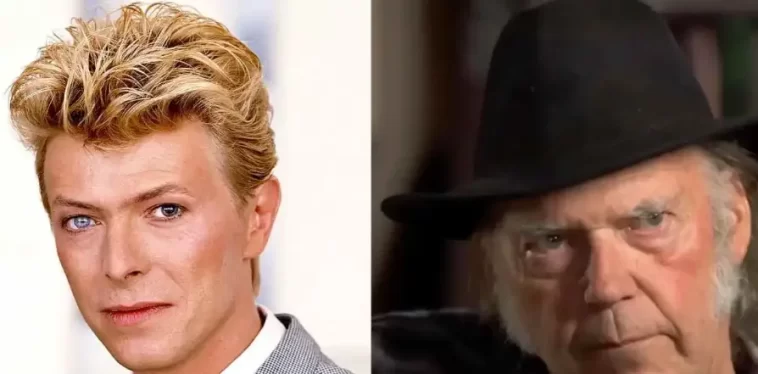
David Bowie’s opinion on Neil Young was more than just a passing comment from one rock star to another; it was a profound acknowledgement of artistic integrity. While David Bowie was known as the “Chameleon of Rock,” constantly shifting his persona, Neil Young was the rugged “Godfather of Grunge,” grounded in raw, electric energy. Despite their different styles, Bowie looked to the Canadian songwriter as a blueprint for how to survive the music industry without losing one’s soul.
To truly understand the history of modern music, we must look at how these giants viewed each other. For Bowie, Neil Young represented a rare form of independence—a refusal to bend to the will of the audience or the pressures of record labels.
The Artistic Bond Between Two Icons
When we examine the career of these two legends, we see a shared fundamental philosophy: the necessity of experimentation. In many interviews, David Bowie’s opinion on Neil Young was filled with admiration for Young’s “youthful redemption.” Bowie saw him as the ultimate independent thinker in an industry that often demands conformity.
In the mid-2000s, Bowie reflected on his own long career and noted that whenever he felt lost, he would look at the trajectories of Neil Young and Bob Dylan. He saw them as mentors who had survived their own professional “disasters.” Bowie understood that to be a true artist, one must be willing to fail publicly. He admired how Young would release experimental or even commercially unsuccessful albums, only to return to his roots with renewed vigor.
How David Bowie’s Opinion on Neil Young Influenced His Songs
The influence of Neil Young on Bowie’s work is most visible in his early and late-career transitions. Many fans might be surprised to learn that the whimsical track “Kooks” from the 1971 masterpiece Hunky Dory was directly influenced by Young. Specifically, Bowie was listening to Young’s 1970 album After the Gold Rush during that period.
The simplicity and emotional directness of Young’s folk-rock style provided a grounding for Bowie’s more theatrical tendencies. Years later, this influence would surface again in a much darker form. In 1997, while promoting the industrial-tinged album Earthling, Bowie revealed that his song “Dead Man Walking” was partially inspired by a live performance he witnessed by Young.
A Moving Performance at the Bridge School Benefit
In 1996, the worlds of these two icons collided when Bowie performed at the Bridge School Benefit. Watching Young perform an acoustic set alongside members of Crazy Horse left a lasting impression on the British icon.
David Bowie’s opinion on Neil Young during this time was that the performance was “moving” and “poignant.” He saw Young and his bandmates moving in a “tight tribal circle,” evoking the youthful energy that rock and roll was founded upon. For Bowie, who was then in his 50s and reflecting on the nature of aging, seeing Young maintain that raw, spiritual connection to his music was a source of great inspiration.
Bowie’s Tribute: Covering “I’ve Been Waiting for You”
The ultimate sign of respect in the music world is the cover version. In 2002, for the album Heathen, Bowie decided to pay a formal tribute to Young by recording “I’ve Been Waiting for You.” This track originally appeared on Neil Young’s self-titled debut album in 1968.
Bowie’s relationship with this song spanned decades. He first heard it in 1969 and was “dazzled” by its sonic complexity. He described the sound as both “majestic” and “lonely,” a combination that perfectly mirrored Bowie’s own frequent themes of isolation and cosmic yearning.
“I’d always wanted to do that song on stage or someplace,” Bowie remarked during an interview with Livewire magazine.
To add another layer of rock history to the track, Bowie brought in Dave Grohl of the Foo Fighters to play guitar on the cover. This collaboration linked three generations of rock innovators—Young, Bowie, and Grohl—all through a single song written in the late sixties.
The Shared Legacy of Independence
Ultimately, David Bowie’s opinion on Neil Young serves as a reminder that the greatest artists are often the greatest fans. Bowie’s admiration for Young wasn’t about wanting to sound like him; it was about wanting to emulate his spirit of freedom.
Both men understood that the audience’s expectations can be a trap. By following their own whims—whether that meant Bowie exploring electronic soul or Young delving into proto-grunge—they ensured their music would remain timeless. They taught the world that “staying relevant” isn’t about following trends, but about being brave enough to ignore them.
