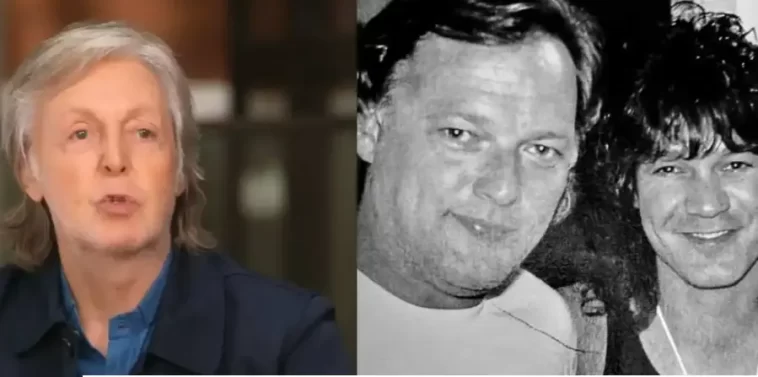
Paul McCartney Van Halen Gilmour is a combination of names that instantly signals musical excellence. When one of the most influential songwriters in history speaks about legendary guitarists, his words carry unusual weight. Paul McCartney is not only a former Beatle or a celebrated bassist; he is a musician who understands instruments from the inside out. Over decades, his reflections on guitar heroes like Eddie Van Halen and David Gilmour have offered rare insight into what truly defines greatness on the instrument.
McCartney’s career has often overshadowed his technical versatility. While best known for melodic bass lines that reshaped popular music, he has consistently played guitar, piano, drums, and more. On several solo projects, he famously recorded every instrument himself. That breadth of experience makes his opinions on guitar players especially revealing.
A Musician Surrounded by Guitar Legends
Paul McCartney has often described himself as “spoiled” when it comes to guitar players. From the earliest days of his career, he was surrounded by innovators who redefined what the electric guitar could do. He witnessed Jimi Hendrix up close during Hendrix’s earliest London performances, long before global fame followed.
McCartney recalled seeing Hendrix in intimate venues where the power of his playing felt almost overwhelming. Small rooms, massive amplifiers, and an energy that seemed impossible to contain left a lasting impression. These early experiences shaped McCartney’s belief that truly exceptional guitarists are rare.
According to him, the world only produces a limited number of players who seem physically and emotionally fused with their instrument. For McCartney, technical skill alone is not enough. What matters is the sense that the guitar becomes an extension of the musician’s body and personality.
Why Eddie Van Halen and David Gilmour Stood Out
Among the many guitarists McCartney has admired, Eddie Van Halen and David Gilmour occupy a special place. Though radically different in style, both players met McCartney’s personal standard for authenticity and musical instinct.
Eddie Van Halen revolutionized rock guitar with speed, innovation, and confidence. His tapping techniques, tone, and rhythmic precision reshaped hard rock and heavy metal. McCartney admired how Eddie could push intensity without losing musicality. For him, Van Halen represented controlled fire—technical brilliance balanced with feel.
David Gilmour, by contrast, became famous for restraint rather than speed. His solos often unfold slowly, focusing on emotion, phrasing, and tone. McCartney has repeatedly praised Gilmour’s ability to say more with fewer notes. In McCartney’s view, Gilmour’s playing proves that silence and space can be as powerful as complexity.
Despite their differences, McCartney grouped both guitarists together for a simple reason: they never sounded mechanical. Whether explosive or atmospheric, their playing felt natural, expressive, and deeply human.
Collaboration and Mutual Respect
McCartney’s admiration for David Gilmour went far beyond words. Over the years, he invited Gilmour to collaborate on multiple projects, both in the studio and on stage. One of the most notable contributions came when Gilmour performed the guitar solo on McCartney’s song “No More Lonely Nights.”
McCartney later explained that he deliberately sought Gilmour out because he viewed him as a musical genius. At the time, Gilmour had recently released solo work, and McCartney felt his tone and sensitivity were perfectly suited to the song. The resulting solo became one of the track’s defining elements.
Their collaboration extended across decades, appearing on albums released in different phases of McCartney’s career. Each time, the partnership reflected mutual respect rather than nostalgia. McCartney treated Gilmour not as a guest, but as an equal creative voice.
Hendrix, Van Halen, and the Question of “The Best”
The comparison between Eddie Van Halen and Jimi Hendrix has long fueled debate among fans and musicians. McCartney, who personally witnessed Hendrix’s rise, never hesitated to express his view.
While praising Van Halen’s brilliance and originality, McCartney consistently placed Hendrix in a category of his own. For him, Hendrix was not just a great guitarist but a transformative force who permanently altered how the instrument was perceived. Hendrix expanded the emotional and sonic vocabulary of rock guitar in ways that could never be fully replicated.
McCartney’s perspective does not diminish Van Halen’s achievements. Instead, it highlights how generational impact plays a role in defining greatness. Hendrix changed the rules entirely, while Van Halen mastered and expanded them.
Heavy Music and the Role of the Guitar
Despite not being associated with heavy metal, McCartney has often spoken positively about the genre—particularly its guitarists. He explained that what draws him to heavier bands is the sense of raw energy and commitment.
However, McCartney has also been clear about his limits. Endless technical displays, he argues, can become tiring if they lack emotional direction. For him, guitar playing should always serve the song. When speed becomes the only goal, the music loses its soul.
This philosophy aligns closely with his admiration for both Van Halen and Gilmour. Though capable of immense technical control, neither guitarist relied on technique alone. Their playing always communicated mood, tension, and release.
Beatles Influence on Van Halen’s Early Years
Eddie Van Halen’s musical roots trace back not only to hard rock but also to British pop and rock. Growing up, Eddie and his brother Alex were initially trained as classical pianists. Their exposure to bands like The Beatles and The Dave Clark Five fundamentally shifted their musical direction.
Interestingly, the brothers were initially more drawn to The Dave Clark Five, whose driving rhythms and direct energy appealed to them. At the time, Alex Van Halen even believed that DC5 might outlast The Beatles—a prediction history would eventually overturn.
Still, the influence of British bands remained embedded in Eddie’s sense of melody and structure. Even within his most aggressive solos, traces of pop sensibility can be heard.
Abbey Road Crossroads and “Dark Side of the Moon”
McCartney’s path crossed with Pink Floyd on several occasions, most notably at Abbey Road Studios. In the late 1960s, The Beatles and Pink Floyd were recording separate albums in adjacent studios. These encounters planted the seeds of a long-term professional connection.
By 1973, the overlap became even more significant. McCartney was recording with Wings while Pink Floyd worked on what would become one of the most celebrated albums in music history. Studio engineers moved between sessions, occasionally sharing snippets of unfinished recordings.
McCartney later recalled hearing early material from “The Dark Side of the Moon” and recognizing its experimental ambition. At one point, Pink Floyd even considered including spoken contributions from Paul and Linda McCartney. Though the recordings were ultimately not used, the moment remains a fascinating “what if” in rock history.
Becoming a Beatle for One Night
In 1999, David Gilmour experienced a dream few musicians ever realize: performing Beatles songs with a Beatle at the Cavern Club in Liverpool. McCartney invited Gilmour to join him for a special live show that celebrated early rock and roll.
The performance included classic Beatles material alongside vintage rock standards. For Gilmour, a lifelong Beatles fan, the experience was unforgettable. He later described the evening as a joyful return to the music that inspired him in his youth.
The event symbolized a full-circle moment—one legend honoring another, not through ceremony, but through shared music.
A Standard Defined by Emotion
When examining McCartney’s reflections on guitarists, one theme appears repeatedly: emotion over excess. Whether discussing Van Halen, Gilmour, or Hendrix, McCartney focuses less on technique and more on feeling.
For him, the greatest guitarists are those who make listeners forget about difficulty and focus instead on expression. They do not merely play notes; they tell stories.
That philosophy explains why McCartney’s praise is so selective. In a world filled with skilled musicians, only a handful truly move him. And when they do, his words become a lasting endorsement of musical integrity.
