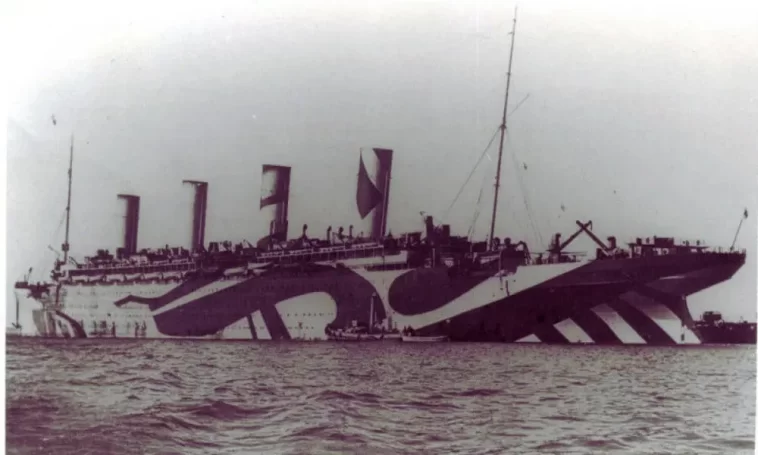
In the midst of World War I, when traditional naval defense methods were failing and German U-boats threatened the survival of British warships, a most unexpected hero emerged: an artist. Norman Wilkinson wasn’t armed with guns or torpedoes—but with brushes, colors, and an idea that would forever blur the lines between art and warfare.
Welcome to the fascinating world of Dazzle Camouflage, the optical illusion that turned ships into floating mirages and disrupted the enemy’s aim without hiding a thing. Here’s everything you need to know about this mind-bending wartime innovation.
🎯 The Problem: U-Boats Were Sinking British Ships Relentlessly
In the early years of World War I, the British Royal Navy faced a deadly threat: German submarines (U-boats) were destroying warships and merchant vessels at an alarming rate. Traditional camouflage aimed to blend objects into the environment, but massive steam-powered warships with smoking funnels were nearly impossible to hide.
The enemy didn’t need to see the whole ship—just a quick glance through a periscope was enough to determine its direction and speed, enabling precise torpedo strikes. Britain needed a solution, fast.
🎨 Enter Norman Wilkinson: “If You Can’t Hide It, Confuse It”
Norman Wilkinson, a professional artist serving as a naval reserve officer, proposed a radical idea: Don’t try to hide the ships—mislead the enemy instead. Thus was born Dazzle Camouflage, a technique unlike anything seen before in military history.
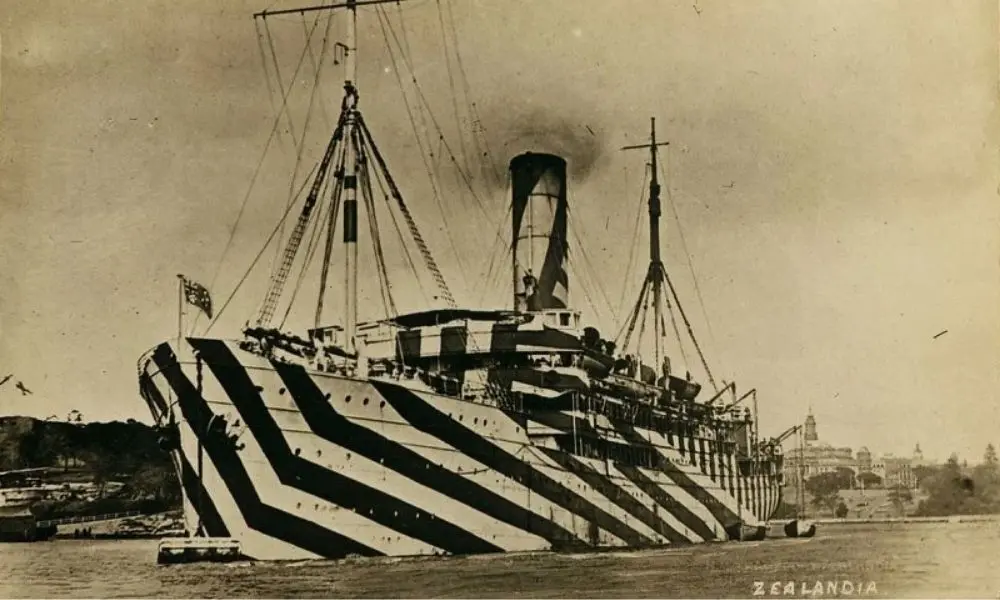
Instead of trying to render ships invisible, Wilkinson suggested painting them with bold geometric shapes, contrasting colors, and disorienting lines, creating an optical illusion that disrupted perception.
🌀 How Dazzle Worked: Illusion Over Invisibility
The goal wasn’t to conceal the ship but to distort its appearance, making it nearly impossible for submarine officers to accurately estimate:
- Speed
- Direction
- Size
- Class of ship
When viewed through a periscope, dazzle-painted ships seemed to be moving in unpredictable directions. Just like zebras in a herd, their high-contrast patterns confused predators (or in this case, enemy torpedoes).
🧪 Field Testing: Art Meets Science
Wilkinson didn’t just paint a few lines and hope for the best. He formed a team of artists and designers, built model ships, and tested the effects using periscopes in a rotating studio. They simulated different weather and lighting conditions to determine which patterns best distorted visual perception.
Even King George V took a peek through a test periscope—and misjudged the direction of a model ship completely. The illusion was working.
⚓ Official Adoption: From Crazy Idea to Naval Strategy
In 1917, the British Admiralty officially adopted dazzle camouflage. Over 2,300 British ships were eventually painted in these mesmerizing patterns. Merchant vessels, too, were included to protect crucial supply routes.
Wilkinson’s technique soon made its way across the Atlantic. In 1918, he presented his strategy to Franklin D. Roosevelt, then Assistant Secretary of the U.S. Navy. The United States quickly established its own dazzle unit.
📊 Did It Really Work?
While exact data remains mixed due to multiple variables (convoys, air patrols, sonar, etc.), the statistics are promising:
- Of 1,256 American ships painted with dazzle between March and November 1918, only 96 were sunk.
- Author Peter Forbes noted that no dazzle-painted warships were lost to torpedoes during the war.
- In the UK, post-war reports acknowledged that dazzle increased enemy torpedo miss rates, even if it didn’t offer absolute protection.
🧬 Nature’s Inspiration: From Zebras to Butterflies
Wilkinson’s idea wasn’t born in isolation. Zoologists and artists had theorized about disruptive camouflage even before the war. In nature, zebras use high-contrast stripes to confuse predators about direction and distance. Certain butterflies and insects display patterns that make it hard to tell where their bodies begin or end.
Dazzle was essentially evolutionary defense applied to maritime warfare.
🔄 The Decline of Dazzle: Enter Radar and Sonar
Dazzle camouflage saw limited use during World War II, even by the Germans. However, the rapid rise of radar, sonar, and aerial reconnaissance made visual deception less effective. The age of optical trickery was over, replaced by technological detection.
Still, dazzle camouflage remains a striking example of how creativity, art, and science can intersect in the most unexpected—and impactful—ways.
🖼️ Legacy: Where Art Meets War
Today, dazzle ships have become iconic symbols of how unconventional thinking can change the course of history. They’ve even inspired modern art installations, fashion designs, and museum exhibitions.
Dazzle wasn’t just a wartime tactic—it was a cultural phenomenon, a blend of military necessity and artistic brilliance.
