Declassified UFO Files 2026 have officially landed, marking the most significant shift in government transparency in over a century. On May 8, 2026, the Pentagon (operating under the newly restructured Department of War) launched a dedicated web portal, fulfilling a direct presidential mandate for “maximum transparency” regarding Unidentified Anomalous Phenomena (UAP).
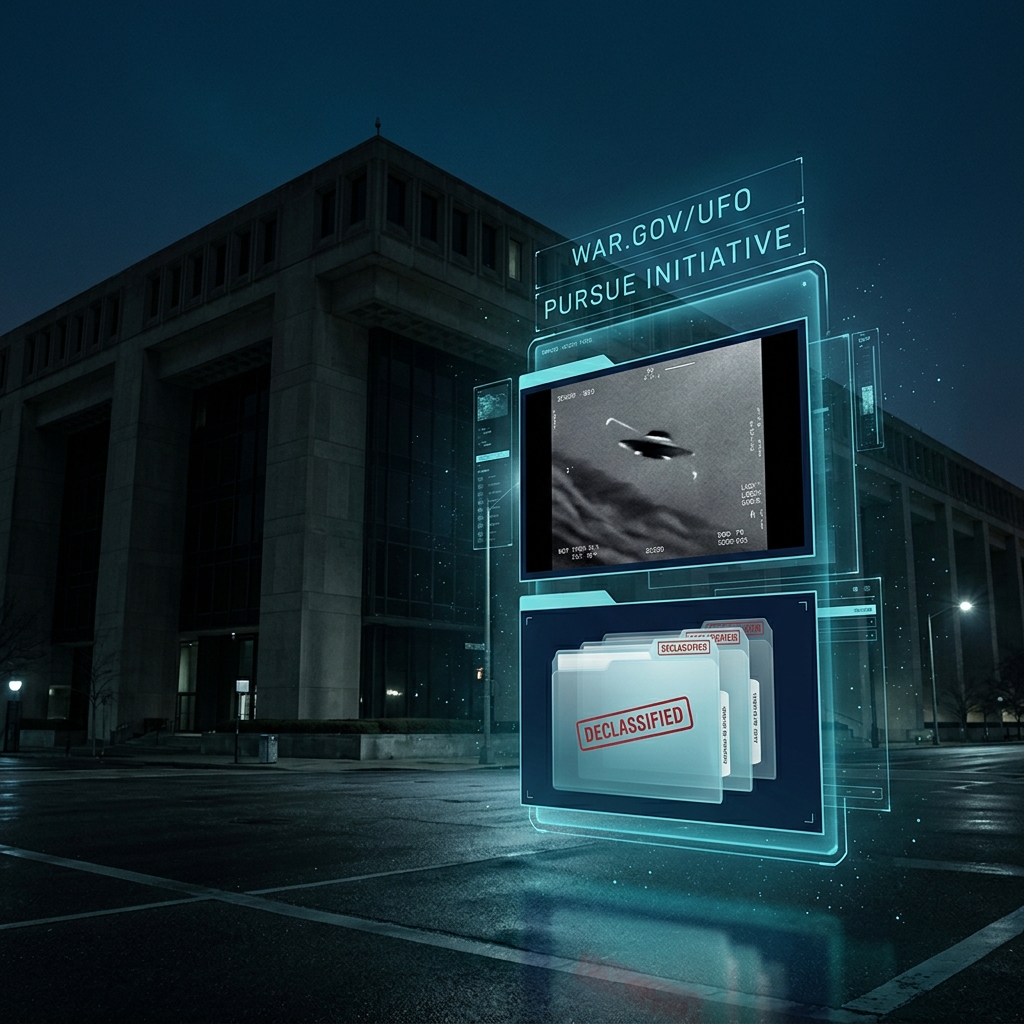
The first batch of this release, which is part of the PURSUE Initiative (Presidential Unsealing and Reporting System for UAP Encounters), consists of 162 files that include high-definition cockpit videos, sensor data, and inter-agency memos that date back to the late 1940s. For millions of Americans who have been tracking these developments, the arrival of the Declassified UFO Files 2026 represents the “smoking gun” they have been waiting for—or at least the most honest government response to date.
1. What is the PURSUE Initiative?
The PURSUE Initiative was established in early 2026 following a wave of whistleblower testimonies in Congress. Unlike previous government efforts that were criticized for being “secretive” or “obfuscating,” PURSUE is designed to be a rolling declassification machine.
The primary goal of this initiative is to remove the “top secret” classification from UAP encounters that do not directly compromise sensitive military sensor technology. By releasing the Declassified UFO Files 2026, the administration aims to hand the data over to the public and the scientific community, allowing civilian experts to analyze flight patterns and thermal signatures that were previously locked behind vault doors.
2. Deep Dive: The 162 Files
The initial tranche of the Declassified UFO Files 2026 contains several standout cases that have already begun trending across social media platforms like X (formerly Twitter) and Reddit.
- The “Atlantic Shadow” (2025): One of the most recent files included in the release involves a 2025 encounter off the coast of Virginia. The file includes a thermal imaging video from an F-35 pilot showing a metallic, diamond-shaped object performing a 90-degree turn at speeds exceeding Mach 5.
- NASA’s “Orbital Anomaly” (2024): For the first time, the Declassified UFO Files 2026 include data from low-earth orbit satellites. This specific file tracks a non-ballistic object moving through the upper atmosphere in a way that defies current propulsion physics.
- The FBI Memos (1950s): The release also reaches into the archives, providing clean, high-resolution scans of FBI field reports from the 1950s that mention “non-human biological entities” recovered from crash sites—though the documents are heavily redacted when it comes to the specific locations of the remains.
3. The Presidential Mandate: Why Now?
The release of the Declassified UFO Files 2026 is not a random bureaucratic event. It follows a direct executive order from President Donald Trump, who has frequently promised to “open the books” on the UFO phenomenon.
“I’m opening them up,” the President stated in a recent press briefing. “The people have a right to know what’s in these files. We’re going to let them decide for themselves.”
This stance has put the Pentagon in a difficult position, forcing them to balance national security interests with the President’s demand for transparency. The result is the Declassified UFO Files 2026, a compromise that provides more data than ever before while still shielding the most sensitive “black projects” currently in development.
4. Public and Scientific Reaction in the USA
In the United States, the reaction to the Declassified UFO Files 2026 has been polarized but intense.
- The Enthusiasts: Groups like MUFON and various “disclosure” advocates are calling this a historic win. They argue that the sheer volume of data in the Declassified UFO Files 2026 makes it impossible for skeptics to claim that UAPs are merely “sensor glitches” or “weather balloons.”
- The Skeptics: Some scientists urge caution. They point out that while the objects in the Declassified UFO Files 2026 are indeed “unidentified,” that does not automatically mean they are “extraterrestrial.” They suggest that many of these encounters could be advanced holographic decoys or electronic warfare tests from rival nations.
- The Tech Community: Silicon Valley is already looking at the Declassified UFO Files 2026 as a dataset for AI training. Startups are springing up to run the sensor data through machine learning models to see if they can find commonalities in the “trans-medium” travel patterns (objects moving seamlessly between air and water).
5. How to Access the Declassified UFO Files 2026
If you want to dive into the data yourself, the government has made it surprisingly easy. The files are hosted at WAR.GOV/UFO (a new domain reflecting the Department of War’s involvement).
When browsing the Declassified UFO Files 2026, you should look for the “Tranche 1” folder. Here, you can download raw .mov files from gun cameras and .pdf scans of original incident reports. Users are encouraged to use the hashtag #UFOFiles2026 to share their findings and crowd-source the analysis of the most complex sensor data.
6. The “June Deadline”: What’s Next?
The current release is just the beginning. The PURSUE Initiative has a roadmap that includes a second, larger batch of files scheduled for June 2026. This upcoming release is rumored to focus specifically on “underwater” encounters (USOs), which many whistleblowers claim are even more frequent than aerial sightings.
The Declassified UFO Files 2026 have set a new standard for how governments handle the unknown. Whether these files prove the existence of alien life or merely reveal a secret arms race in advanced propulsion, one thing is certain: the era of government secrecy on UFOs is officially over.
