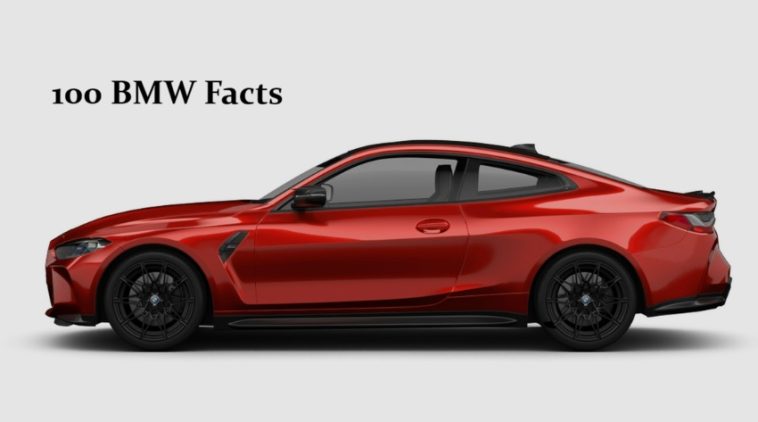
BMW facts are more fascinating than most people realize. Behind every badge, engine, and design decision is over a century of engineering obsession, racing heritage, and bold innovation. Whether you’re a lifelong fan or just getting curious about the brand, these 100 facts cover everything — history, cars, records, technology, and more.
Let’s get into it.
The Origins: BMW Facts About the Early Years
- BMW stands for Bayerische Motoren Werke, which translates to “Bavarian Motor Works” in English.
- BMW was founded on March 7, 1916, in Munich, Bavaria, Germany.
- The company didn’t start with cars. BMW’s roots were in aircraft engine manufacturing during World War I.
- The iconic blue and white logo is often said to represent a spinning propeller against a blue sky — a nod to its aviation origins. BMW itself has confirmed this interpretation in marketing, though the logo originally derived from the Bavarian state flag colors.
- BMW’s first product was the BMW IIIa aircraft engine in 1917, designed by engineer Max Friz.
- After WWI, the Treaty of Versailles banned Germany from producing aircraft engines. BMW pivoted to motorcycle and eventually car manufacturing.
- BMW built its first motorcycle in 1923 — the R32, which debuted at the Paris Motor Show and became an instant icon.
- The R32 introduced the boxer twin engine layout that BMW Motorrad still uses in some bikes today — over 100 years later.
- BMW didn’t build its first car until 1928, when it acquired the Fahrzeugfabrik Eisenach company and began producing the Dixi 3/15.
- The Dixi 3/15 was actually a licensed copy of the Austin Seven, a small British car. It was BMW’s entry into the automobile market.
Pre-War and Post-War BMW Facts
- The BMW 303, launched in 1933, was the first car to feature the now-iconic kidney grille — a design element BMW still uses on every car it makes.
- The BMW 328, introduced in 1936, is considered one of the greatest pre-war sports cars ever built. It won numerous races across Europe.
- The 328 won the 1940 Mille Miglia — a grueling 1,000-mile Italian road race — with an aerodynamic coupe body developed specifically for the event.
- BMW’s Munich factory was heavily bombed during WWII, leaving the company in ruins by 1945.
- After WWII, BMW was banned from producing cars or motorcycles by the Allied Control Council. They survived by making pots, pans, and bicycles.
- BMW resumed motorcycle production in 1948 with the R24, marking the brand’s return to manufacturing.
- Car production resumed in 1952 with the BMW 501, a large luxury sedan nicknamed the “Baroque Angel” for its curvaceous styling.
- By the late 1950s, BMW was in serious financial trouble. The 501 was expensive to build and slow to sell.
- The BMW Isetta, launched in 1955, saved the company. This tiny “bubble car” had a front-opening door and a motorcycle engine — and sold over 160,000 units.
- In 1959, BMW nearly merged with Daimler-Benz. A group of Bavarian investors and dealers blocked the takeover, keeping BMW independent.
The Modern Era: BMW Facts from the 1960s Onward
- The BMW New Class (Neue Klasse) launched in 1962 with the 1500 sedan. It defined what BMW cars would look like and feel like for decades to come.
- The Neue Klasse is credited with saving BMW. It was sporty, modern, and well-priced — everything the market wanted.
- The BMW 2002, launched in 1968, helped create the “sports sedan” category that BMW would come to dominate.
- Car and Driver magazine famously called the 2002 “the best sedan in the world” in the early 1970s.
- BMW launched its first M car in 1978 — the M1, a mid-engine supercar developed with Lamborghini and later Baur.
- The M1 was BMW’s only mid-engine production car to date. It remains one of the most collectible BMWs ever made.
- The “M” in BMW M stands for Motorsport. BMW M GmbH was founded in 1972 as a separate performance division.
- BMW acquired the Rolls-Royce brand name and logo in 1998, following a complex deal after Vickers sold the company. Volkswagen got the factory; BMW got the name.
- BMW has owned the Mini brand since 2000, when it purchased the Rover Group’s assets after the Rover deal collapsed.
- BMW Group today owns three major brands: BMW, Mini, and Rolls-Royce.
Engineering and Technology BMW Facts
- BMW invented the first modern anti-lock braking system (ABS) for motorcycles in 1988, later adapting it for cars across the industry.
- BMW introduced its iDrive infotainment system in 2001 with the 7 Series — one of the first integrated digital control systems in a production car.
- The BMW i8 featured a 1.5-liter three-cylinder engine that produced 231 hp on its own — one of the most powerful small engines ever fitted to a production car.
- BMW’s VANOS system, introduced in 1992, was an early variable valve timing technology that improved both power and efficiency simultaneously.
- Double VANOS, introduced in 1995, adjusted both intake and exhaust camshafts independently — a significant engineering step forward.
- BMW pioneered the use of carbon fiber reinforced plastic (CFRP) in mass-produced cars with the BMW i3 and i8 in 2013.
- The i3’s entire passenger cell is made from CFRP, making it incredibly light and strong while being produced at scale — something never done before.
- BMW developed the world’s first hydrogen-powered production car, the Hydrogen 7, in 2006. It ran on liquid hydrogen and had a limited production run of 100 units.
- BMW’s EfficientDynamics suite of fuel-saving technologies — introduced around 2007 — includes auto start-stop, brake energy regeneration, and low-rolling-resistance tires.
- BMW was among the first automakers to offer wireless smartphone charging in a production car, introducing it in the 7 Series in 2015.
BMW M Division Facts
- The BMW M division was officially established on May 24, 1972, originally to support BMW’s Formula 2 racing program.
- The first M-badged road car available to the public was the M535i in 1980, though the M1 technically came first as a limited production model.
- The E30 M3, launched in 1986, is one of the most celebrated sports cars ever made. It was built to homologate BMW for touring car racing and became a legend on the road.
- The original E30 M3 used a high-revving four-cylinder engine — unusual for a performance car of its class at the time.
- The BMW M5 E28, introduced in 1984, was the world’s fastest production sedan at the time, with a top speed of around 245 km/h (152 mph).
- The F10 BMW M5 was the first M5 to offer all-wheel drive when it arrived in 2012 — a controversial but practical move for the performance sedan.
- BMW M holds a lap record at the Nürburgring Nordschleife with the M4 CSL, which posted a time of 7:20.207 in 2022 — one of the fastest production car laps ever recorded there.
- The M division produces its own engines by hand at the BMW plant in Munich. Each engine is signed by the engineer who assembled it.
- The BMW M3 has never been offered as a two-door coupe since the fourth generation — the coupe became the M4, a naming change introduced in 2014.
- The BMW M2 is widely considered the spiritual successor to the E30 M3 — small, rear-wheel drive, manual gearbox available, and built purely for driving enjoyment.
BMW Racing and Motorsport Facts
- BMW has won 24 Hours of Le Mans outright, most notably in 1999 with the V12 LMR driven by Yannick Dalmas, Joachim Winkelhock, and Pierluigi Martini.
- BMW powered Nelson Piquet’s 1983 Formula 1 World Championship-winning car — the Brabham BT52 used a turbocharged BMW four-cylinder engine producing an estimated 1,400 hp in qualifying trim.
- That BMW F1 engine was based on the block of a regular production car — the M10, which also appeared in road-going BMWs. It remains one of the most extreme uses of a production engine block in racing history.
- BMW dominated the German Touring Car Championship (DTM) multiple times, with drivers including Bernd Schneider, Johnny Cecotto, and Roberto Ravaglia claiming titles in BMW machines.
- The BMW M3 GTR won the 2001 American Le Mans Series championship, powered by a naturally aspirated V8 — the only time a V8 M3 was ever raced or built.
- BMW Art Cars are a motorsport tradition. Since 1975, artists including Andy Warhol, Roy Lichtenstein, and Jeff Koons have painted BMW race cars that competed in major events.
- Andy Warhol painted his BMW M1 Art Car in just 28 minutes in 1979, using his fingers as brushes.
- BMW returned to Formula 1 as a full constructor between 2000 and 2009, with the BMW Sauber team. Robert Kubica scored BMW’s only F1 win at the 2008 Canadian Grand Prix.
- BMW won the Dakar Rally with its GS motorcycle models, one of the toughest off-road endurance races in the world.
- The BMW S1000RR superbike, introduced in 2009, was BMW’s first purpose-built Superbike and immediately set lap records around the world.
Design and Style BMW Facts
- Chris Bangle was BMW’s chief designer from 1992 to 2009 and is one of the most controversial figures in automotive design history. His “flame surfacing” style divided opinion but undeniably moved the brand forward.
- The E38 7 Series (1994–2001) is widely considered one of the most beautiful large sedans ever designed — clean, proportionate, and timeless.
- BMW’s Gina Light concept car (2008) featured a fabric body stretched over a movable wire frame. The headlights were hidden under the fabric and blinked open like eyes.
- The BMW Concept 4 (2019) previewed the controversial elongated kidney grille, which caused debate when it appeared on production models like the 4 Series and iX.
- BMW’s design language is guided by the principle of “dynamic elegance” — combining visual tension and motion cues with refined proportions.
- The Hofmeister kink — a reverse curve where the rear window meets the C-pillar — is a BMW design signature present on nearly every model since the 1961 BMW 1500.
- BMW’s kidney grille has appeared on every BMW car since 1933 — over 90 years of continuous design heritage in a single element.
- The Z8, designed by Henrik Fisker and launched in 1999, was a retro-modern roadster inspired by the legendary 507 from the 1950s. It appeared in the James Bond film The World Is Not Enough.
- The BMW 507 (1956–1959) is one of the most beautiful cars ever made and is now worth several million dollars at auction.
- Elvis Presley owned a BMW 507, which was recently restored by BMW and displayed at the Pebble Beach Concours d’Élégance.
Production and Business BMW Facts
- BMW Group produces approximately 2.5 million vehicles per year across its BMW, Mini, and Rolls-Royce brands.
- BMW’s main production plant is in Munich, Germany, where it has been building cars since 1922. The plant is adjacent to BMW’s global headquarters, the iconic four-cylinder tower building.
- The BMW plant in Spartanburg, South Carolina, is the company’s largest factory in the world by volume, producing mainly X model SUVs for global export.
- Spartanburg exports more cars by value than any other U.S. auto plant, making BMW one of America’s largest automotive exporters.
- BMW employs over 150,000 people worldwide across manufacturing, sales, research, and development.
- BMW’s headquarters building in Munich — the four-cylinder tower — was completed in 1972 and is now a protected architectural landmark.
- The BMW Welt (BMW World) museum and delivery center in Munich opened in 2007 and attracts over 3 million visitors per year.
- Customers can pick up their new BMW directly from the factory in Munich through the European Delivery Program — a popular option among enthusiasts who combine a vacation with picking up their car.
- BMW has manufacturing plants on four continents, including Germany, the UK, the US, China, South Africa, and Mexico.
- China is BMW’s single largest market, with millions of BMWs sold there annually through its joint venture with Brilliance Auto.
Electric and Future BMW Facts
- BMW launched the i sub-brand in 2011 to focus on electric and hybrid vehicles, debuting with the i3 and i8.
- The BMW i3 was the world’s first mass-produced electric car with a carbon fiber body structure, making it lighter than traditional EVs.
- The i3 was discontinued in 2022 after nearly a decade of production, with over 250,000 units sold worldwide.
- BMW’s iX, launched in 2021, is the brand’s flagship electric SUV and represents the next generation of BMW electric vehicle design and technology.
- The BMW i4 M50 is the first fully electric M car available to retail customers, producing 544 hp and reaching 0–100 km/h in 3.9 seconds.
- BMW plans to have 50% of its global sales be fully electric by 2030, as part of its sustainability and electrification strategy.
- BMW’s Neue Klasse platform, set to arrive from 2025, is an all-new electric vehicle architecture built entirely around EV technology from the ground up.
- The Neue Klasse name is a deliberate callback to the 1960s Neue Klasse sedans that saved the company — BMW intends this new platform to be equally transformative.
- BMW was an early adopter of plug-in hybrid technology, offering PHEV versions of models like the 3 Series, 5 Series, X5, and 7 Series years before many competitors.
- BMW’s hydrogen fuel cell vehicle program is ongoing. The iX5 Hydrogen is a pilot program testing hydrogen-powered SUVs in real-world conditions as of 2023.
Surprising and Fun BMW Facts
- The BMW 3 Series is the best-selling BMW model of all time, with over 20 million units sold since 1975 across all generations.
- James Bond has driven a BMW in several films, including GoldenEye, Tomorrow Never Dies, The World Is Not Enough, and Die Another Day. The Z3 in GoldenEye was the first Bond BMW.
- The BMW 7 Series was one of the first cars in the world to offer a built-in refrigerator in the rear armrest — a feature on executive and long-wheelbase models.
- BMW makes bicycles. The BMW Cruise M-Bike and other premium bicycles have been part of its lifestyle accessories lineup.
- The BMW Motorrad GS series is the world’s best-selling motorcycle line. The R 1250 GS consistently tops global motorcycle sales charts year after year.
- BMW holds the Guinness World Record for the longest motorcycle parade, set in 2015 in Madrid with over 1,600 BMW motorcycles riding together.
- The name “Mini” was retained by BMW after its acquisition even though the original Mini was a British Leyland product — BMW simply licensed the name and built an entirely new car around it.
- Every Rolls-Royce built today runs on a BMW platform and uses BMW electronics, though Rolls-Royce engineers extensively develop and tune their own systems.
- The BMW M4 GT3 race car is available for private purchase — meaning anyone with the budget (around €500,000) can buy a factory race car directly from BMW Motorsport.
- BMW’s slogan “The Ultimate Driving Machine” was created by the advertising agency Ammirati & Puris in 1973 for the North American market. It became one of the most enduring taglines in automotive history and is still in use today.
FAQ
When was BMW founded?
BMW was founded on March 7, 1916, in Munich, Germany. It started as an aircraft engine manufacturer before pivoting to motorcycles and eventually cars.
What does BMW stand for?
BMW stands for Bayerische Motoren Werke, which translates to Bavarian Motor Works in English.
What was the first car BMW ever made?
BMW’s first car was the Dixi 3/15, produced in 1928. It was a licensed version of the British Austin Seven and was built at BMW’s newly acquired Eisenach plant.
How many cars does BMW sell per year?
BMW Group sells approximately 2.5 million vehicles per year across its BMW, Mini, and Rolls-Royce brands combined.
What brands does BMW own?
BMW Group owns three brands: BMW, Mini, and Rolls-Royce Motor Cars.
What is the best-selling BMW of all time?
The BMW 3 Series is the best-selling model in BMW’s history, with over 20 million units sold since its introduction in 1975.
Is BMW going fully electric?
BMW has set a target for 50% of its global sales to be fully electric vehicles by 2030. Its all-new Neue Klasse electric platform is set to launch from 2025.
Final Thoughts
A century of BMW facts tells a story of a company that has repeatedly reinvented itself — from aircraft engines to bubble cars to world-class sports sedans to electric vehicles. Few automakers can match BMW’s combination of engineering depth, motorsport heritage, and design evolution.
Whether you’re drawn to the M division, the electric i series, or just the classic thrill of a rear-wheel drive 3 Series on a backroad, there’s a reason BMW has earned the title of “The Ultimate Driving Machine.”
