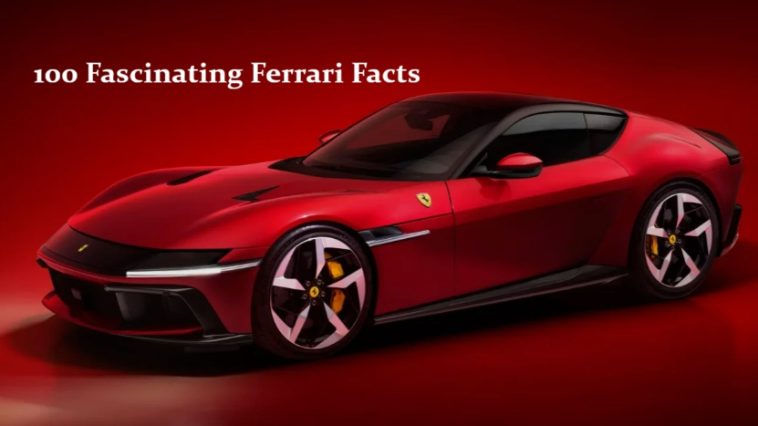
Ferrari. The name alone stirs something deep in anyone who loves cars. From the roar of a V12 engine to the iconic Prancing Horse badge, Ferrari represents passion, speed, and a pursuit of perfection that no other brand quite matches. Here are 100 Ferrari facts that tell the full story of the most romantic car company on earth.
The Origins of Ferrari
1. Enzo Ferrari was born on February 18, 1898, in Modena, Italy — a city that would become the heartland of Italian motorsport.
2. Enzo’s father ran a metal workshop, and young Enzo grew up surrounded by engineering from an early age.
3. Enzo Ferrari was deeply inspired by watching a car race in Bologna at age ten, and from that moment he wanted to be a racing driver.
4. After serving in World War I, Enzo struggled to find work until he landed a job as a test driver for a small Milan car company called CMN.
5. Enzo joined Alfa Romeo’s racing team in 1920 and became a successful racing driver throughout the 1920s.
6. He won his first race at the 1923 Circuito del Savio, after which he received the Prancing Horse emblem from the parents of fallen WWI pilot Francesco Baracca — the symbol Ferrari uses to this day.
7. Enzo Ferrari founded Scuderia Ferrari in 1929 — initially as a racing team that managed Alfa Romeo cars, not as a car manufacturer.
8. Ferrari’s first factory was established in Maranello, Italy, in 1943, where the company headquarters remain to this day.
9. The first car to bear the Ferrari name was the 125 S, completed in March 1947, powered by a 1.5-liter V12 engine.
10. The 125 S won its first race at the Rome Grand Prix on May 25, 1947 — Ferrari’s motorsport legacy began almost immediately.
The Prancing Horse and the Brand
11. The Prancing Horse (Cavallino Rampante) was originally the personal emblem of World War I flying ace Francesco Baracca, painted on the side of his aircraft.
12. Baracca’s mother, Countess Paolina, suggested Enzo use the symbol on his cars for good luck after meeting him at the 1923 race.
13. Ferrari added the yellow background to the horse, representing the color of Modena.
14. The Ferrari shield logo always features the letters “S” and “F” standing for Scuderia Ferrari.
15. The road car badge differs slightly from the racing team’s badge — the road car version includes the full Ferrari wordmark beneath the horse.
16. Ferrari red — Rosso Corsa — became Italy’s official racing color in the early 1900s when international motor racing assigned colors by nation.
17. Not all Ferraris are red. The brand offers dozens of colors, and some of the rarest and most valuable Ferraris are finished in silver, blue, or yellow.
Ferrari in Formula One
18. Scuderia Ferrari is the oldest and most successful constructor in Formula One history.
19. Ferrari entered Formula One at the very first World Championship race — the 1950 British Grand Prix at Silverstone.
20. Ferrari has won 16 Constructors’ Championships in Formula One.
21. Ferrari drivers have claimed 15 Drivers’ World Championships in Formula One.
22. Michael Schumacher won five consecutive Drivers’ Championships with Ferrari from 2000 to 2004 — one of the most dominant streaks in F1 history.
23. Niki Lauda survived a horrific crash at the 1976 German Grand Prix while driving for Ferrari, suffering severe burns. He returned to racing just six weeks later.
24. Gilles Villeneuve is considered by many Ferrari fans to be the greatest driver never to win a World Championship — he was beloved for his raw speed and bravery.
25. Fernando Alonso won back-to-back championships in 2005 and 2006 before joining Ferrari, where he came agonizingly close to the title in 2010 and 2012.
26. Ferrari’s Formula One team is known internally as the Scuderia and is based in Maranello, just steps from the road car factory.
27. The Tifosi — Ferrari’s fanatical Italian fan base — are considered the most passionate supporters in all of motorsport.
28. Ferrari is the only team to have competed in every single Formula One World Championship season since 1950.
Iconic Ferrari Road Cars
29. The Ferrari 250 GTO is widely regarded as the most valuable car ever made — examples have sold for over $70 million at auction.
30. Only 39 examples of the 250 GTO were ever built between 1962 and 1964.
31. The Ferrari Testarossa, launched in 1984, became one of the most recognizable cars of the 1980s thanks in part to its starring role in the TV show Miami Vice.
32. The Testarossa’s name means “redhead” in Italian, referring to the red-painted cam covers on its flat-12 engine.
33. The Ferrari F40, launched in 1987 to celebrate the brand’s 40th anniversary, was the last car personally approved by Enzo Ferrari before his death.
34. The F40 was the first production car to officially break the 200 mph barrier.
35. The Ferrari F50 was designed to bring Formula One technology to the road, featuring a carbon fiber tub and a naturally aspirated V12 derived from the F1 car.
36. The Enzo Ferrari, launched in 2002, was named in honor of the founder and used Formula One-derived technology including a paddle-shift gearbox and carbon fiber construction.
37. Only 400 Enzo Ferraris were produced, plus one additional unit donated to the Vatican for charity auction.
38. The LaFerrari, introduced in 2013, was Ferrari’s first production hybrid car and produced a combined 963 horsepower.
39. The LaFerrari Aperta is the open-top version, with only 210 units built, making it one of the rarest modern Ferraris.
40. The Ferrari 488 GTB replaced the 458 Italia in 2015, introducing a twin-turbocharged V8 after years of naturally aspirated engines.
Ferrari’s Greatest Engines
41. Ferrari has been building V12 engines since the very first car in 1947 — the V12 is the soul of the brand.
42. Gioacchino Colombo designed Ferrari’s original V12, a masterpiece of engineering for its time.
43. The Ferrari F136 V8 engine family, used in the 458 and F430, is considered one of the greatest naturally aspirated V8s ever built.
44. The current 6.5-liter naturally aspirated V12 in the 812 Superfast revs to 8,900 RPM and produces 789 horsepower.
45. The SF90 Stradale uses a twin-turbo V8 combined with three electric motors for a combined output of 986 horsepower.
46. Ferrari’s V12 engines are known for their extraordinary sound — a high-pitched mechanical symphony that no other engine quite replicates.
47. The flat-12 engine used in the 312 BB and Testarossa was Ferrari’s only production flat-12, chosen for its low center of gravity.
48. Ferrari spent years resisting turbocharging on road cars because Enzo himself believed turbos dulled the driving experience. He never drove a turbocharged Ferrari road car.
Ferrari at Le Mans and Endurance Racing
49. Ferrari won the Le Mans 24 Hours nine times, with victories spanning from 1949 to 1965.
50. The Ferrari 250 Testa Rossa won Le Mans three consecutive times from 1958 to 1960.
51. Ferrari’s most bitter Le Mans rivalry was with Ford in the 1960s — Ford’s GT40 program was born specifically to defeat Ferrari after Enzo refused to sell the company to Henry Ford II.
52. Enzo Ferrari reportedly rejected Ford’s takeover bid at the last minute because Ford wanted control over Ferrari’s racing program — something Enzo simply would not allow.
53. The Ferrari 330 P4 finished 1-2-3 at the 1967 Daytona 24 Hours, one of the most dominant results in endurance racing history.
54. Ferrari returned to top-level endurance racing with the 499P in 2023, winning Le Mans outright on their very first attempt — a fairy-tale comeback.
55. The Ferrari 499P victory in 2023 came exactly 50 years after Ferrari’s last Le Mans overall win in 1965 — a remarkable piece of symmetry.
The Men Who Shaped Ferrari
56. Enzo Ferrari was notoriously difficult to work with — he was demanding, manipulative, and would pit his engineers and drivers against each other deliberately.
57. Despite his flaws, Enzo had an extraordinary ability to identify talented engineers and drivers and inspire them to achieve greatness.
58. Enzo Ferrari rarely attended races after 1957, following the Mille Miglia disaster in which a Ferrari crash killed driver Alfonso de Portago and several spectators.
59. Mauro Forghieri was Ferrari’s chief engineer through some of the most successful years in F1 history, developing championship-winning cars from the 1960s through the 1980s.
60. Pininfarina has designed the majority of Ferrari road cars since the 1950s — one of the longest and most celebrated partnerships in automotive design history.
61. Sergio Pininfarina and Enzo Ferrari had a close personal friendship that lasted decades and shaped the aesthetic identity of Ferrari road cars.
62. Luca di Montezemolo served as Ferrari president from 1991 to 2014 and oversaw the brand’s most commercially successful era.
63. Enzo Ferrari died on August 14, 1988, at the age of 90. He lived long enough to see his beloved F40 announced but passed away shortly before it reached customers.
Ferrari and Popular Culture
64. The Ferrari 308 GTS became globally iconic thanks to the TV series Magnum P.I. (1980–1988), in which Tom Selleck’s character drove one throughout the show.
65. The Ferrari 250 GT California Spyder is the star of the 1986 film Ferris Bueller’s Day Off — though the car used in filming was actually a replica.
66. Ferrari has appeared in more films, music videos, and TV shows than virtually any other car brand.
67. Kanye West, Jay-Z, Drake, and countless other musicians have referenced Ferrari in their lyrics — it is the ultimate symbol of success in hip-hop culture.
68. The “Ferrari” song by Bruno Mars (with Anderson .Paak as Silk Sonic) brought the brand into mainstream pop culture once again in 2021.
69. Ferrari commissioned a feature film about Enzo Ferrari’s life — “Ferrari” (2023), directed by Michael Mann and starring Adam Driver as Enzo.
70. The Ferrari theme park, Ferrari World Abu Dhabi, opened in 2010 and features the world’s fastest roller coaster, the Formula Rossa, which accelerates to 240 km/h.
Ferrari Ownership and Exclusivity
71. Ferrari deliberately limits production to maintain exclusivity. The company typically produces around 13,000 to 14,000 cars per year globally.
72. Ferrari was listed on the New York Stock Exchange in October 2015 in one of the most anticipated IPOs in automotive history.
73. Fiat Chrysler (now Stellantis) owned Ferrari for many years. Today, the Agnelli family’s holding company Exor remains the largest shareholder.
74. Ferrari controls who can buy its most exclusive models — customers must have a history of purchasing Ferrari cars to be eligible for limited special editions.
75. The Ferrari Icona series revives classic design themes from the brand’s past — the Monza SP1 and SP2, for example, pay homage to the open barchettas of the 1950s.
76. Ferrari’s one-off XX Programme and Tailor Made Programme allow ultra-wealthy clients to commission bespoke or track-only versions of existing models.
77. The Ferrari FXX K Evo is a track-only machine producing over 1,050 horsepower — and buyers cannot take it home. Ferrari stores, maintains, and transports it for them.
78. Ferrari’s waiting list for popular models can stretch to three years or more, even for existing loyal customers.
Record-Breaking Ferraris
79. The Ferrari 488 Pista lapped the Fiorano test circuit in 1 minute 19.5 seconds — faster than the legendary Enzo Ferrari road car.
80. The Ferrari SF90 Stradale can sprint from 0 to 124 mph in just 6.7 seconds.
81. The LaFerrari set a sub-1:20 lap at Fiorano, making it one of the fastest road-legal Ferraris ever tested there.
82. The Ferrari 250 GTO set class records at Le Mans, the Tour de France Automobile, and countless other events during its brief racing career.
83. The 499P LMH prototype lapped the Le Mans circuit faster than any Ferrari road car in history during its 2023 race-winning run.
Ferrari’s Future
84. Ferrari confirmed it will launch its first fully electric car in 2025 — a landmark moment for a brand built on the sound and feel of combustion engines.
85. Ferrari’s electric car will be manufactured at a new dedicated facility in Maranello, built alongside its existing production line.
86. Ferrari CEO Benedetto Vigna has stated that Ferrari’s electric cars will still need to excite the senses — the brand is working on creating an artificial sound experience that communicates speed and performance.
87. The Ferrari Purosangue, launched in 2022, is Ferrari’s first-ever four-door, four-seat car — technically not an SUV, according to Ferrari, but a “Ferrari utility vehicle.”
88. The Purosangue uses a front-mid mounted naturally aspirated V12 — an extraordinary choice for a family car that signals Ferrari’s commitment to the combustion engine for as long as regulations allow.
89. Ferrari plans to offer hybrid powertrains across its entire range by 2026, reducing emissions while maintaining performance.
90. Ferrari has partnered with HP Inc. as title sponsor of the F1 team from 2024, renaming it the Scuderia Ferrari HP team.
Fun and Lesser-Known Ferrari Facts
91. Ferrari’s Fiorano Circuit, located right next to the factory in Maranello, was built by Enzo Ferrari in 1972 as a private test track.
92. Every new Ferrari road car is tested on the Fiorano Circuit before being delivered to the customer.
93. Ferrari operates the Museo Ferrari in Maranello and the Museo Enzo Ferrari in Modena — two separate museums dedicated to the brand.
94. The Ferrari Challenge one-make race series, launched in 1993, gives Ferrari owners the chance to race their own cars at circuits worldwide.
95. Charles Leclerc, Ferrari’s lead Formula One driver, is one of the most popular drivers in the sport and has a devoted global fanbase.
96. Ferrari holds an annual Finali Mondiali event where owners of Ferrari sports cars and Challenge racers gather to celebrate the season — it is the biggest Ferrari event on the calendar.
97. Enzo Ferrari’s personal office in Maranello has been preserved exactly as it was on the day he died and can be viewed by visitors.
98. Ferrari produces its own official merchandise, fragrances, and lifestyle products — the brand extends well beyond cars into fashion and luxury goods.
99. The sound of a Ferrari V12 at full throttle is protected as a sonic trademark in several markets — it is literally considered intellectual property.
100. More than 75 years after the first Ferrari turned a wheel, the brand remains the most emotionally powerful name in the automotive world — not just a car company, but a dream that millions of people carry with them throughout their lives.
Frequently Asked Questions (FAQ)
Who founded Ferrari?
Enzo Ferrari founded Scuderia Ferrari in 1929 as a racing team, and established the car manufacturing company in Maranello in 1943. The first car to bear the Ferrari name rolled out in 1947.
What does the Prancing Horse on Ferrari mean?
The Prancing Horse (Cavallino Rampante) was the personal emblem of World War I flying ace Francesco Baracca. His mother gave Enzo Ferrari permission to use it for good luck. The yellow background represents the color of Modena, Ferrari’s home city.
How many Formula One championships has Ferrari won?
As of 2026, Ferrari has won 16 Constructors’ Championships and its drivers have claimed 15 Drivers’ World Championships, making it the most successful constructor in F1 history by total championships.
What is the most expensive Ferrari ever sold?
The Ferrari 250 GTO holds the record for the most expensive car ever sold at auction — a 1963 example sold for approximately $70 million. Private sales may have exceeded this figure.
Why does Ferrari limit production?
Ferrari deliberately caps production — typically around 13,000 to 14,000 cars per year — to maintain exclusivity and desirability. Enzo Ferrari famously said he always wanted to make one fewer car than the market demanded.
Is Ferrari making electric cars?
Yes. Ferrari confirmed its first fully electric model will launch in 2025, manufactured at a new dedicated facility in Maranello. The brand has pledged that the car will still feel and excite like a true Ferrari.
What is Ferrari’s most powerful road car?
As of 2026, the SF90 Stradale remains among the most powerful, producing 986 combined horsepower from its hybrid powertrain. Limited track-focused variants like the FXX K Evo exceed 1,050 horsepower, though these are not road-legal.
Final Thoughts
Ferrari is more than a car manufacturer — it is a living legend. From the sawmill workshops of postwar Italy to the cutting edge of hybrid hypercar technology, every chapter of Ferrari’s story is driven by the same obsession: to build the most thrilling machines on earth. These 100 Ferrari facts capture just a fraction of what makes the Prancing Horse so enduringly special. The passion never stops. The horse never slows down.
