Our knowledge on these islands which we have heard a lot from the Theory of Evolution does not go beyond “Darwin laid the foundations of the evolution in the Galapagos Islands”. But this group of islands needs more elaborate information than that.
We would like to promote these islands protected at the global scale by the WWF (World Nature Protection Foundation).
Galapagos Islands on the Nazca tectonic plate was created 4 million years ago with volcanic movements 4,000 meters deep under the sea. The eastern islands (San Cristobal and Espanola) are millions of years older than the western islands (Isabela and Fernandina).
Galapagos Islands on the Nazca tectonic plate was created 4 million years ago with volcanic movements 4,000 metres deep under the sea. The eastern islands (San Cristobal and Espanola) are millions of years older than the western islands (Isabela and Fernandina).
This is why this place is called the “islands”. These islands with 13 big islands, 6 small islands and 107 islets are home to 25 thousand people.
The Galapagos Islands were discovered by the “modern” world in 1535. These islands were accidentally discovered by Panama Bishop Tomas de Berlanga who was travelling to Peru. We say by accident because if Berlanga’s ship wasn’t dragged in the open sea, the bishop wouldn’t have found this region. The images on the Inca pots show that humans came here before the “civilization”.
The name means turtle in Spanish.
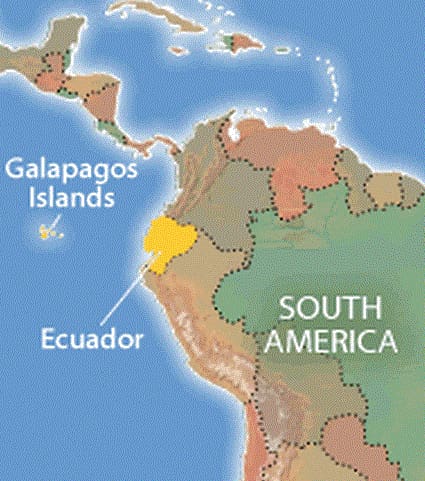
The island is known as “Islas Galápagos” in Spanish and the official name is “Archipiélago de Colón” or Colón Archipelago. The islands are about 1,000 km away from Ecuador. “Galápago” means “turtle” in Spanish.
National Park on the 100th year of the Origin of Species
Galapagos Islands were declared national park in 1959, 100 years after the Origin of Species book by Charles Darwin based on his observations of these islands was published. Charles Darwin Foundation was established on the same year..
UNESCO protection
The islands were accepted as the common value of humanity in 1978 by UNESCO and they are protected.
Six volcanic eruptions: Isabela Island
The largest of the Galapagos Islands is the Isabela Island. The difference from the other island in terms of formation is that while other islands were formed by a single volcanic eruption, Isabela Island was formed by the accumulation of six volcanic eruptions.
The only place with a sea iguana around the world: Fernandina Island
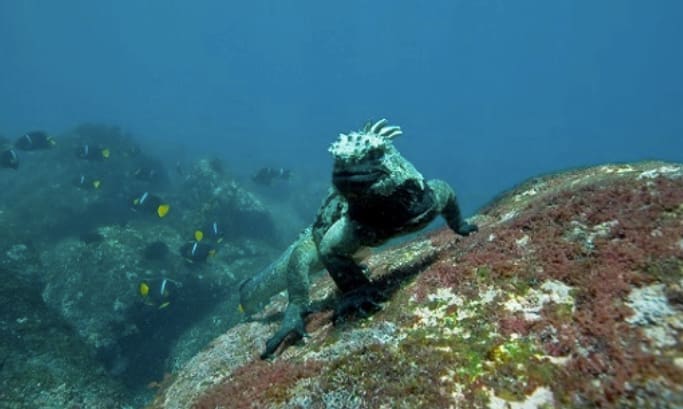
Fernandina is the most volcanically active island among the Galapagos Islands and this is why it is younger than other islands. This island with the largest surface area among the other islands has the only “sea iguana” around the world. This iguana species is known as the “Galapagos dragon” or “sea lizard”. Since the natural environment of the island isn’t suitable for land life, this animal was forced to feed from the sea unlike the other land-based iguanas.
Vegetation and local species are protected Santiago Island
Also known as the James Island, this island takes its name from the King of England James II. This island which Darwin visited for the second time experiences a fast recovery process in terms of vegetation and local species thanks to conservation efforts. While the vegetation on the island is recovered, it experiences black rat problem. The rats that came to the island with the ships consume the plants that the other species on the island should consume.
The most touristic island of Galapagos: Santa Cruz Island
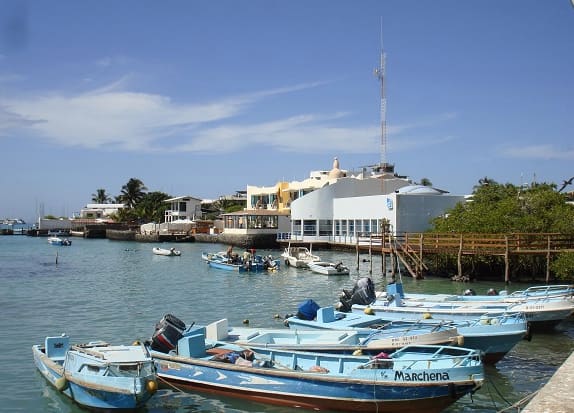
Santa Cruz Island means “Holy Cross” and the volcanic activities stopped a long time ago. This island has a long history in terms of settlement and agricultural activities. The geological structure, vegetation variety and wild life drove people here. Santa Cruz is the most touristic one among these islands.. Because booking.com lists 50 accommodation options in Puerto Ayora. This popularity is normal due to its closeness to the airport and asphalt roads.
The capital of Galapagos: San Cristobal Island
This is one of the eastern Galapagos islands. There are three or four inactive volcanos. The small lake called El Junco is the only fresh water source of the island. Darwin stepped on this island in 1835. In the past (1880s), Ecuador government built a prison here. Puerto Baquerizo Moreno here was the capital of Galapagos state. This is the second most dense place after Santa Cruz.
Other islands
In addition to the islands above, Baltra, Bartolome, Darwin, Espanola, Floreana, Genovesa, Marchena, North Seymour, Pinta, Pinzon, Plazas, Rabida, Santa Fe and Wolf islands are a part of the Galapagos islands.
Incredible species variety
Although there are few mammals on the islands, there is high variety of sea creatures and birds. While grass and ferns are the most common vegetation, large seed plants are few. Some of the species on the island are finch, blue-footed booby, tortoise, Galapagos penguin, marine iguana and sea lion.
A Galapagos loner: Lonesome George
We must talk about Lonesome George while speaking of Galapagos. Of course, you might ask who George is. George is a Pinta Island tortoise (a subspecies of Galapagos tortoise) but he is an unlucky and lonely tortoise. This tortoise on Pinta Island found in 1971 was lonely because she didn’t have any tortoise to mate and she is the last of her kind. You might ask whether she can mate with another tortoise? They mated but embryos didn’t form. She left this world on 24 June 2012 without mating and leaving an offspring.
