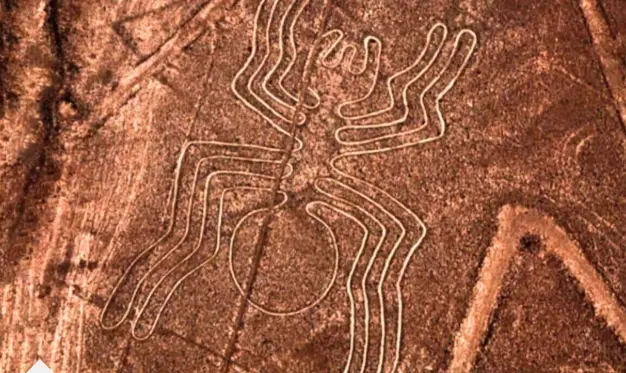
AI discovers Nazca geoglyphs in the vast desert of southern Peru, revealing hundreds of ancient figures that had remained hidden for more than two thousand years. Thanks to advanced artificial intelligence systems and modern aerial imaging technology, researchers have dramatically accelerated the discovery of these mysterious desert drawings, bringing new insight into one of the world’s most fascinating archaeological landscapes.
For decades, archaeologists suspected that many more Nazca geoglyphs existed across Peru’s desert plateau. However, the sheer size of the Nazca Pampa and the faint appearance of many figures made finding them extremely difficult. Now, artificial intelligence has helped researchers locate hundreds of previously unknown geoglyphs, opening a new chapter in the study of ancient civilizations.
The Nazca Desert: Home of One of Archaeology’s Greatest Mysteries
The Nazca Desert in southern Peru is famous for its enormous geoglyphs, known as the Nazca Lines. These massive shapes were created by the Nazca people more than 2,000 years ago by removing dark stones from the surface to reveal lighter soil underneath.
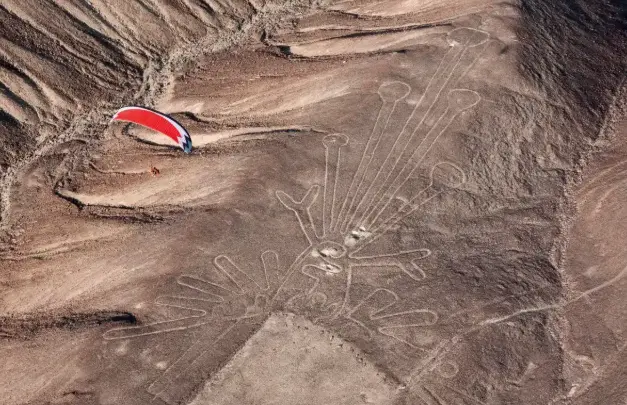
From ground level, the desert appears mostly empty. The reddish-brown surface hides faint markings that are nearly impossible to recognize without aerial views. But from above, enormous images emerge: animals, plants, geometric patterns, and human figures stretching across the landscape.
For much of the 20th century, archaeologists relied on airplanes and manual surveys to document these figures. While the work produced important discoveries, the process was extremely slow. Researchers often spent months studying photographs and walking across the desert to verify possible shapes.
Even with decades of research, many experts believed that a large number of geoglyphs remained undiscovered.
How AI Discovers Nazca Geoglyphs Using Advanced Technology
The breakthrough came when archaeologists collaborated with data scientists to develop an artificial intelligence system capable of detecting possible geoglyph patterns in aerial images.
This AI system was trained using deep learning, a method where computers analyze thousands of visual examples to learn how to recognize patterns. In this case, researchers used existing photographs of known Nazca figures as training material.
Because there were relatively few confirmed geoglyph images available, the research team used a creative strategy. They divided each image into smaller sections and fed these fragments into the AI model. This allowed the system to learn the visual characteristics of Nazca geoglyphs even from limited data.
Once trained, the AI analyzed thousands of aerial images of the desert.
Instead of simply highlighting shapes, the software produced a probability map showing areas where geoglyphs were most likely to exist. These maps helped researchers identify specific locations that deserved closer inspection.
Across the entire Nazca plateau, the system generated tens of thousands of potential discovery points.
From AI Predictions to Field Discoveries
After the AI identified possible sites, human experts began the verification process.
Archaeologists examined high-resolution images from airplanes and drones to filter the most promising candidates. This digital review process alone required more than 1,200 hours of analysis.
From tens of thousands of potential locations, the researchers eventually selected around 1,300 high-priority sites for further investigation.
Drones equipped with advanced cameras then flew over these areas to capture detailed photographs of the terrain. These images revealed subtle patterns of stones and soil color that could indicate ancient geoglyphs.
Finally, teams of archaeologists traveled into the desert to conduct ground surveys.
Walking across the plateau under official permits, the researchers carefully examined hundreds of locations identified by the AI system.
AI Discovers Nazca Geoglyphs That Humans Missed for Decades
The field surveys produced remarkable results.
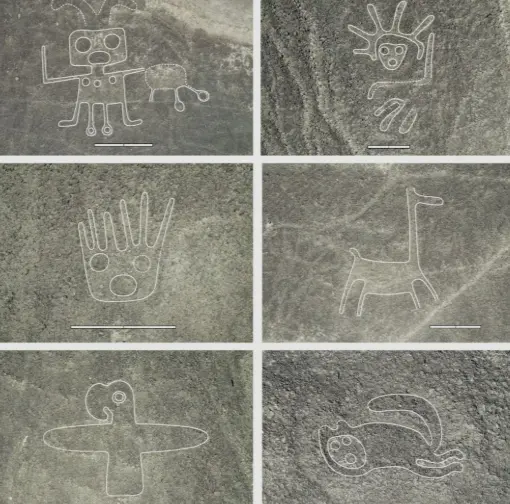
Researchers confirmed the existence of 303 previously unknown figurative geoglyphs, along with 42 additional geometric shapes that had never been documented before.
This dramatically increases the total known number of Nazca geoglyphs.
Most of the newly discovered figures are relatively small compared to the famous giant lines. On average, these new images measure about nine meters in length and are often located on gentle slopes or hillsides.
Because of their small size and faint outlines, many of these geoglyphs had remained invisible to researchers for decades.
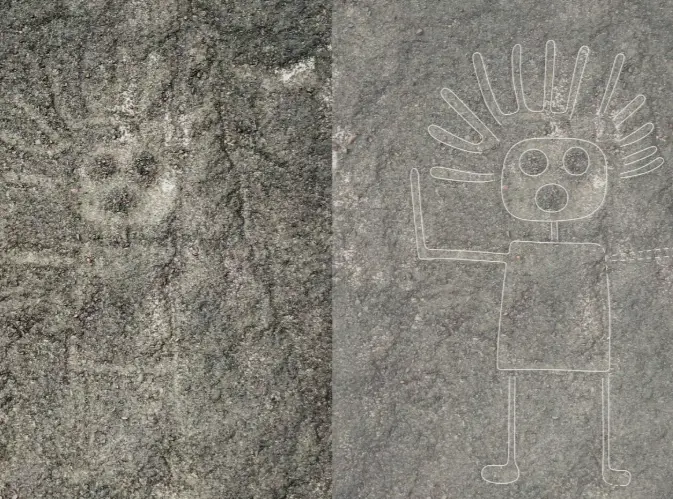
Some of the new figures depict humans, animals, or symbolic motifs associated with Nazca culture.
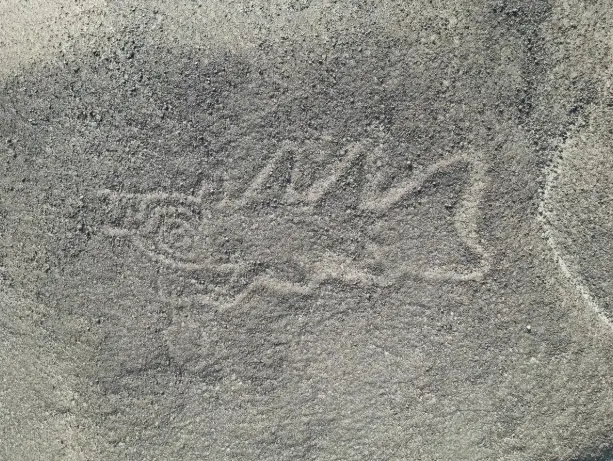
One of the most striking discoveries is a 22-meter-long image of a killer whale holding a knife, a design that closely resembles illustrations found on Nazca pottery.
Other geoglyphs depict animals such as llamas, birds, and mythical creatures.
Two Different Styles of Nazca Geoglyphs
The discoveries also revealed new information about how the Nazca people created and used these designs.
Researchers identified two main categories of geoglyphs:
Relief-Type Geoglyphs
Relief geoglyphs are created by piling stones or clearing areas to produce subtle contrasts on the ground.
These figures are usually smaller and often appear near ancient walking paths. Many of them depict human figures, animals, or symbolic imagery.
Experts believe these designs were meant to be seen by people traveling along local routes.
Line-Type Geoglyphs
Line geoglyphs are the large and famous Nazca designs visible from aircraft.
These include enormous straight lines, trapezoids, and large animal figures that can stretch up to 90 meters or more.
They are often located on flat terrain and may have been part of ceremonial routes or ritual processions.
AI Dramatically Accelerates Archaeological Discovery
The discovery also highlights how dramatically artificial intelligence can transform archaeological research.
For most of the past century, archaeologists discovered new Nazca figures at an extremely slow pace.
From the 1940s until the early 2000s, researchers identified only about one or two new figurative geoglyphs per year.
Later improvements in aerial photography increased the rate of discovery slightly, but progress remained slow.
With the help of artificial intelligence, however, researchers were able to identify hundreds of geoglyphs in just a single field season.
This represents a massive increase in efficiency compared with traditional survey methods.
Experts estimate that the AI-assisted system accelerated the discovery process more than sixteen times faster than previous approaches.
AI and Archaeology: A Powerful New Partnership
Despite the impressive results, archaeologists emphasize that artificial intelligence does not replace human researchers.
Instead, AI serves as a powerful tool that helps guide fieldwork.
By analyzing huge amounts of imagery, the system can highlight areas that deserve attention, allowing experts to focus their efforts more effectively.
Even after the recent discoveries, hundreds of AI-identified sites remain unexplored.
Statistical models suggest that hundreds more Nazca geoglyphs may still exist across the desert.
The Future of AI-Powered Archaeology
The success of the Nazca project is already influencing archaeological research around the world.
Scientists believe similar AI systems could be used to detect other ancient features that are difficult to see with the human eye, including:
- buried settlements
- ancient roads
- agricultural terraces
- hidden temples
Drone technology, satellite imagery, and artificial intelligence are increasingly becoming essential tools in modern archaeology.
By combining these technologies, researchers can explore massive landscapes much more efficiently than ever before.
A New Era for Understanding the Nazca Civilization
The discovery of hundreds of new geoglyphs is more than just a technological achievement. It also provides valuable clues about the culture and beliefs of the ancient Nazca people.
These mysterious desert drawings may have served religious, ceremonial, or navigational purposes. Some scholars believe they were connected to water rituals in one of the driest regions on Earth.
Every new geoglyph discovered adds another piece to this ancient puzzle.
With artificial intelligence now helping archaeologists analyze the Nazca desert, experts expect many more discoveries in the coming years.
What was once considered an impossible search has suddenly become one of the most exciting frontiers in archaeological research.
