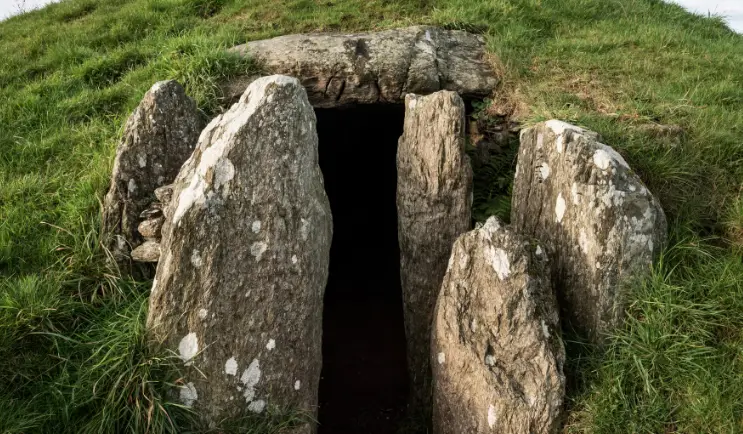
5,000-year-old tomb discovered in Spain is giving archaeologists an extraordinary look into the lives, beliefs, and burial traditions of prehistoric communities on the Iberian Peninsula. Researchers working in southern Spain recently uncovered a massive stone-built tomb in the province of Málaga, and experts say the discovery could significantly expand our understanding of ancient societies that lived thousands of years ago.
The structure, which dates back roughly five millennia, is remarkable not only for its age but also for its size and condition. Measuring approximately 42 feet (around 13 meters) in length, the tomb appears to be one of the most impressive and best-preserved prehistoric burial monuments ever found in the Andalusia region.
Inside the ancient structure, archaeologists discovered a large number of cultural artifacts, human remains, and valuable materials that suggest the tomb served as an important collective burial site for an ancient community.
5,000-Year-Old Tomb Discovered in Spain: A Monumental Dolmen
The 5,000-year-old tomb discovered in Spain is believed to be a dolmen—a type of prehistoric megalithic structure made from large upright stones supporting massive horizontal slabs. Dolmens were commonly used as burial monuments during the Neolithic and early Bronze Age periods.
Experts involved in the excavation say the newly uncovered site could rank among the most significant dolmens ever discovered in southern Spain.
According to archaeologists from the University of Cádiz, the monument is both large and unusually complex. The internal structure includes multiple compartments created by huge vertical stones known as orthostats. Some of these slabs reach heights of more than six feet.
The tomb also appears to have originally been sealed by large horizontal stone slabs. On top of these slabs, ancient builders constructed a tumulus—a mound made of sand and small stones—covering the entire burial monument.
This design helped protect the interior for thousands of years, which explains why the site remains in such exceptional condition today.
Ancient Artifacts Found Inside the Tomb
One of the most exciting aspects of the 5,000-year-old tomb discovered in Spain is the wide variety of artifacts uncovered inside the burial chambers.
During excavation work, researchers identified several internal spaces that functioned as ossuaries—rooms where the bones of the deceased were placed. These chambers contained the remains of multiple individuals, suggesting that the monument was used as a collective burial site over an extended period.
Alongside the human remains, archaeologists discovered numerous grave goods, including:
- Arrowheads crafted from flint
- Large flint blades used as tools
- An unusually well-preserved halberd, a two-handed axe-like weapon
- Seashells brought from coastal areas
- Pieces of ivory
- Amber fragments
- Sophisticated stone tools
Many of these items were likely symbolic or ceremonial objects placed in the tomb to accompany the dead.
The presence of rare materials such as ivory and amber suggests that prehistoric communities in the region were part of long-distance trade networks.
Evidence of Ancient Trade Networks
Another major insight from the 5,000-year-old tomb discovered in Spain is the evidence it provides for prehistoric trade connections.
One of the most striking discoveries at the site is the presence of seashells. While shells might not seem unusual, the tomb is located inland, far from the coast.
This indicates that ancient communities transported materials over long distances, either through trade routes or social exchange networks. Archaeologists believe the sea may have held symbolic or prestigious significance for these communities.
Ivory and amber artifacts further support the idea that the region was connected to broader exchange systems. These materials were not commonly found locally, meaning they likely arrived from distant areas.
Such findings suggest that people living in southern Iberia thousands of years ago maintained cultural and economic relationships that stretched across large territories.
Understanding Prehistoric Burial Practices
The 5,000-year-old tomb discovered in Spain also offers valuable insight into ancient burial traditions.
The multiple ossuaries found within the structure indicate that the tomb was reused over time, probably serving as a communal burial site for generations. This practice was common among Neolithic societies, where tombs functioned as important ancestral monuments.
Rather than burying individuals separately, communities often placed remains together in shared chambers. These burial spaces reinforced social identity and family connections across generations.
The presence of prestigious grave goods suggests that rituals played an important role in burial ceremonies. Items placed alongside the dead may have symbolized status, protection in the afterlife, or connections to spiritual beliefs.
Because the tomb is so well preserved, archaeologists believe it could help reconstruct detailed aspects of daily life, belief systems, and social organization in prehistoric Iberia.
A Rare Level of Preservation
One reason the 5,000-year-old tomb discovered in Spain is attracting global attention is its remarkable state of conservation.
Many prehistoric burial sites have been damaged over centuries by erosion, looting, or modern construction. However, this tomb appears to have remained largely intact beneath its protective stone and earth covering.
The excellent preservation allows researchers to carefully study the layout of the monument and the exact placement of objects within the burial chambers.
Such details are extremely valuable because they help archaeologists reconstruct how the site was originally used.
Researchers expect that continued excavation will reveal additional artifacts and provide further clues about the people who built the structure.
Dolmens Across Europe and Beyond
The 5,000-year-old tomb discovered in Spain is part of a much larger tradition of megalithic construction that existed across Europe and parts of Asia.
Dolmens are among the most recognizable prehistoric monuments. These structures typically consist of several large upright stones supporting a massive horizontal slab, creating a chamber beneath.
Although many dolmens served as burial sites, they were also used for other purposes in different cultures.
In some cases, they functioned as ceremonial or ritual spaces. In others, they may have acted as territorial markers, signaling ownership of land or the presence of a particular community.
Famous examples of dolmens can be found throughout Europe. Spain itself is home to several well-known sites, including the Dolmen of Guadalperal—sometimes called the “Spanish Stonehenge.”
Elsewhere in Britain, Arthur’s Stone in England is another notable example. This monument consists of multiple upright stones supporting a massive capstone weighing an estimated 27 tons.
These ancient monuments demonstrate that prehistoric societies possessed sophisticated engineering knowledge and strong communal organization.
Why This Discovery Matters
The 5,000-year-old tomb discovered in Spain could become one of the most important archaeological discoveries in the region in recent years.
Because the monument is so well preserved and filled with artifacts, it offers an exceptional opportunity to study prehistoric life in detail.
Researchers hope the site will help answer several key questions:
- How prehistoric communities organized burial rituals
- What tools and weapons they used
- How long-distance trade networks operated
- What materials were considered valuable or symbolic
- How societies structured communal burial spaces
Future research may also involve advanced scientific techniques such as DNA analysis and isotope studies. These methods can reveal where individuals originally came from, what they ate, and how populations moved across ancient landscapes.
Continued Excavations Expected
Excavations at the site are ongoing, and archaeologists believe that much of the tomb remains unexplored.
Each new excavation season could uncover additional chambers, artifacts, or human remains. These discoveries will help researchers build a clearer picture of how the tomb was used and why it was constructed.
The 5,000-year-old tomb discovered in Spain is therefore not only a remarkable archaeological find but also a gateway to understanding a distant era of human history.
As research continues, the ancient monument in Málaga may provide one of the most detailed glimpses yet into the cultural world of prehistoric Iberian societies.
