For decades, the primary hurdle between humanity and the Red Planet hasn’t just been oxygen, radiation, or food—it’s been speed. Chemical rockets, the workhorses of the 20th century, are simply too slow and too “thirsty” for the massive payloads required to sustain human life on a multi-month journey through deep space.
But this week, a quiet laboratory at NASA’s Jet Propulsion Laboratory (JPL) may have just rewritten the future of interplanetary travel. NASA engineers have successfully demonstrated a record-breaking test of a lithium-fed magnetoplasmadynamic (MPD) thruster, reaching power levels of 120 kilowatts—the highest ever achieved for this type of propulsion in a U.S. facility.
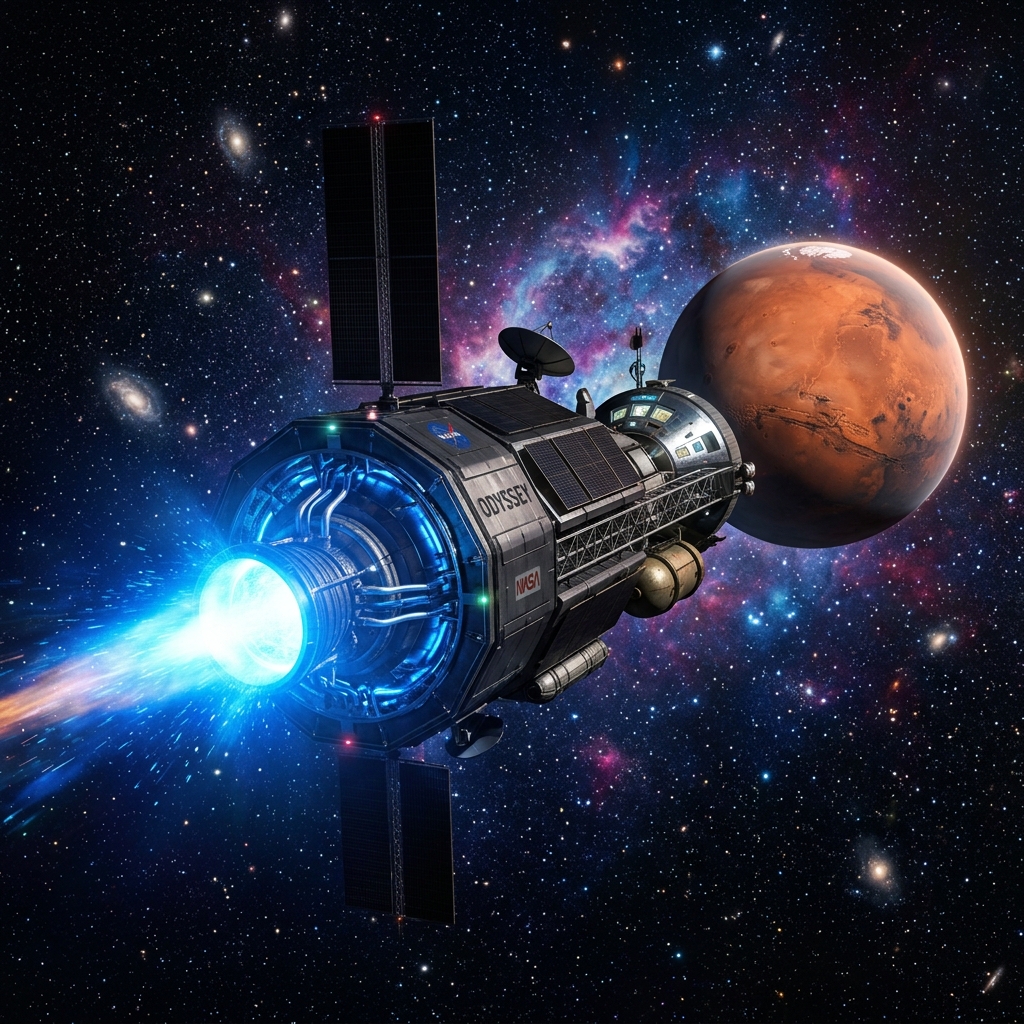
What is an MPD Thruster?
To understand why this is a big deal, you have to look past the fire and smoke of traditional rocket launches. While a chemical rocket is great for getting off the Earth’s surface, once you are in the vacuum of space, efficiency is king.
An MPD thruster is a type of electric propulsion. Instead of burning fuel, it uses high electrical currents interacting with a magnetic field to accelerate ionized gas (plasma) to incredible speeds. In this specific test, NASA used lithium metal vapor as the propellant. The result? Exhaust speeds that are far higher than anything a traditional rocket could dream of, meaning you can get more “push” out of every gram of fuel.
25 Times More Powerful
The 120-kilowatt milestone is staggering when you compare it to current technology. NASA’s Psyche mission, currently traversing the asteroid belt, uses state-of-the-art Hall thrusters that operate at roughly 4.5 kilowatts. The new MPD prototype is approximately 25 times more powerful.
During the test inside JPL’s specialized “CoMeT” vacuum chamber, the thruster’s central electrode reached temperatures exceeding 5,000 degrees Fahrenheit—hotter than the surface of some stars. This level of power is what’s required to move the massive habitats, water supplies, and life-support systems needed for a crewed Mars mission.
Why Lithium?
The choice of lithium as a “fuel” is a strategic masterstroke. Traditional electric thrusters often use xenon gas, which is rare and incredibly expensive. Lithium, however, is abundant and stores more energy per unit of mass in this specific type of engine.
By using lithium, NASA is aiming for a propulsion system that is up to 90% more efficient than chemical alternatives. This efficiency means a Mars-bound ship could be lighter, faster, and carry more scientific equipment. More importantly, it could potentially cut the transit time to Mars significantly, reducing the amount of cosmic radiation the astronauts are exposed to.
The Vision: Nuclear-Electric Propulsion
While 120 kilowatts is a record, NASA isn’t stopping there. To send a human crew to Mars, we will likely need a propulsion system in the “megawatt” class—between 2 and 4 megawatts of power.
Where would that power come from? Solar panels aren’t enough when you get that far from the sun. The long-term vision is to pair these MPD thrusters with small nuclear reactors. This “Nuclear-Electric Propulsion” (NEP) setup would provide a constant, high-thrust acceleration that could push a spacecraft across the solar system at speeds we’ve only seen in science fiction.
Challenges on the Horizon
Of course, building a Mars engine isn’t without its “Shark Tank” moments of skepticism. The extreme heat generated by these thrusters—as seen in the 5,000-degree electrode at JPL—is a major engineering challenge. NASA engineers now need to prove that these engines can run not just for a few minutes, but for thousands of hours (target: 23,000+ hours) without the components melting or degrading.
There is also the question of the vacuum of space. While JPL’s chambers are advanced, the true test will come when these lithium-fueled beasts are fired in the actual environment of the solar system, where maintenance is impossible and every gram of weight counts.
Why Americans Should Care
For the average American, space exploration often feels like a distant, expensive hobby. But the technology being developed for these thrusters has immediate “Earthly” applications. The advancements in high-temperature materials, plasma physics, and efficient energy conversion are the same technologies that will drive the next generation of clean energy and advanced manufacturing on our own planet.
Furthermore, it represents a renewal of American leadership in deep-space exploration. As other nations ramp up their lunar and Martian ambitions, the MPD thruster is NASA’s way of saying that the road to Mars still runs through the United States.
The Next Steps
The success of the 120kW test is a green light for further development. The next phase will involve scaling the prototype even further and testing it for long-duration reliability. NASA is looking toward the 2030s and 2040s for the first human footprints on Mars, and those footprints will almost certainly be carried there by the blue glow of a plasma engine.
Final Thoughts
We are living in a second “Space Age.” Unlike the first one, which was defined by the race to reach the Moon, this one is defined by the technology to stay and travel further than ever before. The MPD thruster might look like a piece of high-tech plumbing in a lab today, but tomorrow, it will be the heart of the first ship to carry humans to another planet.
