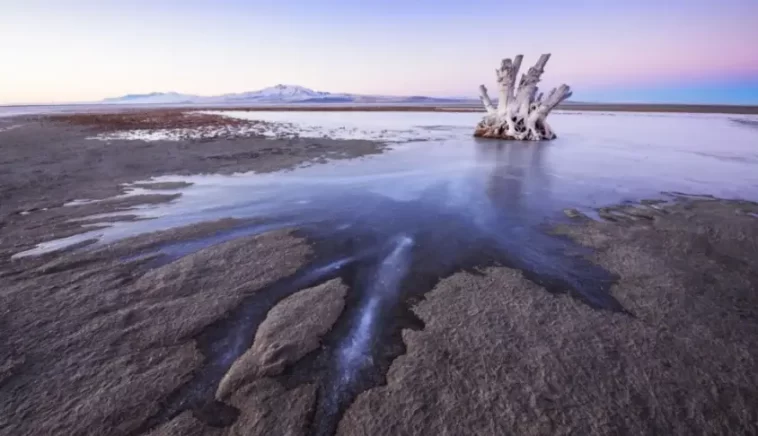
Great Salt Lake nematodes discovery has surprised scientists and revealed a hidden ecosystem living deep inside the salty sediments of one of North America’s most unusual lakes. For decades, researchers believed the lake’s biological life was simple and limited to only a few hardy species. However, new research shows that microscopic animals have been quietly thriving beneath the lakebed all along.
The discovery adds an entirely new layer to our understanding of the Great Salt Lake ecosystem. Hidden between grains of mud and crystals of salt, tiny roundworms known as nematodes were found moving through sediment samples taken from the lake floor. These organisms are so small they can only be seen with a microscope, yet they play a surprisingly important role in the environment.
Scientists say the discovery proves that even environments long considered biologically simple may still hide complex forms of life waiting to be found.
A Harsh Environment in the Great Salt Lake
The Great Salt Lake in Utah is famous for its extreme salinity. In some parts of the lake, salt concentrations are several times higher than those found in the ocean. These harsh conditions make it very difficult for most animals and plants to survive.
Because of this, scientists traditionally believed that the lake supported only a limited number of organisms. Two species have long dominated scientific discussions about life in the lake.
The first is the brine shrimp, a tiny crustacean known scientifically as Artemia franciscana. These small animals appear in huge seasonal swarms and are an essential part of the lake’s ecosystem. They feed on microscopic algae and in turn provide food for millions of migratory birds.
The second well-known inhabitant is the brine fly. These insects live along the lake’s shoreline where their larvae grow in thick mats of algae and bacteria. Large flocks of birds feed on these flies during migration, making the lake one of the most important bird habitats in North America.
For years, researchers believed these organisms represented most of the animal life in the lake.
But the Great Salt Lake nematodes discovery suggests that this view was incomplete.
Scientists Discover Nematodes in Lake Sediments
The discovery came from researchers at the University of Utah who were studying life in extreme environments. The research team collected sediment samples from multiple locations within the lake.
Reaching those sampling points required unusual fieldwork methods. Scientists used kayaks to reach shallow areas and mountain bikes to cross large stretches of salt flats along the shoreline.
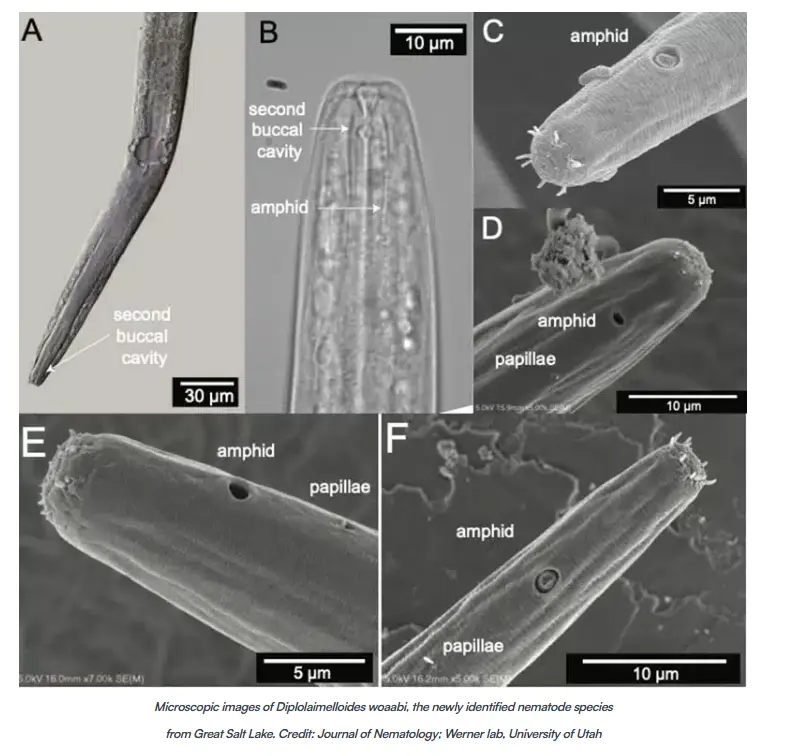
Once the sediment samples were brought back to the laboratory, researchers examined them under high-powered microscopes. What they saw was unexpected.
Moving through the sediment were extremely thin, thread-like worms measuring only a fraction of a millimeter in length. Genetic analysis confirmed that these organisms belonged to a group of animals called nematodes.
Nematodes, also known as roundworms, are among the most abundant animals on Earth. They live in nearly every environment imaginable, including soil, freshwater, oceans, and even deep underground ecosystems.
However, scientists had never previously confirmed their presence in the highly salty environment of the Great Salt Lake.
The Importance of the Great Salt Lake Nematodes Discovery
The Great Salt Lake nematodes discovery is significant because it reveals that the lake’s ecosystem is more complex than previously believed.
Researchers found not just a single worm but multiple types of nematodes living within the sediment. This indicates that several species have adapted to survive in the lake’s challenging chemical conditions.
These tiny animals likely feed on bacteria, microscopic algae, and organic material that settles into the sediment. This places them near the base of the lake’s hidden food web.
Even though they are invisible to the naked eye, nematodes play an essential ecological role. By consuming microbes and breaking down organic debris, they help recycle nutrients within sediments.
Their movement through the mud also mixes layers of sediment, which helps oxygen and nutrients circulate. These processes support the microscopic communities that live beneath the lakebed.
How Animals Survive in Hypersaline Conditions
Life inside the Great Salt Lake must cope with extremely salty water. In hypersaline environments like this, the salt concentration can disrupt the balance of water inside cells, which can be fatal for many organisms.
Animals that survive in such conditions must develop special biological adaptations.
For example, brine shrimp regulate the salt concentration inside their bodies while filtering food from the water. Brine flies grow in shoreline mats where bacteria and algae provide nutrients.
The newly discovered nematodes appear to have adapted to a completely different habitat within the lake. Instead of living in open water, they survive in the sediment where conditions may be slightly more stable.
Tiny spaces between grains of mud create microhabitats where organic matter and microbial life accumulate. These small pockets provide food and shelter for the worms.
Scientists believe this hidden sediment environment allows the nematodes to survive despite the lake’s extreme chemistry.
A Hidden Microscopic Ecosystem
The Great Salt Lake nematodes discovery also highlights how much remains unknown about microscopic ecosystems.
Sediments at the bottom of lakes and oceans often contain incredibly complex communities of microbes and tiny animals. Because these organisms are difficult to observe, they can remain undiscovered even in well-studied environments.
In the case of the Great Salt Lake, researchers had focused mainly on organisms visible in the water or along the shoreline. The deeper sediment layer had received far less attention.
The new findings suggest that the lakebed may host many additional species that scientists have not yet identified.
In fact, researchers found that some sediment samples contained notable numbers of nematodes, indicating that they are not rare visitors but established residents of the lake.
Why This Discovery Matters for Science
Understanding microscopic life in extreme environments can help scientists answer larger biological questions.
Extreme habitats often host organisms with unusual adaptations that allow them to survive conditions that would normally be deadly. Studying these adaptations may provide insights into how life evolves under stress.
Research on extremophiles—organisms that live in harsh environments—also helps scientists understand where life might exist on other planets or moons.
For example, hypersaline lakes on Earth are sometimes used as models for environments that may exist on Mars or icy moons such as Europa.
The Great Salt Lake nematodes discovery therefore contributes to a growing body of knowledge about how life can persist in unexpected places.
More Discoveries May Still Be Waiting
Researchers believe this discovery may only be the beginning. The lake’s sediments have not been extensively explored, and scientists suspect that more microscopic organisms may be waiting to be found.
Future studies will likely examine different areas of the lake and analyze additional sediment samples. Advanced genetic techniques could also reveal microbial species that have never been identified before.
Each new discovery helps scientists build a more complete picture of the lake’s hidden ecosystem.
Even environments that appear simple on the surface may contain complex biological communities beneath.
A Reminder That Nature Still Holds Surprises
The Great Salt Lake often looks quiet and empty to visitors. Wide salt flats stretch toward shallow water, and the landscape can appear almost lifeless in the desert heat.
But the Great Salt Lake nematodes discovery reminds us that life can exist in places we least expect.
Deep inside the salty mud of the lakebed, tiny worms are quietly moving through sediment, feeding on microbes, and helping sustain an unseen ecosystem.
Their presence shows that even in one of North America’s harshest environments, life continues to adapt, evolve, and survive in remarkable ways.
And for scientists studying the natural world, it is a powerful reminder that many secrets of our planet may still be hidden beneath the surface.
