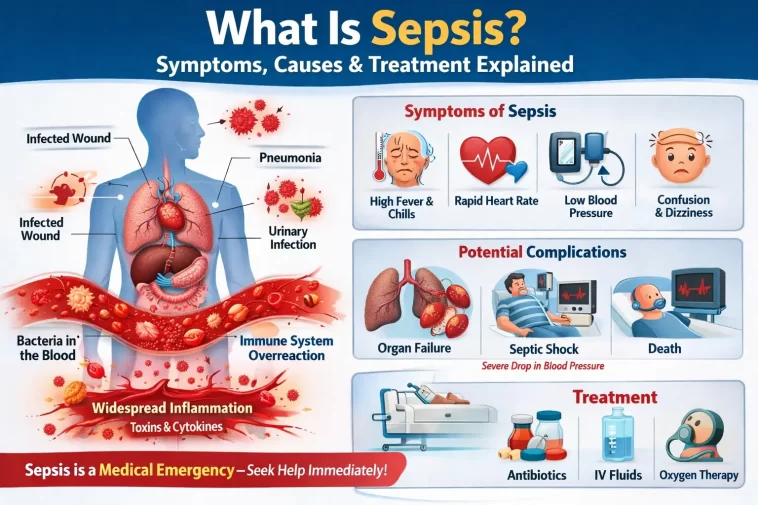
What is sepsis? It’s a question that most people never think about — until someone they love is lying in a hospital bed and a doctor says those words out loud. Sepsis is one of the most dangerous medical conditions in the world, yet it’s still widely misunderstood. Many people confuse it with a regular infection or assume it only happens to elderly patients. The truth is much more sobering.
Every year, sepsis affects millions of people globally. According to the World Health Organization, it is responsible for around 11 million deaths annually — that’s one death every three seconds. Despite those numbers, awareness remains surprisingly low. In this post, we’re going to break it all down in plain language: what sepsis actually is, what causes it, how to recognize the warning signs early, and what happens when it’s treated — or when it isn’t.
So, What Is Sepsis Exactly?
Sepsis is not an infection itself. It’s the body’s extreme, out-of-control response to an infection.
Here’s how it works: When you get an infection — whether from bacteria, a virus, or a fungus — your immune system kicks in to fight it. Normally, that response is localized. Your body targets the problem, deals with it, and moves on. But in some cases, the immune system panics. Instead of staying focused, it floods the entire body with inflammatory chemicals. Those chemicals start damaging the body’s own tissues and organs rather than just attacking the germs.
That widespread, self-destructive immune response is what we call sepsis.
The result is a chain reaction that can quickly spiral out of control. Blood pressure drops, organs stop receiving adequate blood flow, and within hours — sometimes less — the situation can become life-threatening. This is why sepsis is considered a medical emergency.
Think of it like a small fire in your kitchen that somehow triggers every sprinkler in the building, floods the entire structure, and causes more damage than the original fire ever could have.
What Causes Sepsis?
Any type of infection can trigger sepsis, but some are more commonly associated with it than others.
Bacterial infections are the most common cause. These include pneumonia (a lung infection), urinary tract infections, abdominal infections like appendicitis or a perforated gut, and infections in the skin or soft tissue. In hospitals, sepsis often develops as a complication from procedures, surgery, or devices like catheters that can introduce bacteria into the bloodstream.
Viral infections can also lead to sepsis. COVID-19, for instance, was shown to cause sepsis in a significant number of severe cases. Influenza can do the same, particularly in vulnerable individuals.
Fungal infections are less common but can cause sepsis, especially in people with weakened immune systems.
Here’s something many people find surprising: sepsis doesn’t always come from a “serious” infection. Sometimes it starts with something as ordinary as a urinary tract infection, a small cut that gets infected, or a dental abscess. The severity of the original infection doesn’t always predict whether sepsis will develop.
Who Is Most at Risk?
While sepsis can affect anyone, certain groups are significantly more vulnerable.
- Older adults (over 65): The immune system weakens with age, making it harder to fight off infections before they escalate.
- Infants and young children: Their immune systems are still developing and may not respond appropriately.
- People with chronic illnesses: Diabetes, kidney disease, liver disease, and heart conditions all impair the body’s ability to handle infections.
- Immunocompromised individuals: This includes cancer patients undergoing chemotherapy, people living with HIV, and organ transplant recipients taking immunosuppressants.
- People who have recently had surgery or been hospitalized: Hospital environments, while sterile, carry their own infection risks, and invasive procedures create potential entry points for bacteria.
That said, it’s worth repeating: healthy adults can and do develop sepsis. No one is completely immune.
Recognizing the Warning Signs
This is arguably the most important section of this entire post, because early recognition of sepsis can genuinely be the difference between life and death.
The tricky part is that the early symptoms of sepsis look a lot like other, less serious conditions. Fever, chills, fast heart rate, confusion — these could easily be mistaken for a bad flu or extreme exhaustion. That’s exactly why so many cases are caught too late.
Watch for these warning signs, especially if you or someone you know already has an infection:
- A high fever (above 38.3°C / 101°F) or an abnormally low body temperature (below 36°C / 96.8°F)
- Rapid heart rate (more than 90 beats per minute)
- Rapid breathing (more than 20 breaths per minute)
- Confusion, disorientation, or altered mental state
- Extreme fatigue that seems disproportionate
- Clammy or mottled (blotchy) skin
- Feeling like something is “seriously wrong” — an instinctive sense of dread that medical professionals actually take seriously
A helpful acronym used in awareness campaigns is TIME:
- Temperature — higher or lower than normal
- Infection — signs of a known or suspected infection
- Mental decline — confusion, drowsiness, difficult to rouse
- Extremely ill — a gut feeling that something is very wrong
If multiple of these signs are present at the same time — especially alongside a known infection — call emergency services or get to a hospital immediately. Do not wait to see if it gets better on its own.
What Is Septic Shock?
Septic shock is the most severe stage of sepsis. At this point, the drop in blood pressure becomes so extreme that even aggressive treatment has difficulty restoring normal circulation. Organs begin to fail — the kidneys, liver, lungs, and heart are often the first to show damage.
Mortality rates for septic shock are disturbingly high, often ranging between 30% and 50% depending on the study and the patient’s baseline health. This is why doctors and nurses are trained to act on sepsis before it ever gets to this stage.
How Is Sepsis Diagnosed?
There’s no single test that definitively diagnoses sepsis. Instead, doctors use a combination of physical examination findings, patient history, and lab results to build a picture.
Common diagnostic tools include:
Blood tests — These check for elevated white blood cell counts (a sign of infection), abnormal kidney and liver function, lactate levels (high lactate suggests organs aren’t getting enough oxygen), and the presence of bacteria in the blood (a blood culture).
Imaging — Chest X-rays, CT scans, or ultrasounds may be used to identify the source of infection.
Clinical criteria — Doctors often use scoring systems like the qSOFA (quick Sequential Organ Failure Assessment) to quickly gauge how serious a patient’s condition is.
One of the biggest challenges in diagnosing sepsis is speed. The condition can deteriorate rapidly, so clinicians are trained to make decisions quickly — often before all the test results are back.
Treatment: Every Minute Counts
Sepsis treatment is aggressive and time-sensitive. Research has consistently shown that outcomes improve dramatically when treatment begins within the first hour.
The core components of sepsis treatment include:
Antibiotics — Given as soon as possible, usually intravenously. Because the specific bacteria often aren’t identified immediately, doctors start with broad-spectrum antibiotics that cover a wide range of potential organisms.
Intravenous fluids — Large volumes of IV fluids are given quickly to help stabilize blood pressure and support organ perfusion.
Vasopressors — If fluids alone don’t bring blood pressure back up, medications that constrict blood vessels (vasopressors) are added to help maintain circulation to vital organs.
Oxygen support — Supplemental oxygen or mechanical ventilation may be needed if the lungs are struggling.
Source control — Identifying and treating the original infection is critical. This might mean draining an abscess, removing an infected catheter, or performing emergency surgery.
Most patients with sepsis are treated in an intensive care unit (ICU), where they can be monitored around the clock.
Recovery and Life After Sepsis
Surviving sepsis is a significant achievement — but for many patients, it’s not simply a matter of going home and returning to normal life. Post-sepsis syndrome is a real condition that affects a large proportion of survivors.
Symptoms of post-sepsis syndrome can include:
- Persistent fatigue and weakness
- Difficulty concentrating or memory problems (sometimes called “brain fog”)
- Recurring nightmares or anxiety
- Muscle and joint pain
- A weakened immune system, making future infections more likely
Recovery can take months — or in some cases, years. The psychological impact is often underestimated. Many survivors develop PTSD, depression, or anxiety following their experience. Support from healthcare providers, mental health professionals, and community groups for sepsis survivors can make a meaningful difference.
Can Sepsis Be Prevented?
Not every case of sepsis can be prevented, but there are meaningful steps that reduce the risk.
Vaccinations are one of the most effective tools. Staying up to date on vaccines for pneumonia, influenza, meningitis, and COVID-19 reduces the risk of the infections that most commonly lead to sepsis.
Good hygiene — especially proper handwashing — limits the spread of infection. This applies both in everyday life and in healthcare settings.
Prompt treatment of infections is essential. If you have a wound that looks infected, a UTI that isn’t getting better, or a fever that’s climbing, don’t wait. Getting treatment early dramatically reduces the chance of an infection progressing to sepsis.
For patients in hospitals, ask your care team about infection prevention protocols, including catheter care and wound hygiene. Patients and families who advocate for themselves can genuinely reduce risk.
FAQ: Common Questions About Sepsis
Is sepsis contagious?
No. Sepsis itself is not contagious — you cannot “catch” sepsis from another person. However, the underlying infection that triggered sepsis (such as the flu or a bacterial infection) may be transmissible. It’s the body’s response to the infection, not the condition itself, that’s the issue.
How quickly can sepsis develop?
Sepsis can progress from early symptoms to life-threatening septic shock in as little as 12 to 24 hours — sometimes faster. This is why rapid recognition and treatment are so critical.
Can children get sepsis?
Yes. Infants and young children are actually among the highest-risk groups. Neonatal sepsis (sepsis in newborns) is a leading cause of infant mortality worldwide. Parents should be aware of warning signs like poor feeding, high fever, unusual irritability, and pale or mottled skin in young children.
Is sepsis the same as blood poisoning?
“Blood poisoning” is an older, non-medical term that was often used to describe what we now call sepsis or bacteremia (bacteria in the bloodstream). These days, healthcare professionals use the term sepsis. The old term is misleading because sepsis can be triggered by viral or fungal infections too, not just bacteria “poisoning” the blood.
What’s the difference between sepsis and septicemia?
Septicemia specifically refers to a bacterial bloodstream infection. Sepsis is a broader term — it refers to the body’s dangerous inflammatory response to any infection, which may or may not involve bacteria directly in the bloodstream. Sepsis is now the preferred medical term.
Can you recover fully from sepsis?
Many people do recover fully, especially if sepsis is caught and treated early. However, a significant number of survivors experience lasting physical and psychological effects. Recovery often takes much longer than expected, and ongoing medical support can be very important.
When should I go to the emergency room for a suspected infection?
Go immediately if you have an infection and you’re also experiencing confusion, extreme difficulty breathing, a very high or very low fever, rapid heart rate, or you simply feel severely unwell in a way that seems out of proportion to the infection. Trust your instincts — and don’t wait.
Final Thoughts
Sepsis is not rare. It is not something that only happens to “other people.” It’s a condition that can affect any of us — young or old, healthy or not — and it moves fast. The single most powerful thing any of us can do is simply know what to look for and act quickly when something feels wrong.
If you take one thing away from this post, let it be this: when an infection is present and a person’s condition is rapidly worsening — especially with confusion, extreme fatigue, or difficulty breathing — that is an emergency. Treat it like one.
This article is for informational purposes only and does not constitute medical advice. If you or someone you know is experiencing symptoms of sepsis, contact emergency services immediately.
