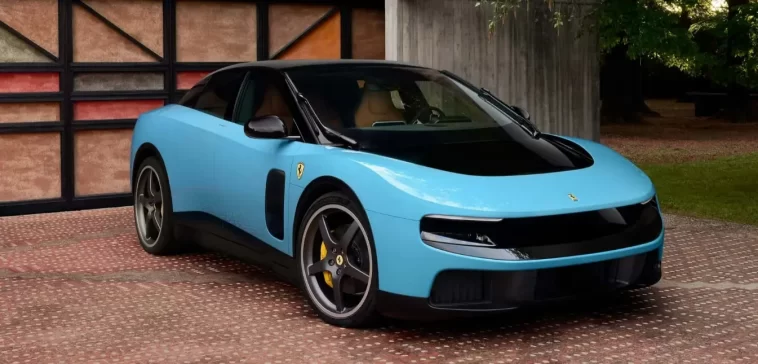
Ferrari Luce electric has officially arrived, and it’s turning heads for all the right — and perhaps unexpected — reasons. The Italian automaker, long synonymous with roaring V8s and V12 combustion engines, has taken its boldest step yet into the electric era. Meet the Luce: a four-door, five-seat, four-motor grand tourer that rewrites what it means to wear the prancing horse badge.
This isn’t a half-hearted hybrid or a cautious toe dip into electrification. The Ferrari Luce electric is a full commitment — a 1,035 horsepower, 530-kilometre range flagship that costs around €550,000 in Europe and carries the DNA of Ferrari’s most radical thinking to date.
What Does “Luce” Mean — and Why That Name?
Luce is the Italian word for light — fitting for a car that signals a new dawn for one of the world’s most storied automotive brands. Ferrari has always named its cars with intention, and Luce is no different. It speaks to illumination, to a new direction, and perhaps to the clean energy philosophy underpinning the entire project.
Ferrari has historically been resistant to electrification on principle. The brand long argued that the sound, sensation, and character of a combustion engine were inseparable from the Ferrari experience. The Luce challenges that belief head-on.
Design: LoveFrom Takes the Wheel
The most immediately striking thing about the Ferrari Luce electric is how it looks. Designed almost entirely by LoveFrom — the creative studio founded by Jony Ive and Marc Newson after departing Apple — the Luce is unlike any Ferrari that has come before it.
LoveFrom was given what Ferrari described as full creative freedom. This wasn’t a brief to “refresh” an existing Ferrari silhouette or evolve a previous model’s language. The studio was asked to imagine something genuinely unfamiliar, and they delivered exactly that.
The front fascia features a large aerodynamic wing reminiscent of the Dodge Charger Daytona EV, which will surprise Ferrari purists. The rear appears sedan-like at first glance, but the entire rear glass and panel section lifts as a single piece — more of a fastback hatch than a traditional boot. At the sides, 23-inch front and 24-inch rear wheels dominate the profile, giving it a stance that’s closer to a supercar than a luxury saloon.
Hidden door handles are standard, and rear passengers enter through suicide-style doors that open rearward. Ferrari says design references were drawn from the 360 Modena and 458 Italia — two of the brand’s most beloved modern classics — though the connections are subtle rather than obvious.
Strip the badge off and many observers might struggle to identify the Luce as a Ferrari. That’s either the bravest or most controversial decision the company has made in decades, depending on who you ask.
Interior: Analogue Soul, Digital Precision
Inside the Ferrari Luce electric, the brand has taken a more considered approach than many EV rivals. Rather than eliminating physical controls in favour of a minimalist touchscreen interface, Ferrari has retained physical buttons alongside digital displays — a nod to driver engagement and tactile satisfaction.
The steering wheel is machined from fully recycled aluminium and works in conjunction with a floating instrument cluster that moves with the wheel, keeping key information in the driver’s line of sight at all times. It’s a clever piece of engineering that avoids the awkward visual interruption of a fixed display behind a moving rim.
A physical lever mounted on the ceiling activates Launch Mode — a deliberate and theatrical touch that turns entering maximum acceleration mode into a ritual rather than a menu selection. Optional features include massaging seats with rear-passenger controls, and a 3,000-watt, 21-speaker audio system for those long motorway stretches.
The cabin seats five across two rows, making the Luce the most practical Ferrari ever built from a passenger-capacity standpoint.
Ferrari Luce Electric Performance Specs
The numbers are genuinely extraordinary, even by Ferrari’s lofty standards.
The Luce is powered by four electric motors derived from the architecture of Ferrari’s F80 hypercar. The system produces 1,035 horsepower (772 kW) and 990 Nm of torque. The 0–100 km/h sprint takes just 2.5 seconds, and the car continues to 200 km/h in 6.8 seconds. Top speed is electronically limited to 310 km/h.
Despite its considerable 2,260 kg kerb weight — making it among the heaviest Ferraris ever produced — the engineers claim the Luce responds dynamically like a vehicle some 400 kg lighter. This is achieved through an elastically mounted subframe, the four-motor torque vectoring system, and a battery pack that doubles as a structural chassis element, reportedly increasing body rigidity by 25 percent.
Full specification summary:
| Spec | Detail |
|---|---|
| Power | 1,035 hp / 772 kW |
| Torque | 990 Nm |
| 0–100 km/h | 2.5 seconds |
| 0–200 km/h | 6.8 seconds |
| Top Speed | 310 km/h |
| Range (WLTP) | 530 km |
| Battery | 122 kWh |
| Architecture | 800V |
| Fast Charging | 350 kW |
| Charge time | 70 kWh in ~20 minutes |
| Weight | ~2,260 kg |
| Price (Europe) | ~€550,000 |
No Fake Engine Noise — But Not Silent Either
Ferrari has made a deliberate and principled decision not to pipe artificial engine sounds into the cabin — a practice some EV makers use to simulate familiarity. Instead, sensors positioned on the rear axle capture actual mechanical vibrations from the drivetrain and processing hardware. That signal is then run through a system Ferrari compares to a guitar amplifier, translating real physical feedback into an acoustic experience tuned for each driving mode.
Drivers can adjust the volume and character of this sound to their preference. It won’t sound like a V12, but Ferrari argues it will feel authentic rather than manufactured.
Battery, Charging, and Real-World Range
The Luce carries a 122 kWh battery pack built on an 800V electrical architecture, putting it in the same technical league as the Porsche Taycan and Audi e-tron GT in terms of charging sophistication.
With a peak charging rate of 350 kW, the Luce can add around 70 kWh of charge in roughly 20 minutes at a compatible high-power station — enough to add well over 300 km of range in a single quick stop. The official WLTP range figure stands at 530 km, which is competitive for a performance-focused vehicle of this weight and power output.
The battery isn’t just an energy store — it’s integrated into the car’s structure, contributing to chassis stiffness and allowing for a lower centre of gravity than would otherwise be possible with a separate pack and frame.
How Does the Luce Compare to Rivals?
The Ferrari Luce electric enters a market that has become increasingly competitive at the ultra-luxury EV end. Its closest natural rivals include the Porsche Taycan Turbo GT, the Rimac Nevera, and potentially the forthcoming electric variants from Lamborghini and Aston Martin.
Against the Taycan Turbo GT, the Luce offers more power, greater range, and a significantly higher price. Against pure hypercars like the Nevera, it offers more practicality and longer range. Ferrari is essentially defining its own category here: an everyday-capable grand tourer that delivers hypercar performance.
FAQ: Ferrari Luce Electric
What is the Ferrari Luce? The Ferrari Luce is the brand’s first fully battery-electric production car. It’s a four-door, five-seat grand tourer with four electric motors, producing over 1,000 horsepower.
How fast is the Ferrari Luce? It accelerates from 0 to 100 km/h in 2.5 seconds and reaches a top speed of 310 km/h.
Who designed the Ferrari Luce? The exterior design was largely created by LoveFrom, the studio founded by former Apple design chief Jony Ive and designer Marc Newson.
What is the range of the Ferrari Luce? The WLTP-rated range is 530 kilometres on a full charge from its 122 kWh battery.
How much does the Ferrari Luce cost? In Europe, the Ferrari Luce is expected to be priced at approximately €550,000.
Does the Ferrari Luce have engine sound? It doesn’t use artificial engine sounds. Instead, real mechanical vibrations from the drivetrain are captured and amplified through a custom audio system, adjustable by the driver.
When will the Ferrari Luce go on sale? Ferrari has announced the model but has not confirmed a specific global on-sale date at the time of writing. European pricing has been revealed at around €550,000.
Is the Ferrari Luce heavier than other Ferraris? Yes. At approximately 2,260 kg, the Luce is one of the heaviest cars Ferrari has ever produced — though the engineering team claims dynamic behaviour equivalent to a car some 400 kg lighter.
Final Thought
The Ferrari Luce electric represents one of the most significant pivots in automotive history. A brand built entirely on the romance of internal combustion has produced something that is, by any measure, extraordinary — even if it challenges every expectation of what a Ferrari should look and sound like.
Whether longtime enthusiasts embrace it will take time to become clear. But on pure numbers, engineering ambition, and design courage, the Luce makes a very strong opening argument for Ferrari’s electric future.
