Let’s be honest about something most people won’t say out loud.
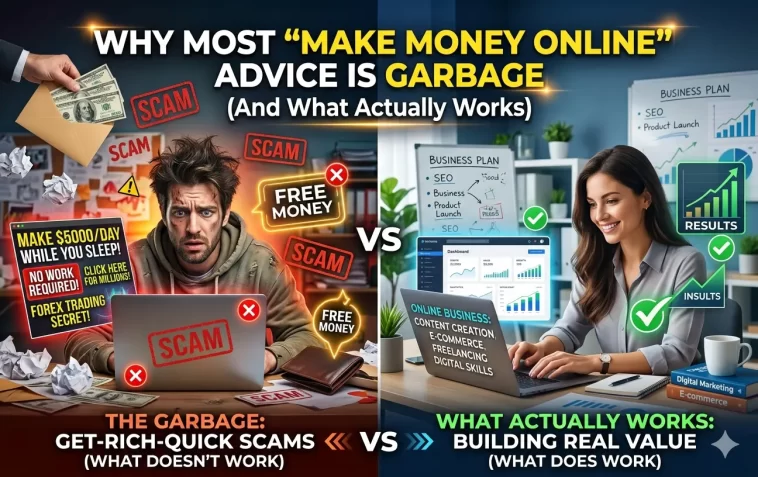
Most “make money online” advice is garbage. Not because the internet is full of liars — though some of it is — but because most of the advice you find online is designed to make money for the person giving it, not for you.
You’ve seen the content. The screenshots of Stripe dashboards. The “I made $10,000 in my first month” thumbnails. The YouTube guru with a rented Lamborghini in the background. The course that promises to teach you the “secret system” for $997.
It’s everywhere. And it works — because millions of people are desperate to escape bad jobs, pay off debt, or just have more freedom. That desperation is the product being sold.
This article is different. No screenshots. No affiliate links to courses. Just an honest look at why most online money advice fails people, and what the evidence actually shows works.
Why “Make Money Online” Advice Is Usually Worthless
1. The Person Giving It Is Making Money From Giving It
This is the most important thing to understand, and almost nobody says it clearly.
When someone builds a YouTube channel, blog, or newsletter about “how to make money online,” their actual business model is the audience — not the method they’re teaching.
They make money from:
- Selling their own courses
- Affiliate commissions when you sign up for tools
- Sponsorships from companies that want access to you
- Ad revenue from views
Their income is not proof that their strategy works. It’s proof that they built an audience around a topic that attracts desperate buyers. That’s a completely different skill than dropshipping, affiliate marketing, or crypto trading.
2. What You See Online Is Never the Full Story
The internet doesn’t show you the process of making money. It shows you the outcome.
You see the Stripe screenshot after two years of failing. You see the “passive income” after 14 hours a day of active work. You see the finished result after all the wrong turns were quietly deleted from the feed.
This creates a completely distorted picture of what’s normal and what’s realistic.
A CFP Board survey found that nearly 3 in 5 Americans (57%) say they’ve made regrettable financial decisions based on misleading online information. Even with the vast availability of financial content online, fewer than 2 in 5 Americans (39%) believe this information actually serves their best interests.
The gap between what people see online and what they experience themselves isn’t bad luck. It’s by design.
3. Most Tactics Are Already Overcrowded or Outdated
Dropshipping. Affiliate marketing. Print-on-demand. Amazon FBA. Crypto day trading. NFTs.
Every single one of these has been through the same cycle:
- A small number of early movers find real success
- Gurus start selling courses about it
- The market gets flooded with people following the same playbook
- Platforms and algorithms adjust, making it harder
- The gurus move on to the next thing — still selling courses
In 2026, most of those classic “make money online” paths are either overcrowded, replaced by AI tools, or structured in a way where it’s easier to lose money than to make it.
The course sellers don’t tell you that part. By the time the strategy is packaged into a $500 course, the window is usually closing.
4. The “Passive Income” Myth
“Passive income” is one of the most misused phrases in personal finance content.
Real passive income — the kind where money comes in while you’re sleeping without you doing much at all — is rare, and it almost always requires years of active work to build first.
What gets sold as passive income is usually:
- Blogging: Months or years of writing before seeing meaningful traffic
- YouTube: Hundreds of videos before monetization kicks in
- Online courses: Requires building an audience first
- Affiliate sites: Constant maintenance and SEO work to stay relevant
None of these are bad. But calling them passive is dishonest. They’re deferred income — you work hard now and maybe earn money later. That’s very different, and most people burn out long before “later” arrives.
5. Advice That Works for One Person Often Can’t Scale
The person teaching you dropshipping started in 2017. The person teaching you affiliate marketing built their site before Google‘s algorithm updates. The person teaching you short-form video grew their channel when the platform was still boosting new creators aggressively.
Timing matters enormously online. A strategy that genuinely worked for someone three years ago may be nearly impossible to replicate today — not because they’re lying, but because the conditions have changed.
The advice isn’t wrong in the abstract. It’s just stale. And stale advice delivered with confidence looks identical to fresh, relevant advice.
Red Flags to Watch For
Before we get to what actually works, here’s a quick checklist. If any of these apply to the advice you’re reading or watching, step away:
- Promises a specific income number (“Make $5,000/month guaranteed”)
- Requires you to buy something first to access the “system”
- Shows income screenshots with no context about time, cost, or effort
- Claims the method is “secret” or something gurus don’t want you to know
- Uses urgency or scarcity (“Only 10 spots left!” “Offer expires tonight!”)
- No real product or service — just teaching others how to teach others
- Success stories without failure stories — if nobody failed using this method, it’s not real
What Actually Works (And Why It’s Not Exciting)
Here’s the uncomfortable truth: the things that actually work online are mostly the same things that work offline. Skill, consistency, and genuine value for other people.
That’s not what people want to hear. It doesn’t sell courses. But it’s what the evidence consistently shows.
1. Selling a Real Skill as a Service
Freelancing remains one of the fastest and most reliable paths to legitimate online income.
If you have any marketable skill — writing, editing, graphic design, video editing, coding, bookkeeping, data analysis, translation, social media management — there are buyers willing to pay for it right now on platforms like Upwork, Fiverr, and LinkedIn.
The smartest freelancers in 2026 niche down aggressively. “Graphic designer” is a crowded, hard-to-differentiate category. “Brand identity designer for health and wellness startups” is a searchable, specific position that attracts the right clients and commands better rates.
Anonymous freelancing is increasingly difficult. The freelancers earning the most show their work, share their results, and build a personal brand alongside their services. Trust is what separates a $25/hour freelancer from a $150/hour one. The work might be similar — the trust is not.
Realistic expectations: $500–$2,000 in the first month is possible with real skills. $3,000–$8,000/month within a year is achievable for people who commit. This is not passive. It is active. But it’s real.
2. Building One Skill Deeply (Not Jumping Between Tactics)
The most consistent pattern among people who fail to make money online is what’s been called “shiny object syndrome” — jumping between tactics every few weeks without building depth in anything.
Today affiliate marketing. Tomorrow dropshipping. Next week some new AI tool. No depth. No mastery. No sustainable income.
Money is a byproduct of skill. When skill is missing, income becomes unstable or disappears completely.
The people who do well online almost universally made a decision at some point to go deep on one thing and become genuinely good at it before trying to monetize. That’s boring advice. It’s also the most reliable path.
3. AI Services (The Honest Version)
AI has genuinely created new demand for certain skills — not in the “use AI to get rich quick” sense that gurus are selling, but in a real, practical way.
Businesses need people who can:
- Create AI-generated product videos and marketing content
- Manage and optimize AI writing pipelines
- Design prompts for consistent, brand-aligned output
- Automate repetitive business workflows
The supply of people who can do this well has not caught up with demand. That creates a real income opportunity for people willing to learn these tools properly — not from a $997 course, but from actual practice.
This is genuinely different from most “AI side hustle” content, which usually boils down to: use ChatGPT to write articles, post them to a website, and wait for passive income. That ship sailed in 2023.
4. Content Creation — With Honest Expectations
Content creation can work. YouTube, newsletters, podcasts — these are real businesses. But the timeline and effort involved are almost always misrepresented.
What works in 2026:
- Niche down hard. Broad content in crowded spaces doesn’t grow. Specific, useful content for a defined audience does.
- Consistency over years, not months. Most successful creators published for 18–36 months before seeing meaningful income. Most advice implies it takes 90 days. It usually doesn’t.
- Treat it as a business, not a hobby. Successful creators think about audience, conversion, and monetization from the start. “Just make content and see what happens” is a recipe for burnout.
5. Digital Products (Built on an Existing Audience)
Online courses, templates, ebooks, and digital downloads can generate real income. The key phrase is “built on an existing audience.”
The failure mode most people fall into is building the product first and then trying to find buyers. It almost never works.
The path that actually works: build an audience (through freelancing, content, or social media) by providing free value, understand exactly what they struggle with, then build a product that solves that specific problem.
The audience comes first. The product comes second. Most advice gets this backwards.
The Mindset Shift That Changes Everything
Most “make money online” advice is framed around tactics: do this, then this, then this. That framing is part of why it fails so many people.
What actually changes outcomes is a shift in how you think about income:
From: “What’s the easiest way to make money online?” To: “What value can I provide that someone would pay for?”
That sounds simple. But it completely changes the types of opportunities you look for, the patience you bring to them, and how you respond when something doesn’t work immediately.
The people who build real online income aren’t people who found a better trick. They’re people who stopped looking for tricks.
Where to Start If You’re Beginning From Zero
If you’re starting with no audience, no online presence, and no clear skill to sell, here’s the most practical path:
- Pick one skill based on what you’re already decent at or genuinely interested in learning. Don’t overthink this step.
- Learn it properly. Use free resources — YouTube tutorials, documentation, free courses on Coursera or YouTube — before paying for anything.
- Build samples. Do a few small projects (even for free or very cheap) so you have something to show.
- Create a simple profile on Upwork, Fiverr, or LinkedIn.
- Get your first client. Start with a low rate to build reviews. Raise rates once you have proof of results.
- Reinvest earnings into better tools, continued learning, and eventually building an audience.
That’s it. Nothing secret. Nothing exciting. Just a process that works if you follow it consistently.
FAQ: Make Money Online — Honest Answers
Is it really possible to make money online, or is it all a scam?
Making money online is absolutely real. Millions of people do it legitimately through freelancing, content creation, services, and digital products. The scam isn’t the concept — it’s the specific “systems” and courses that promise shortcuts to results that require real work.
Why do so many people fail at making money online?
The most common reasons are jumping between strategies without building depth in anything, following tactics designed for market conditions from 2–3 years ago, and quitting too early. Most people expect results in weeks. Most legitimate paths take months to show meaningful income.
Is passive income real?
Some forms of it are real — but almost all of them require years of active work to build first. Royalty income, dividend investing, and some content platforms pay ongoing revenue, but building them to meaningful levels is not passive. The “sit on a beach while money rolls in” version is mostly marketing.
Should I buy an online course to learn how to make money online?
Be very skeptical of any course that primarily teaches you to make money by teaching others to make money. If the course creator’s main income is the course itself, that’s a red flag. For skill-based learning (coding, design, writing, video editing), paid courses can be worthwhile — but free alternatives often teach the same skills.
How long does it realistically take to make consistent income online?
For freelancing with a real skill: 1–3 months to get first clients, 6–12 months to build reliable income. For content creation: 12–36 months before meaningful monetization. For digital products: dependent on audience size, which takes time to build. Anyone promising results in 30 days is either exceptional, misleading you, or selling something.
What skills are actually in demand online right now?
Writing and editing, video editing, graphic design, web development, data analysis, AI content management, bookkeeping, social media management, email marketing, and virtual assistance are all consistently in demand. The higher the skill level and the more niche the expertise, the higher the rates.
How do I know if a “make money online” opportunity is a scam?
Red flags: requires upfront payment to get started, promises specific income numbers, claims to be a “secret method,” shows screenshots without context, uses high-pressure urgency tactics, and cannot clearly explain what product or service is actually being sold to an end customer.
Final Thoughts
The reason most “make money online” advice is garbage isn’t that the people giving it are all liars. Some are, but many genuinely believe what they’re teaching.
The real problem is a structural one. Online advice gets rewarded for being exciting, not accurate. For being fast, not realistic. For making you feel like success is just one trick away.
Real income online looks boring from the outside. Someone learned a skill, got good at it, found people who needed it, delivered good work consistently, built trust slowly, and eventually built something sustainable.
That story doesn’t get a million views. It doesn’t sell a $997 course. But it’s what actually happens — and the sooner you stop waiting for the exciting version, the sooner you can start building the real one.
