Earning money on Fiverr and Upwork is one of the most accessible ways to start making real income online — no office, no boss, no commute. You pick a skill, set up a profile, and start connecting with clients from anywhere in the world.
But here’s what most beginner guides don’t tell you: these two platforms work in completely different ways. What works on Fiverr can fail on Upwork, and vice versa. Treating them the same is one of the biggest mistakes new freelancers make.
This guide covers both platforms from the ground up — how they work, how to set up a profile that actually gets noticed, how to land your first client, and what realistic income looks like at each stage.
Fiverr vs. Upwork: Understanding the Key Difference
Before diving into tactics, you need to understand the fundamental difference between these two platforms.
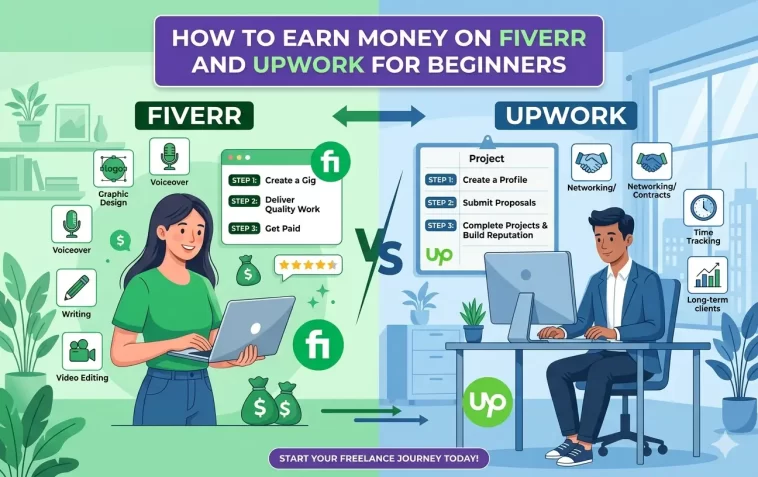
Fiverr is a marketplace where you create “Gigs” — packaged services with fixed prices. Buyers search for what they need, find your listing, and purchase directly. You wait for orders to come to you.
Upwork is a job board where clients post projects and you submit proposals to win them. You search through listings, write a cover letter for each one, and pitch yourself. You actively chase the work.
This single difference changes everything: your profile strategy, your pricing approach, your timeline to first income, and the type of clients you attract.
| Fiverr | Upwork | |
|---|---|---|
| How it works | Clients find you | You pitch clients |
| Barrier to entry | Very low | Slightly higher (profile approval) |
| First order timeline | 1–4 weeks | Can be faster with good proposals |
| Service fees | 20% flat on all earnings | 0–15% depending on lifetime billings |
| Best for | Packaged, creative services | Long-term projects, higher-value work |
| Pricing model | Fixed packages | Hourly or fixed-price per project |
The short version: use Fiverr for quick first sales and packaged services, use Upwork for scaling to higher rates and longer-term clients.
Many freelancers start on Fiverr to build reviews and confidence, then move to Upwork to grow their income. Both together is also a valid strategy.
Part 1: How to Earn Money on Fiverr
Step 1: Choose the Right Skill to Sell
The most important decision you’ll make on Fiverr isn’t your price or your gig image — it’s what you choose to sell.
The best starting point is a skill you already have, even if it feels basic. Here are beginner-friendly categories with consistent demand in 2026:
- Writing and editing — blog posts, product descriptions, proofreading, copywriting
- Graphic design — logos, social media graphics, business cards, thumbnails
- Video editing — short-form video, YouTube videos, Reels, subtitles
- Digital marketing — social media management, SEO, email campaigns
- AI-related services — prompt writing, AI content editing, AI image generation
- Virtual assistance — data entry, research, scheduling, email management
- Translation — if you speak two or more languages fluently
- Voiceovers — if you have a clear, pleasant speaking voice
You don’t need to be the best in the world at any of these. You need to be competent, reliable, and specific about who you help.
Step 2: Niche Down Before You Create Your Gig
“Graphic designer” is overcrowded. “Minimalist logo designer for fitness brands” is discoverable and attracts better clients.
Niching down does two things. It makes your gig easier to find in Fiverr’s search, and it signals to buyers that you understand their specific world.
Think about it this way: if you owned a restaurant and needed a menu designer, would you hire a general “graphic designer” or someone who specifically designs restaurant menus? The specialist wins almost every time, even if they charge more.
Before creating your gig, spend time looking at what successful sellers in your category are doing. Note their titles, tags, pricing structure, and how they describe their packages.
Step 3: Create a Gig That Converts
Your Fiverr gig is your storefront. Every element affects whether you show up in search and whether buyers click “Order.” Here’s what matters most:
Gig Title Include your main keyword at or near the beginning. Be specific. Instead of “I will design a logo,” write “I will design a modern minimalist logo for your business or brand.”
Gig Description Start with what the buyer gets, not who you are. Address their problem first. Be clear about what’s included in each package. Keep paragraphs short.
Gig Packages (Basic, Standard, Premium) Use all three tiers. Your Basic package should be genuinely useful at a lower price — don’t make it so stripped-down that nobody buys it. Your Premium package should have clear added value that justifies the higher price.
Gig Images and Video Your thumbnail is what gets the click. It should be clean, readable, and visually represent what you deliver. Gigs with a short introduction video typically get significantly more orders than those without one. It builds trust fast.
Tags Use all five available tags. Choose terms buyers actually search for, not vague descriptions of yourself.
Step 4: Price Yourself Strategically as a Beginner
As a new seller with no reviews, you’re asking buyers to take a risk on you. Your pricing needs to reflect that reality.
Starting with lower prices doesn’t mean selling yourself short permanently — it’s a strategy to accumulate reviews quickly. Your goal in the first 30–60 days is reviews, not maximum profit.
A reasonable starting point for most beginner gigs:
- Basic package: $10–$25
- Standard package: $25–$50
- Premium package: $50–$100
Once you have 10–20 positive reviews and a solid completion rate, you can raise your prices gradually. Many experienced sellers charge 3–5x their starting rates after building a track record.
Step 5: Stay Active and Respond Fast
Fiverr’s algorithm favors active sellers. One of the most significant ranking factors in 2026 is your activity status — buyers can filter by “sellers online,” and being visible in that filter gets your gig in front of more buyers.
Install the Fiverr mobile app and keep your status active during working hours. When a buyer messages you, respond within a few hours at most. Response rate is tracked, and a slow response rate actively hurts your ranking.
Step 6: Deliver Exceptional Work Every Single Time
This sounds obvious, but it’s worth saying clearly: your reputation on Fiverr is your entire business.
One bad review early in your journey can take months to recover from. Overdeliver on your first orders. Communicate clearly during the project. Deliver before the deadline when you can. Ask for feedback proactively once the order is complete.
Happy clients come back. They leave positive reviews. They refer friends. A 5-star reputation is the most valuable thing you can build on Fiverr.
Fiverr Seller Levels and What They Unlock
Fiverr has a tiered level system that rewards active, high-quality sellers:
| Level | Requirements | Key Benefits |
|---|---|---|
| New Seller | Just signed up | Up to 7 active gigs |
| Level 1 | 60 days active, 10 completed orders, 4.7+ rating | More gigs, gig extras, priority in search |
| Level 2 | 120 days, 50 orders, 4.7+ rating | More visibility, higher earning potential |
| Top Rated Seller | Invitation based | Maximum visibility, dedicated support |
Each level unlocks more gigs, higher earning potential, and faster payment processing. Reaching Level 1 should be your first milestone.
Realistic Fiverr Income for Beginners
Here’s what beginners can realistically expect:
- Months 1–2: $50–$300/month (building reviews, low volume)
- Months 3–6: $300–$1,000/month (Level 1 reached, more orders)
- Month 6–12: $1,000–$3,000/month (Level 2, higher prices, repeat clients)
- Year 2+: $3,000–$8,000+/month (Top Rated, premium pricing)
These are realistic ranges, not guarantees. Results depend heavily on the skill you offer, the quality of your work, and how consistently you stay active on the platform.
Part 2: How to Earn Money on Upwork
Step 1: Create a Profile That Looks Like a Solution, Not a Resume
Most beginners treat their Upwork profile like a CV — listing qualifications, education, and a generic paragraph about being “passionate and hardworking.”
Clients on Upwork don’t want to read a CV. They have a problem, they need it solved, and they’re scanning dozens of profiles looking for the person who can do it. Your profile needs to speak directly to that.
Your headline should follow this pattern: [Skill] + [Who You Help] + [What Result You Deliver]
Instead of: “Experienced Copywriter” Try: “Email Copywriter for SaaS Startups — I Turn Subscribers Into Paying Customers”
Instead of: “Web Developer” Try: “Shopify Performance Developer — I Cut Load Times and Increase Conversion Rates”
Your profile overview should open with the problem you solve, not with your background. Upwork truncates your overview after roughly 300 characters in search results. That means your first two sentences need to do all the heavy lifting — don’t waste them on “Hello, my name is…”
Step 2: Build Your Portfolio Before You Apply to Anything
If you have no previous client work to show, create samples. This is non-negotiable.
If you’re a writer, write three strong pieces in your target niche and publish them. If you’re a designer, create 3–5 mock projects for fictional brands. If you’re a developer, build a few small projects and put them on GitHub.
Clients on Upwork take profiles without portfolios far less seriously, especially from new accounts. Even two or three well-made samples change the conversation completely.
Step 3: Understand Connects (Upwork’s Proposal Currency)
Upwork uses a system called “Connects” to submit proposals. Every application costs a certain number of Connects, and you have a limited supply each month. New accounts receive a small monthly allowance; additional Connects can be purchased if needed.
This system is Upwork’s way of reducing spam proposals. Use your Connects strategically:
- Target jobs with fewer than 10–15 proposals already submitted
- Apply within the first few hours of a job being posted (early proposals get more attention)
- Don’t waste Connects on jobs with extremely high budgets if you have no track record — competition is fierce and established freelancers usually win those
Step 4: Write Proposals That Actually Get Read
Most job posts on Upwork receive between 20 and 50 proposals within the first 24 hours. Premium projects see even more. A generic, copy-paste proposal gets ignored immediately.
The proposals that work all share the same structure:
1. Open with the client’s specific situation Read the full job description and reference something specific from it. Don’t start with “Dear Hiring Manager, I am interested in your project.” Start with something that proves you actually read it.
2. State what you’d do and how Give a brief, specific outline of your approach. This shows expertise and makes the client feel like they’re already working with you.
3. Show relevant proof One or two examples directly relevant to what they need. A link to your portfolio, a result you achieved for a similar client, anything that backs up what you’re claiming.
4. Keep it short Most winning proposals are under 200 words. Clients are busy. Respect their time.
5. End with a simple question Ending with a relevant question invites a response and opens a conversation. Something like “Have you already started on the wireframes, or would you like me to come in from the beginning?”
Step 5: Target the Right Jobs as a Beginner
With no reviews on your profile yet, applying for the highest-paying jobs is mostly a waste of Connects. Established freelancers with proven track records will almost always win those.
Instead, focus on:
- Jobs with smaller budgets — less competition, easier to win
- Newer job posts — applying early makes a real difference
- Smaller clients — individuals and small businesses are more willing to take a chance on a new freelancer than large companies
- Jobs that match your portfolio exactly — the more specific your pitch, the better
Your goal for the first 1–3 months on Upwork is not maximum hourly rate. It’s Job Success Score — the rating that shows on your profile and affects how seriously future clients take you. A few lower-paid but perfectly executed contracts build the foundation for everything that comes after.
Step 6: Set Your Rates Realistically
As a new Upwork freelancer, setting your rate too high kills your chances. Setting it too low devalues you and attracts problematic clients.
Here are reasonable starting hourly rates by category for beginners with no prior Upwork history:
- Writing/editing: $15–$25/hour
- Graphic design: $15–$30/hour
- Virtual assistance: $10–$20/hour
- Web development: $20–$40/hour
- Video editing: $15–$30/hour
- Data analysis: $20–$35/hour
As your Job Success Score climbs and your completed contracts stack up, raise your rate incrementally. Freelancers making $100+/hour on Upwork almost universally got there through specialization and a proven track record — not by starting high.
Upwork Fees: What You Actually Keep
Upwork charges a service fee on your earnings:
- 0–10% fee on lifetime billings with a client (the more you earn with one client, the lower the fee)
This is meaningfully better than Fiverr’s flat 20% fee, especially for long-term client relationships. A $60,000 annual freelancer loses roughly $4,000–$5,000 more on Fiverr than on Upwork due to the fee structure alone.
Realistic Upwork Income for Beginners
- First month: $0–$500 (writing proposals, landing first small contracts)
- Months 2–4: $500–$1,500/month (first reviews, building momentum)
- Months 4–12: $1,500–$4,000/month (stronger profile, better jobs)
- Year 2+: $5,000–$10,000+/month (specialization, retainer clients)
Upwork takes longer to gain traction than Fiverr because proposals take more time and effort. But the income ceiling is generally higher, and long-term client relationships are more common.
Skills in Highest Demand on Both Platforms in 2026
Regardless of which platform you choose, certain skills consistently attract buyers and command better rates:
High demand, beginner-accessible:
- Short-form video editing (Reels, TikTok, YouTube Shorts)
- Social media content creation
- Copywriting and blog writing
- Virtual assistance and project support
- Graphic design (especially for social media)
High demand, slightly more skilled:
- AI content management and prompt engineering
- Email marketing and automation
- SEO writing and optimization
- Web design (WordPress, Shopify)
- Data entry and analysis
High income, requires real expertise:
- Full-stack web development
- UI/UX design
- Paid advertising (Google, Meta)
- Video production and editing
- Business consulting and strategy
If you’re just starting out, pick one skill from the first two categories and go deep on it before branching out.
Common Beginner Mistakes to Avoid
On Fiverr:
- Creating too many gigs at once before any have reviews
- Copying another seller’s gig description (Fiverr penalizes this)
- Going offline for days at a time (kills your ranking)
- Accepting scope creep without updating the order
- Delivering mediocre work just to close the order
On Upwork:
- Sending the same generic proposal to every job
- Applying to jobs that are clearly out of your league as a new freelancer
- Setting hourly rates too high before you have reviews
- Giving up after the first 10 rejected proposals
- Communicating outside the platform (violates Upwork’s terms)
On both platforms:
- Trying to build two platforms simultaneously before mastering one
- Disappearing after landing a client
- Missing deadlines, even by a few hours
- Not asking satisfied clients for a review
FAQ: Fiverr and Upwork for Beginners
Do I need experience to start on Fiverr or Upwork?
No formal experience is required. What you need is a skill you can deliver reliably and a few portfolio samples to show potential clients what you’re capable of. Many successful freelancers started with zero prior clients.
Which platform is better for a complete beginner?
Fiverr is generally easier to get started on because there’s no application process and no proposal writing — you create a gig and buyers find you. Upwork requires a bit more setup and patience with proposals, but can lead to higher-paying work faster if your profile is strong.
How long does it take to get the first order on Fiverr?
Most beginners get their first order within 7–30 days if they have a well-optimized gig and stay active on the platform. Some get their first order within a few days; others take 6–8 weeks. Staying online, responding fast, and having a clear niche all speed up the process.
How do I get paid on Fiverr and Upwork?
Fiverr holds payment for 14 days after order completion (7 days for Level 2 and above). You can withdraw via PayPal, Payoneer, or bank transfer. Upwork releases funds after client approval and holds them for a security period. Withdrawal options include PayPal, Payoneer, and direct bank transfer.
Can I use both Fiverr and Upwork at the same time?
Yes. Many freelancers use both. A common approach is to start on Fiverr first, build a review base, then move to or add Upwork for higher-value work. Running both simultaneously can be overwhelming at first, so mastering one before adding the other is usually better.
What is Fiverr’s service fee?
Fiverr charges a flat 20% commission on every transaction, regardless of the order size or how long you’ve worked with a client. If a client pays $100, you receive $80.
What are Upwork’s service fees?
Upwork charges a 0–10% fee depending on your lifetime billings with each client. The more you earn with a single client over time, the lower the fee becomes. This rewards long-term client relationships.
Is it worth starting with low prices?
Yes, at the very beginning. Your first goal is to get reviews, not to maximize revenue. A few $10–$25 orders that result in 5-star reviews will unlock far more $100–$300+ orders later. Think of the early, lower-priced work as an investment in your reputation.
Final Thoughts
Fiverr and Upwork are two of the most reliable ways to turn a skill into real income online. Neither platform is a shortcut, and neither guarantees results without real work and patience.
But both give you something valuable: access to buyers from all over the world who are actively looking for what you know how to do.
Start with one platform. Pick one skill. Create the best profile you can. Deliver excellent work on your first few orders. Then raise your rates, broaden your services, and build from there.
The path is unglamorous. It’s also genuinely one of the most accessible ways to earn real money independently — and it works.
