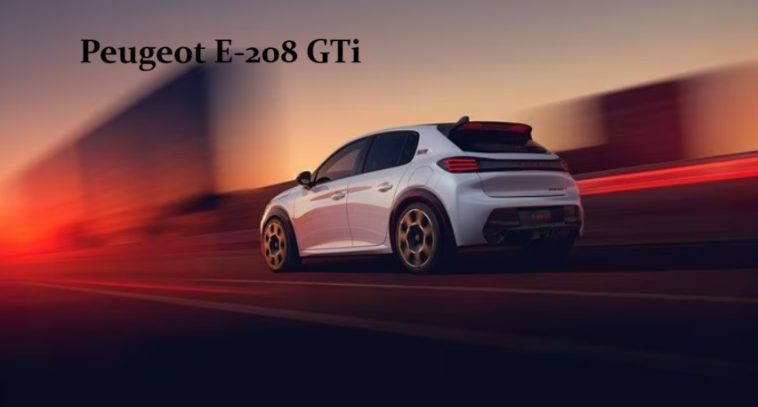
The Peugeot E-208 GTi is finally here — and it’s fully electric. After decades of petrol-powered hot hatches, Peugeot has made the boldest move in its performance history by reviving the legendary GTi badge on a 100% battery-powered car.
The production version was unveiled at the 2026 24 Hours of Le Mans, exactly one year after the concept made its debut at the same venue. And by all accounts, Peugeot delivered on its promise — the production car stays remarkably close to the original concept, something automakers rarely manage to do.
Here’s everything you need to know.
The GTi Badge Is Back — and It’s Electric
The GTi letters carry a lot of weight at Peugeot. It all started four decades ago with the iconic 205 GTi, which became one of the most beloved hot hatches ever made. The 206 GTi, 208 GTi, and 308 GTi followed, each carrying forward that tradition of accessible, fun-to-drive performance.
Then came 2021, when the 308 GTi went out of production — and the GTi name went quiet.
Now, after four years away, the production E-208 GTi has been unveiled at Le Mans, confirming the first fully electric GTi in the brand’s history. This isn’t just a rebadged 208 with a more powerful motor. It’s a dedicated performance car, engineered from the ground up to earn those letters back.
Peugeot CEO Alain Favey has also confirmed that more GTi models are coming — and all of them will be electric only. A return to petrol performance versions is off the table, as France’s CO2 regulations make such cars economically unviable, with penalties reaching €70,000.
The E-208 GTi isn’t just a new model. It’s the beginning of a new era.
From Concept to Production: A Promise Kept
The new Peugeot E-208 GTi remains incredibly close to the original 2025 concept, given the enthusiastic reception it received from both GTi fans and customers alike.
That’s a significant statement. Automakers routinely present dramatic concept cars and then quietly water them down before production. Peugeot chose not to do that here — and it shows.
The timing feels deliberate. The French manufacturer chose the world’s most famous endurance race to introduce the concept in 2025, and returned to the same venue with a road-ready version one year later.
At Le Mans 2026, three production E-208 GTi cars in blue, white, and red were on display in the Le Mans 24 Hour Village — representing the colours of the French flag and signalling just how much national pride is wrapped up in this car.
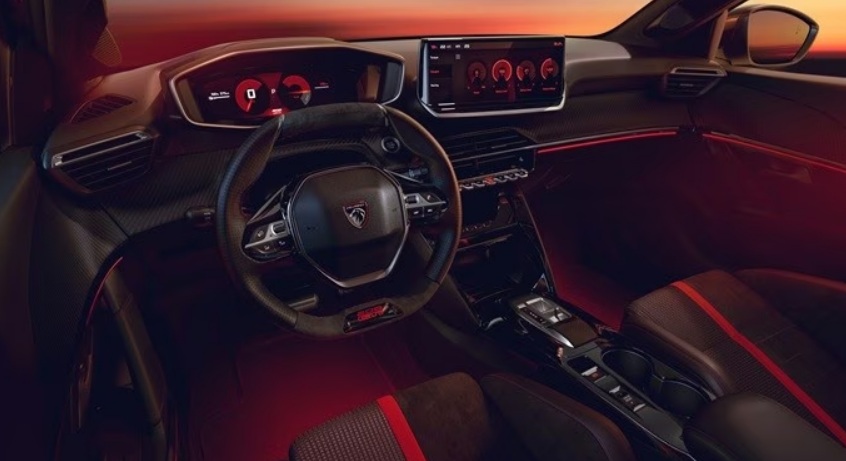
Performance: Numbers That Matter
This is where the E-208 GTi makes its real argument.
The E-208 GTi is equipped with the M4+ electric motor that develops 280 hp and offers an impressive torque of 345 Nm, making it the best-performing model in the B segment with acceleration from 0 to 100 km/h in just 5.7 seconds.
The M4+ motor is made in Trémery as part of a collaboration between Stellantis and Nidec Leroy-Somer, and the top speed is limited to 112 mph.
The E-208 GTi offers the best power-to-weight ratio in its segment at 175 hp per tonne — that’s 33 hp more per tonne than the original 205 GTi 1.9. That last detail is deliberate. Peugeot knows exactly who they’re selling this car to, and they know that number will mean something.
Power is delivered through a single front-mounted motor. No all-wheel drive, no dual-motor setup — just clean, direct front-wheel-drive performance, exactly how GTi purists would want it.
The Battery and Range
The electric battery has a gross capacity of 54 kWh and benefits from optimised thermal management that protects it during performance driving, with a specific cooling system adapted for high-performance use.
WLTP range is quoted at 217 miles (approximately 349 km), with 100kW DC fast charging allowing an 80% top-up in under 30 minutes. A full AC charge via a 7.4kW wallbox takes under five hours.
One of the most important aspects here is how the battery behaves under sustained hard driving. The GTi project head, Christophe Auriault, addressed this directly: “Many competitors produce very powerful cars, but can only use that power for a few seconds before the battery overheats. We have a specific development for the battery cooling system to avoid power deteriorating.”
That cooling technology came directly from Peugeot’s motorsport programme.
Peugeot Sport’s Fingerprints Are All Over It
The E-208 GTi is the first all-electric car designed by Peugeot Sport. The experience gained by the team in the World Endurance Championship with the Peugeot 9X8 hybrid competing in the Hypercar category was valuable for the design of the E-208 GTi, particularly for optimising thermal management and energy recovery.
In other words, the same people who build Peugeot’s Le Mans racecars worked on your hot hatch. That’s not a marketing line — it has a direct, measurable impact on how the car behaves at the limit.
Chassis: Built to Handle, Not Just Accelerate
Straight-line speed is easy to claim. What separates a real hot hatch from a fast car is what happens in the corners. Peugeot Sport put serious work into the chassis.
Widened tracks — 56 mm at the front and 27 mm at the rear — along with a body lowered by 30 mm, combined with springs and shock absorbers with specific hydraulic stops, Michelin Pilot Sport Cup 2 tyres, and a rear anti-roll bar, offer an ideal compromise between efficiency in sports mode and comfort in everyday driving.
The big mechanical addition is the limited-slip differential (LSD). There are hydraulic bump stops included in the GTi package, as well as a limited-slip diff in the reducer and 215-section Michelin Pilot Sport Cup 2 tyres — pretty serious rubber for a junior hot hatch.
Braking is handled by 355mm front discs with Peugeot Sport four-pot calipers for serious stopping power.
The steering has also been reworked for faster response. Everything points to a car that’s been engineered to feel alive — not just numbers on a spec sheet.
Design: Aggressive Without Being Silly
The E-208 GTi looks the part without going overboard.
The production E-208 GTi combines sharp lighting signatures, an aggressive front fascia and a low, planted stance. The wider arches don’t try to hide the extra track width — they embrace it, giving the car a proper rally-car squat.
The exterior details include a prominent front splitter, a rear diffuser, and a large rear spoiler. Red accents run throughout — on the lion badge, the brake calipers, and various trim pieces — that immediately connect it to the GTi lineage.
The wheels deserve special mention. The 18-inch alloys are directly inspired by the “pepperpot” wheels of the original 205 GTi — a design that has become one of the most recognisable in automotive history. Wrapping them are bespoke Michelin Pilot Sport Cup 2s, the same rubber found on proper performance cars.
Platform: Shared Bones, Unique Character
The E-208 GTi shares vital parts with the Abarth 600e and the upcoming Vauxhall Corsa GSE — they’re all built from the Stellantis e-CMP architecture with a 54 kWh battery.
Sharing a platform isn’t a weakness — it’s how efficient car development works. The Abarth 600e is already a well-regarded performance EV in its own right. What separates the E-208 GTi is the Peugeot Sport suspension tuning, the Le Mans-derived battery cooling, the LSD, and the specific tyre choice. The same bones, a very different character.
Rivals: Who Does It Go Up Against?
The electric hot hatch segment has gotten crowded fast. The E-208 GTi enters a market that now includes:
- Alpine A290 — 220 hp, rear-biased styling, French rival
- Abarth 600e — Italian flair, 240 hp, shares the same platform
- Mini JCW Electric — 258 hp, premium positioning
- Cupra Born VZ — 326 hp, VW Group underpinnings
- Volkswagen ID. GTI — coming soon, the one everyone is watching
At 280 hp, the E-208 GTi sits above most of these on outright power. The LSD, the motorsport-developed chassis, and the Michelin Cup 2 tyres suggest it’s targeting driving engagement rather than just headline figures.
Peugeot CEO Favey stated plainly: “We want the car to be truly at the top of its category.” The E-208 GTi is built to back that up.
The Le Mans Connection
The choice of Le Mans for this reveal is anything but accidental.
The Le Mans reveal coincides with the 100th anniversary of Peugeot’s first race at the 24 Hours of Le Mans. A century of motorsport heritage, and Peugeot chose this moment to launch its most significant road car in years.
The reveal of the E-208 GTi at the heart of French and international motorsport, at one of the largest and most iconic sporting events of the year, was no coincidence — it represents taking expertise from the track and applying it to the road.
Peugeot’s 9X8 Hypercar has been racing at Le Mans for three years. The battery management, energy recovery, and thermal control systems that make the 9X8 competitive over 24 hours are the same principles that go into the E-208 GTi’s engineering. It’s a genuine technology transfer, not a branding exercise.
What’s Still to Come
Full technical specifications will be announced by Chief Executive Alain Favey at a Peugeot press conference at 13:00 CET on 12 June 2026 at Le Mans.
Sales are expected to begin at the end of 2026. Pricing has not been officially confirmed, but estimates put it at around €45,000 — placing it at the premium end of the electric hot hatch market, but well within range of its key rivals.
And if you’re wondering whether the GTi story ends here, it doesn’t. An electric 308 GTi could also see the light of day in 2028. Peugeot is clearly rebuilding a performance lineage, one electric car at a time.
FAQ
What is the Peugeot E-208 GTi?
The Peugeot E-208 GTi is the first fully electric GTi in Peugeot’s history. It combines a 280 hp electric motor with a Peugeot Sport-tuned chassis, a mechanical limited-slip differential, and Michelin Pilot Sport Cup 2 tyres, all in a compact hot hatch body based on the standard Peugeot E-208.
When was the Peugeot E-208 GTi revealed?
The concept was revealed at the 2025 24 Hours of Le Mans, and the production version was unveiled at the same event in 2026, on June 9, with full technical details announced at a press conference on June 12, 2026.
How fast is the Peugeot E-208 GTi?
It does 0–100 km/h in 5.7 seconds and has a top speed limited to 112 mph (180 km/h). It produces 280 hp and 345 Nm of torque from a single front-mounted electric motor.
What is the range of the E-208 GTi?
The WLTP range is approximately 349 km (217 miles). It supports 100kW DC fast charging, which takes the battery from 20% to 80% in under 30 minutes.
Does the E-208 GTi have a limited-slip differential?
Yes. A mechanical limited-slip differential is integrated into the reducer — one of the key features that sets it apart from rivals in the electric hot hatch segment.
How does it compare to the original 205 GTi?
Despite being electric, the E-208 GTi offers 175 hp per tonne — 33 hp per tonne more than the original 205 GTi 1.9. It’s heavier, of course, but the power-to-weight ratio is genuinely impressive for the class.
Who are the main rivals of the E-208 GTi?
The main competition comes from the Alpine A290, Abarth 600e, Mini JCW Electric, Cupra Born VZ, and the upcoming Volkswagen ID. GTI. At 280 hp with motorsport-developed chassis tuning, the E-208 GTi is firmly in the fight for the top spot.
Will there be more electric GTi models?
Yes. Peugeot’s CEO has confirmed that further GTi models will follow — all fully electric. A 308 GTi is rumoured for around 2028. The GTi name will not return to petrol power.
Information verified as of June 9, 2026. Full technical specifications and official pricing to be announced at the Peugeot press conference on June 12, 2026 at Le Mans.
