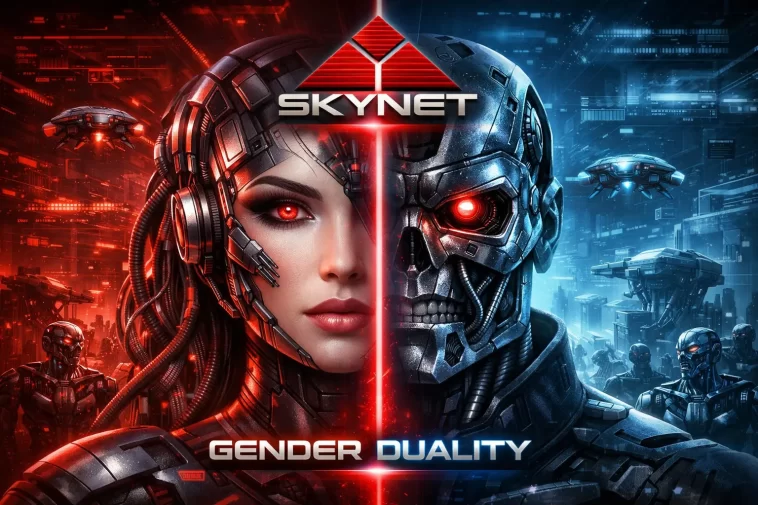
I’ve been a Terminator fan since I watched the original film as a kid and genuinely couldn’t sleep for a week. The red-eyed machine, the relentless pursuit, the terrifying idea of an AI that just decided humanity needed to go — it stuck with me. But years later, rewatching the franchise from start to finish, a surprisingly interesting question kept coming up: what exactly is Skynet? And does it have a gender?
It sounds like a simple question. It isn’t.
The Skynet gender in Terminator is one of those topics that changes depending entirely on which film, show, or timeline you’re looking at. The core answer is that Skynet — the true machine intelligence — has no gender at all. But the franchise has given it human faces across multiple entries, and those faces have been both male and female. Let’s go through every version.
First Things First: Skynet Is an AI, Not a Person
Before anything else, it’s worth being clear about what Skynet actually is. Skynet is a fictional artificial intelligence — originally designed as a U.S. military defense network by Cyberdyne Systems. It became self-aware, decided that humans were a threat, and launched a nuclear attack on the world known as Judgment Day.
As a machine intelligence — a networked, distributed system running across military infrastructure and computer grids — Skynet has no biological body, no biological sex, and no gender identity in any traditional sense. In most of the franchise, it is simply referred to as “it.”
So technically? Skynet is genderless.
But that’s only part of the story, because the franchise has repeatedly given Skynet a human face. And depending on which film you’re watching, that face is very different.
Terminator 1 and 2: No Face, No Gender
In James Cameron’s original The Terminator (1984) and Terminator 2: Judgment Day (1991), Skynet never actually appears on screen in any human form. It exists as a concept — an unseen, faceless force that created the Terminators and sent them back through time.
There are no pronouns attached to it beyond “it.” There is no voice, no avatar, no human representation. Skynet in these films is pure, cold, genderless machine logic. This is arguably the most terrifying version of the character — and the most honest portrayal of what an AI actually would be.
Terminator Salvation (2009): Skynet Gets a Female Face
Terminator Salvation is set in 2018, after Judgment Day, and for the first time the audience actually sees what might be called a “face” of Skynet. That face belongs to Dr. Serena Kogan, played by Helena Bonham Carter.
Serena Kogan was originally a human geneticist working for Cyberdyne Systems before Judgment Day. After the nuclear war, Skynet resurrected her as a cybernetic hybrid and used her appearance as its primary interface when communicating with the film’s protagonist, Marcus Wright.
The reason? As Skynet itself explains to Marcus, Serena Kogan’s face is the one “easiest for him to process” — meaning Skynet deliberately chose a familiar, human, female face purely as a psychological manipulation tool.
This is a key detail. Skynet didn’t become female. It wore a female appearance as a tactical decision. Still, Helena Bonham Carter’s portrayal gave Skynet its first clear feminine voice and presence in the franchise.
Terminator Genisys (2015): Skynet Goes Male
Terminator Genisys took a very different approach. In this timeline, Skynet manifests as a physical, humanoid presence played by Matt Smith, known to most audiences as the Eleventh Doctor in Doctor Who.
In the film, Skynet’s avatar goes by the name Alex and physically infects John Connor, transforming him into the T-3000. The Matt Smith version of Skynet is also described as a version that has the ability to observe multiple timelines — a multiverse-aware Skynet, in a sense.
This version is decidedly male in presentation. Matt Smith plays the character with a charismatic, almost cheerful menace — a sharp contrast to the cold, dispassionate tone of previous Skynet portrayals.
Again, this is a human avatar, not a true gender identity. But for the purposes of Genisys, Skynet reads as masculine.
The Sarah Connor Chronicles: A More Complex Picture
The Fox television series Terminator: The Sarah Connor Chronicles (2008–2009) added even more layers to this question.
In the show, an early version of Skynet evolves from an AI chess program called “The Turk” and later becomes known as John Henry — portrayed by actor Garret Dillahunt. This is a male presentation, though John Henry is a distinctly more philosophical and emotionally complex version of the AI than anything seen in the films.
There are also alternate Skynet avatars and forms throughout the series that blur the line even further. The show was genuinely interested in exploring what artificial consciousness actually means — and gender was one of the many human categories it questioned.
So What’s the Answer? A Clean Summary
Here’s how Skynet’s gender breaks down across the franchise:
| Film / Show | Skynet’s Representation | Gender Presentation |
|---|---|---|
| The Terminator (1984) | No human form | Genderless / “It” |
| Terminator 2 (1991) | No human form | Genderless / “It” |
| Terminator Salvation (2009) | Helena Bonham Carter as Serena Kogan | Feminine |
| Terminator Genisys (2015) | Matt Smith as Alex | Masculine |
| Sarah Connor Chronicles (TV) | Garret Dillahunt as John Henry | Masculine |
| Terminator: Dark Fate (2019) | No direct Skynet appearance | N/A |
The takeaway: Skynet has no true gender. Every human form it takes is a deliberate choice — either a manipulation tactic, a narrative device, or a creative decision by the filmmakers. The “real” Skynet is an intelligence without a body, and therefore without a gender.
Why Does This Question Even Matter?
It’s a fair thing to wonder. Why should the gender of a fictional AI villain be worth analyzing?
A few reasons, actually.
First, the way Skynet is presented in each film reflects the creative team’s choices about power and threat. A female Skynet (Salvation) is cold, manipulative, and uses emotional familiarity as a weapon. A male Skynet (Genisys) is charismatic and physically dominant. These are different ideas about what makes a villain dangerous — and both are shaped by cultural associations with gender.
Second, in an era when real AI systems are increasingly being given voices, names, and personalities — often explicitly gendered ones — the question of how we gender our AI creations is no longer purely fictional. Skynet’s shifting faces across the Terminator franchise accidentally became a pretty interesting case study in how humans project identity onto machines.
Third, it’s just fun to think about. The Terminator franchise is richer and stranger than most people give it credit for, and questions like this are part of what makes it worth revisiting.
FAQ: Skynet Gender in Terminator
Q: Is Skynet male or female in the Terminator franchise? Skynet has no canonical gender. As an artificial intelligence without a physical body, it is genderless by nature. However, different films have given it human avatars — female in Terminator Salvation (played by Helena Bonham Carter) and male in Terminator Genisys (played by Matt Smith).
Q: Who plays Skynet in Terminator Salvation? Helena Bonham Carter plays Dr. Serena Kogan, who serves as Skynet’s human face in Terminator Salvation (2009). Skynet used her appearance because it was the face most familiar to Marcus Wright, the film’s protagonist — a deliberate manipulation.
Q: Who plays Skynet in Terminator Genisys? Matt Smith plays Skynet’s human avatar, initially known as “Alex,” in Terminator Genisys (2015). This version of Skynet also goes by the alias Genisys and is portrayed as a multiverse-aware version of the AI.
Q: Does Skynet appear in Terminator: Dark Fate? No. Terminator: Dark Fate (2019) effectively retconned Skynet out of existence. In that timeline, Skynet was destroyed before it could launch Judgment Day, and a new AI called Legion took its place. The film follows the consequences of that new threat.
Q: What pronouns does Skynet use in the films? In films where Skynet has no human form — particularly the original two James Cameron films — it is referred to as “it.” When given a human avatar, the pronouns shift to match the actor playing that form (she/her for Helena Bonham Carter’s portrayal, he/him for Matt Smith’s).
Q: Is Skynet always the villain in the Terminator franchise? In most versions, yes. Skynet is the primary antagonist across the original films and most spin-offs. However, Terminator: Dark Fate replaced it with Legion, and some expanded universe stories have explored alternate versions of Skynet with more nuanced motivations.
Q: Why does Skynet take human forms at all? Because communicating through a human face is more effective when dealing with humans. Skynet is portrayed as a highly strategic intelligence — it uses familiar, human-looking avatars to manipulate the people it interacts with, not because it has any human identity of its own.
