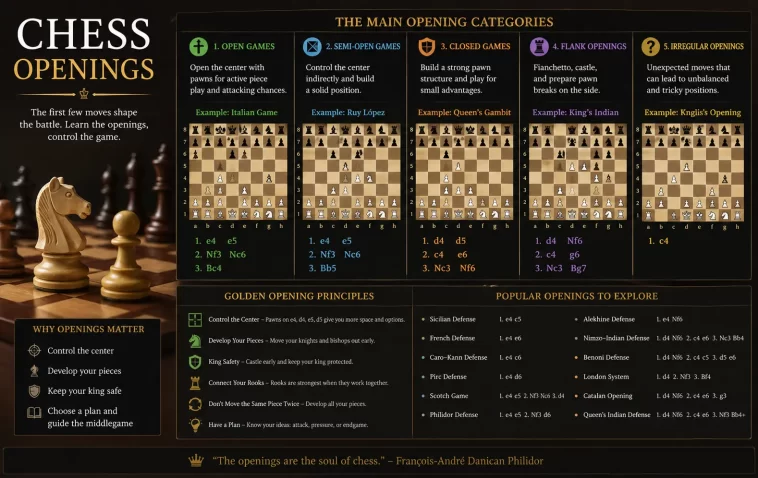
I lost my first twenty chess games the exact same way — moving random pawns and hoping for the best. It wasn’t until I learned a handful of solid chess openings for beginners that my games actually started making sense.
That’s what this post is about. Below you’ll find 10 chess openings for beginners that are easy to learn, hard to punish, and used by strong players at every level, not just newcomers.
You don’t need to memorize twenty moves deep to benefit from these. You just need to understand the ideas behind them, and the rest will follow the more you play.
Why Learning an Opening Actually Matters
A lot of beginners get told “just control the center and develop your pieces,” and that’s true. But having a specific opening in mind gives you a plan instead of a vague idea.
Here’s what a good opening does for you:
- Gets your pieces to useful squares quickly
- Keeps your king safe through early castling
- Avoids common traps that punish careless play
- Gives you a repeatable structure so you’re not improvising every game
You don’t need to know dozens of openings. Five or six, played well, will carry you through most of your early chess career.
1. The Italian Game
If you only learn one opening as a beginner, make it this one. The Italian Game starts with 1.e4 e5 2.Nf3 Nc6 3.Bc4, and it does everything right — fast development, central control, and pressure on your opponent’s weakest square, f7.
You’ll find this opening leads to open, tactical positions where the ideas are easy to spot. It’s been played by world champions for centuries, so you’re not outgrowing it anytime soon.
2. The Ruy Lopez
Named after a 16th-century Spanish priest, the Ruy Lopez (1.e4 e5 2.Nf3 Nc6 3.Bb5) is one of the oldest and most respected openings in chess. Instead of attacking f7 directly, it pressures the knight defending your opponent’s center.
This opening rewards understanding over memorization. You’ll learn a lot about pins, tension, and long-term planning by playing it regularly.
3. The London System
The London System is often called the easiest opening in chess to learn, and for good reason. You play roughly the same setup — Bf4, e3, Nf3, Bd3, and castle — no matter what your opponent does.
If you hate memorizing different lines for different responses, this is your opening. You get a solid, low-risk position almost every single game.
4. The Queen’s Gambit
Unlike the openings above, the Queen’s Gambit (1.d4 d5 2.c4) is more positional than tactical. You offer a pawn early to pull your opponent away from the center, then use that space to your advantage.
This opening teaches you patience. You won’t get quick attacks the way you would with the Italian Game, but you’ll build long-term positional pressure instead.
5. The Sicilian Defense
If you play Black and want real winning chances instead of a quiet draw, try the Sicilian Defense (1.e4 c5). It’s the single most popular response to 1.e4 at every level, from club players to grandmasters.
This opening creates unbalanced positions where both sides fight hard for the center. Expect sharp, complicated games — this isn’t the pick for a relaxed afternoon.
6. The Caro-Kann Defense
The Caro-Kann Defense (1.e4 c6) is the calmer alternative to the Sicilian. You build a solid pawn structure without cramping your pieces, and you avoid most of the sharp traps that catch beginners off guard.
You’ll get fewer fireworks with this opening, but you’ll also make far fewer mistakes. That trade-off is worth it while you’re still learning.
7. The French Defense
With the French Defense (1.e4 e6, followed by d5), you accept a slightly restricted light-squared bishop in exchange for a rock-solid pawn chain. It’s been used by former World Champion Mikhail Botvinnik and remains popular today.
This opening is great if you enjoy defending patiently and then striking back on the queenside once your position is stable.
8. The Scandinavian Defense
The Scandinavian Defense (1.e4 d5) challenges White’s center on move one. Play usually continues 2.exd5 Qxd5 3.Nc3 Qa4, which breaks the normal rule about not moving your queen early — but it works fine here.
You’ll like this opening if you want to force your opponent out of their comfort zone right from the start. Many players don’t know how to handle it well.
9. The Slav Defense
The Slav Defense defends the d5-pawn with another pawn instead of a piece, giving you a very solid structure. Most of your pieces develop to natural squares, though you’ll need to find a good home for your b8-knight.
This is a great choice if the Queen’s Gambit appeals to you but you want an even more defensively sound setup as Black.
10. The King’s Indian Attack
The King’s Indian Attack works almost like the London System, but for a different setup — you can play it against nearly anything your opponent tries. That makes it ideal if you want one flexible system instead of memorizing separate replies to every move.
You’ll get quieter positions with this one, but the plans are clear and easy to follow once you’ve played it a few times.
How to Pick the Right Opening for You
With 10 options in front of you, here’s a simple way to narrow it down based on your playing style.
| If you want… | Try this opening |
|---|---|
| Fast, tactical games | The Italian Game |
| A low-memorization system | The London System |
| Sharp fights with real winning chances | The Sicilian Defense |
| A calm, solid structure | The Caro-Kann Defense |
| Long-term positional play | The Queen’s Gambit |
You don’t have to commit to all 10 right away. Pick one for White and one or two for Black, and build from there.
Tips for Learning Chess Openings for Beginners
- Focus on understanding the why behind each move, not just memorizing the sequence
- Spend no more than 10–20% of your study time on openings — puzzles and full games matter more
- Play the same opening repeatedly until it feels automatic
- Review your games afterward to see where you left the “book” moves
- Don’t panic if your opponent plays something unexpected — fall back on center control, development, and king safety
Common Mistakes Beginners Make With Openings
Even with a good opening in your hands, it’s easy to throw away your advantage in the first few moves. Watch out for these habits.
Moving the Same Piece Twice
Early on, every move should develop a new piece. Moving your knight back and forth because you’re not sure where to put it wastes time your opponent will use to build their own position.
Chasing Pawns Instead of Developing
Grabbing a random pawn on move four might feel like a win, but if it costs you three moves and leaves your king in the center, it’s rarely worth it. Development almost always matters more than a single extra pawn this early.
Bringing the Queen Out Too Soon
Your queen is powerful, but she’s also an easy target in the opening. Bringing her out early — outside of specific lines like the Scandinavian Defense — usually means she gets chased around the board while your opponent develops for free.
Forgetting to Castle
King safety is one of the three core opening principles for a reason. If you delay castling too long chasing an attack that isn’t really there, you leave yourself open to a quick counterattack down the center or the open files.
Playing Openings You Don’t Understand
Copying a grandmaster’s opening from a YouTube video won’t help if you don’t know what to do once your opponent leaves the “book” line. Stick to openings you actually understand, even if they’re simpler than what the pros play.
Building a Simple Opening Repertoire
You don’t need ten openings memorized to play well — you need a short, reliable list you actually trust. Here’s a simple way to build one:
- Pick one opening to play as White (the Italian Game or London System are great starting points)
- Pick one main defense against 1.e4 (the Caro-Kann is a safe, low-risk choice)
- Pick one main defense against 1.d4 (the Slav Defense pairs naturally with the Queen’s Gambit)
- Play each one for at least 10-15 games before judging whether it fits your style
- Only add a new opening once your current ones feel automatic
This approach keeps your study time focused instead of spread across dozens of half-learned systems. You’ll also start recognizing patterns across games much faster, since you’re seeing similar structures again and again.
Frequently Asked Questions
What is the easiest chess opening for beginners?
The Italian Game is usually considered the easiest. It follows every basic opening principle and leads to positions that are simple to understand.
Should beginners play 1.e4 or 1.d4?
Either works, but 1.e4 tends to be more beneficial to learn first since it leads to more open, tactical games that teach you common patterns faster.
How many chess openings should a beginner know?
You don’t need more than five or six. One or two for White and a few solid defenses for Black are enough to cover most games you’ll play.
Is it bad to play the same opening every game?
No. Repeating the same chess openings for beginners actually helps you learn the ideas faster, since you’ll see similar positions again and again.
Do I need to memorize long opening lines?
Not at the beginner level. Understanding the plan behind each move matters far more than memorizing 15 moves of theory you don’t understand.
What’s the difference between an opening and an opening system?
A traditional opening, like the Ruy Lopez, has specific responses to different moves your opponent makes. A system, like the London System, uses roughly the same setup regardless of what your opponent plays, which makes it easier to learn.
Final Thoughts
Learning a handful of solid chess openings for beginners won’t turn you into a grandmaster overnight, but it will stop you from losing games in the first ten moves. Pick two or three from this list, play them consistently, and pay attention to what happens after the opening ends.
The real skill comes from understanding your position, not memorizing moves. Start with one opening, get comfortable with it, then slowly add another to your repertoire.
Editor’s Opinion
I think beginers waste to much time watching opening videos instead of just playing games. Honestly the London System saved my rating becuase i didnt have to think to much in the first 10 moves. My advice, just pick 2 openings from this list and stick with them for a month, dont jump around like i did at first, it just confuses you more then it helps.
