Best indie games of all time — I’ve typed that phrase into search bars more times than I can count, usually at 1 a.m. while my backlog sat untouched on Steam. I’ve spent over a decade playing small-team and solo-developer games, from clunky early access builds to polished hits that outsold AAA blockbusters. Somewhere along the way I stopped trusting “best of” lists that just repeat the same five titles, so I built my own.
This list pulls from games that changed genres, won major awards, sold millions of copies on word of mouth alone, or simply stuck with me long after the credits rolled. Some are over a decade old. Others launched this year. All of them earned their spot.
If you’re tired of scrolling through outdated rankings, here’s a list that actually holds up.
What Makes a Game “Indie” Anyway?
Before jumping into the list, it helps to know what we’re actually ranking. An indie game is typically built without major publisher funding, which means the developer keeps creative control over the final product.
This freedom is exactly why indie games often feel more personal than big-budget releases. There’s no committee softening the weird ideas or cutting the risky mechanics.
A few things usually define this category:
- Small teams — often just one to ten people
- Self-funded or crowdfunded development
- Creative risk-taking over mass-market safety
- Tight gameplay loops instead of bloated content padding
- Distinct art styles, since big budgets for graphics usually aren’t available
Keep that in mind as you read through the picks below. Budget size has nothing to do with quality here.
How I Picked These Games
I didn’t just throw together a list of personal favorites. Every game on here had to meet at least a couple of these criteria:
- Strong critical reception across multiple review outlets
- Lasting cultural impact or influence on later games
- Commercial success relative to its budget and team size
- A loyal, active community years after release
- Something genuinely original in its design or storytelling
That filtering is why you won’t find filler picks here. Every entry below earned its place through some combination of sales, critical acclaim, or genuine influence on the genre.
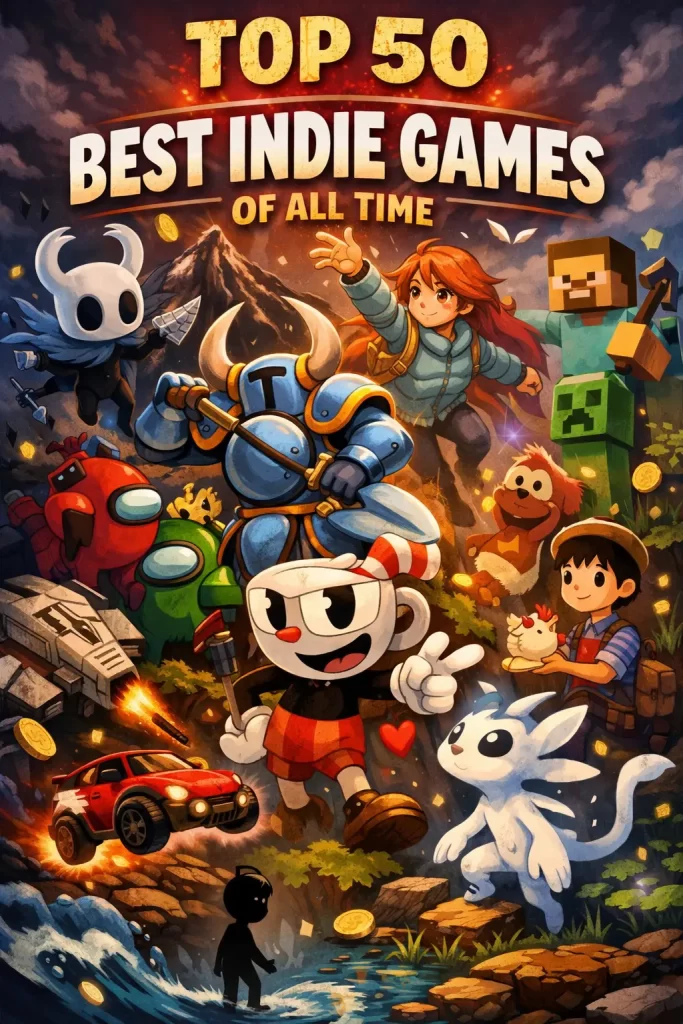
The Top 50 Best Indie Games of All Time
I’ve grouped these by genre so it’s easier to find something that matches what you actually want to play right now.
Story-Driven and Narrative Games
These games prove that small teams can write better stories than most blockbuster studios.
- Undertale — A genre-bending RPG with a morality system that actually changes how combat plays out.
- Disco Elysium — A detective RPG with some of the best writing in any video game, indie or not.
- Hades — A roguelike dungeon crawler that weaves its story directly into every failed run.
- What Remains of Edith Finch — A short, emotional walking simulator told through a family’s strange history.
- Oxenfree — A supernatural coming-of-age story with natural, overlapping dialogue.
- Firewatch — A first-person mystery set in the Wyoming wilderness in 1989.
- Night in the Woods — A slice-of-life story about returning home after dropping out of college.
- Citizen Sleeper — A tabletop-inspired RPG about identity, debt, and survival in space.
- Va-11 Hall-A — A bartending sim where your drink choices shape other people’s stories.
- The House in Fata Morgana — A gothic visual novel with a tragic, sprawling narrative across centuries.
Metroidvanias and Action-Adventure
If you love exploring connected maps and earning new abilities, start here.
- Hollow Knight — The gold standard of modern Metroidvanias, built by a team of three.
- Hollow Knight: Silksong — A massive, demanding sequel that expands on everything the original did well.
- Ori and the Blind Forest — A visually stunning platformer with hand-painted art and an emotional core.
- Ori and the Will of the Wisps — The sequel that refined the combat and expanded the world even further.
- Dead Cells — A roguelike Metroidvania with frantic, satisfying combat and endless replay value.
- Axiom Verge — A solo-developed sci-fi Metroidvania built almost entirely by one person.
- Guacamelee! — A wrestling-themed Metroidvania packed with Mexican folklore and humor.
- Tunic — An isometric adventure that channels classic Zelda design while hiding secrets in plain sight.
- Mina the Hollower — A gothic 8-bit Metroidvania from the team behind Shovel Knight.
- Pizza Tower — A frantic, surreal platformer with some of the fastest movement in the genre.
Roguelikes and Deck-Builders
Perfect for players who want “just one more run” to turn into three hours.
- Slay the Spire — The game that defined the modern roguelike deck-builder genre.
- Slay the Spire 2 — A bigger, sharper sequel with new characters and online co-op.
- Balatro — A poker-inspired roguelike that became a genuine cultural phenomenon.
- Into the Breach — A tense, turn-based tactics game from the creators of FTL.
- FTL: Faster Than Light — A spaceship survival roguelike that influenced an entire genre.
- Vampire Survivors — A minimalist bullet-heaven game that exploded in popularity almost overnight.
- Rogue Legacy 2 — A genealogy-based roguelike platformer with hundreds of character variations.
- Spelunky 2 — A brutally fair cave-diving roguelike built on procedural generation.
- The Binding of Isaac: Rebirth — A dungeon crawler roguelike with near-endless item combinations.
- Mewgenics — A long-awaited cat-breeding roguelike from the creator of The Binding of Isaac.
Platformers and Precision Games
These titles test your reflexes as much as your patience.
- Celeste — A precision platformer about climbing a mountain and confronting anxiety.
- Shovel Knight: Treasure Trove — A retro-styled action platformer with tight, rewarding controls.
- Cuphead — A run-and-gun shooter styled after 1930s rubber-hose cartoons.
- Cave Story — One of the earliest influential indie games, still worth playing today.
- VVVVVV — A gravity-flipping platformer known for its brutal but fair level design.
- Super Meat Boy — A punishing, fast-paced platformer that helped kickstart the indie boom.
- Owlboy — A story-driven platformer where you fly and explore a beautifully animated world.
- A Hat in Time — A colorful 3D platformer with collectathon roots and genuine charm.
Simulation, Sandbox, and Life Games
Slower-paced, but just as influential as anything on this list.
- Stardew Valley — A farming sim built by one developer that’s sold tens of millions of copies.
- Terraria — A sandbox adventure where both the journey and the world are fully player-driven.
- Don’t Starve — A wilderness survival game soaked in dark humor and science fiction.
- Minecraft — Originally a solo indie project before it became one of the best-selling games ever made.
- Subnautica — An underwater survival adventure set on an alien ocean planet.
- Untitled Goose Game — A slapstick sandbox game about being the worst goose in the village.
- Among Us — A social deduction game that became a worldwide phenomenon during the pandemic.
Puzzle and Mystery Games
For players who’d rather think their way through a game than fight their way through it.
- Return of the Obra Dinn — A monochrome detective mystery about reconstructing a ship’s final voyage.
- Baba Is You — A puzzle game where the rules themselves are physical objects you can move.
- The Witness — An open-world puzzle game built almost entirely around environmental logic.
- Outer Wilds — A space exploration mystery wrapped inside a time loop.
- Animal Well — A minimalist, secret-stuffed exploration game from a solo developer.
Why Indie Games Keep Getting Better
It’s worth asking why this genre keeps producing some of gaming’s most memorable experiences. The answer comes down to risk.
AAA studios answer to shareholders and franchise expectations. Indie developers usually answer only to themselves and their players.
That freedom shows up in three ways:
- Genre experimentation — combining mechanics that big studios would consider too risky
- Tighter scope — smaller games with more focused, polished gameplay loops
- Direct community feedback — many indie titles update for years based on player input
Stardew Valley is a perfect example. It’s still receiving free content updates years after launch, something most publisher-backed games would never justify financially.
How You Can Find Your Next Favorite Indie Game
Now that you’ve seen the list, here’s how you can actually find more games like these on your own.
Step 1: Pick a Platform That Fits Your Habits
You’ll get the best indie discovery experience on Steam, since it has the largest library and the most detailed user reviews. If you play on console, check your platform’s indie storefront section directly, since most consoles now spotlight indie titles separately from AAA releases.
Step 2: Use Curated Lists, Not Just Algorithms
You shouldn’t rely only on store algorithms, since they tend to recommend whatever is trending rather than what fits your taste. Instead, follow curated picks from outlets like Polygon, Kotaku, or community hubs like Reddit’s r/IndieGaming.
Step 3: Try Before You Buy
You can download demos during Steam Next Fest, which happens twice a year and features hundreds of upcoming indie titles. This lets you test a game’s feel before spending any money on it.
Step 4: Match the Game to Your Mood
You should think about how much time and energy you actually have before picking a genre. Here’s a quick way to match your mood:
- Short sessions → Roguelikes like Slay the Spire or Balatro
- Deep immersion → Narrative games like Disco Elysium or Citizen Sleeper
- Relaxation → Life sims like Stardew Valley
- Challenge-seeking → Metroidvanias like Hollow Knight or Dead Cells
Step 5: Check Review Tags Before Committing
You can filter Steam reviews by tags like “Overwhelmingly Positive” combined with genre filters to skip past mediocre titles entirely. This single habit will save you more wasted hours than any other tip on this list.
Common Myths About Indie Games
A few misconceptions keep popping up, so let’s clear them up.
Myth: Indie games are always short or unfinished. Many indie titles offer 20 to 100+ hours of content, with post-launch polish that rivals big-budget releases.
Myth: Indie games are only for PC gamers. Switch and console ports have made most major indie titles accessible to console-only players.
Myth: Indie automatically means low quality. Hades won a BAFTA. Celeste swept Game of the Year lists in 2018. Quality has never been about budget size.
FAQ About the Best Indie Games of All Time
What are considered the “big three” indie games? Minecraft, Stardew Valley, and Hollow Knight are widely seen as the three titles that proved indie games could compete commercially and critically with AAA studios.
Is Minecraft still considered an indie game? Not anymore. Minecraft started as a solo indie project but became an AAA-owned title after Microsoft acquired Mojang in 2014.
What’s the best indie game to start with if I’m new to the genre? Stardew Valley is the easiest entry point if you want something relaxing. Hollow Knight is the better pick if you want action and challenge.
Are indie games cheaper than AAA games? Usually, yes. Most indie titles launch between $10 and $30, though some, like Hollow Knight: Silksong, have matched full AAA pricing due to scope and demand.
Where can I find indie games before they become popular? Steam Next Fest, itch.io, and curated subreddits like r/IndieGaming are the best places to spot promising titles early.
Do indie games receive long-term support after launch? Many do. Stardew Valley, Dead Cells, and Terraria are known for years of free post-launch content.
Final Thoughts
The best indie games of all time aren’t defined by budget, marketing spend, or studio size. They’re defined by original ideas executed with care, often by teams small enough to fit in a single living room.
Whether you’re chasing a tight roguelike run, an emotional narrative, or a relaxing farm sim, this list should give you a solid starting point. Pick one, give it a few hours, and you’ll probably understand why indie games keep stealing Game of the Year nominations from studios ten times their size.
Editor’s Opinion
Honestly i think Hollow Knight and Stardew Valley are still the two games everyone shoud try at least once, no matter what kind of games you normally like. I been playing indie games for years and theese two just hit diffrent, they dont feel like “small” games at all. Hades is great too but its a bit more niche if you dont like roguelikes. New stuff like Mina the Hollower is exciting but it hasnt had time to prove its lasting power yet. Anyway, just pick something off this list and give it a real chance, you wont regret it.
